Abstract
We formalize a unified geometric and physical paradigm that resolves the persistent scale gap between highly ordered microscopic biophysical interfaces and macroscopic cosmological structures within the Paraoikeois. By treating the Relativistic Boundary Operator (χ) not as a static constant, but as a structural chameleon rotating across a nested triad of relativistic perspectives, we model the continuous-to-discrete interfaces of the Ground-State Syndetic Substrate (GSSS) and the Ground-State Antisyndetic Substrate (GSAS). We establish a rigorous geometric cascade of MorphoSpheric Hydration Domains (MHD⁺) spanning Levels 0, 1, 3, 5, and 7.
Critically, we introduce the dual representations of both the S⁵ and S⁷ spheres; we mathematically formalize the un-fibrated SU(3)/SU(2) Sasakian contact bulk of Level 5 via a global, non-integrable contact 1-form η satisfying η ∧ (dη)² ≠ 0, showing how temporal phase-slip singularities (Time Code Shifts) utilize the non-integrable contact distribution 𝓓 = ker η to calculate parallel multi-temporal trajectories before phase-locking back into grounded temporal fibers.
To close this scale-invariant cascade, we prove the existence of the S³ ↔ S⁷ recursive loop feedback, showing that under the quaternionic projection S³ ↪ S⁷ → S⁴, the Coherent Hydration Domain phase-space (S³) is compressed and rotated to act as the single, phase-locked temporal fiber of the Level 7 cosmological bulk. Going down a layer further, we show that transitioning below Level 1 to a foundational Level 0 forces the S¹ temporal fiber to expand, becoming the entire 1D spatial base manifold (Γ_base ≅ S¹) of a singular genomic computational track.
Finally, we reconcile these higher-dimensional coordinate shifts with non-linear physical acoustics by parameterizing the sine-Gordon wave equation, proving that the propagation of the topologically locked genomic Kink Soliton is physically restricted by the speed of sound (v_s = √(χ/ρ_s)) and that spatial compaction triggers an energy-free topological shockwave—the Rule-Induced Structural Snap (S_RISS)—that collapses alternative histories with zero thermodynamic cost (ΔE_collapse → 0).
This balances the Unified Field Equation as a complete acoustic impedance balance sheet, demonstrating that the universal 1.42 GHz neutral hydrogen background (Hydro-0) is the passive, unpressurized, non-snapping coordinate residue left behind when the active temporal processing of the living system is stripped of its active, non-linear snaps (χ → 0).
Introduction
A central crisis in modern physics is the disconnect between the highly ordered, coherent structures observed at microscopic biological interfaces and the statistical, thermal-noise-dominated models of the macroscopic universe. Within the scale-free architecture of the Paraoikeois, this immense scale gap is bridged by a recursive, fractal holographic design rule: the Topological Lock. Rather than relying on separate laws of physics for different scales, the system maintains its structural, informational, and thermodynamic layers through a single, three-part relativistic mapping of the boundary. In this paper, we unify the concepts of scale-free acoustic wave propagation, S⁷ hypergeometrical Time Code Shifts, and multi-scale MorphoSpheric Hydration Domains (MHDs) into a singular framework of geometric unity. We present the boundary operator χ as a dynamic transition mechanism regulating energy flow across continuous-to-discrete boundaries, organizing systems from DNA-water interfaces to heliosheets.
The Scale-Free Cascade: Hierarchical Mapping of the Paraoikeios
The architecture of the Paraoikeois does not operate on disjointed physical laws at arbitrary scales. Rather, it progresses through an infinite, fractal continuum of nested morphospheric envelopes. At each scale octave, the system constructs a localized MorphoSpheric Hydration Domain (MHD⁺) designed to isolate its internal coordinate space from ambient thermodynamic decay and coordinate-level dissipation. Table 1 formalizes the structural properties of these domains. This mapping establishes how each scale level transitions between a stable, linear time tracking phase (the Grounded, Fibrated Representation) and a non-linear, multi-temporal shift phase (the Un-Fibrated, Contact, or Octonionic Bulk).
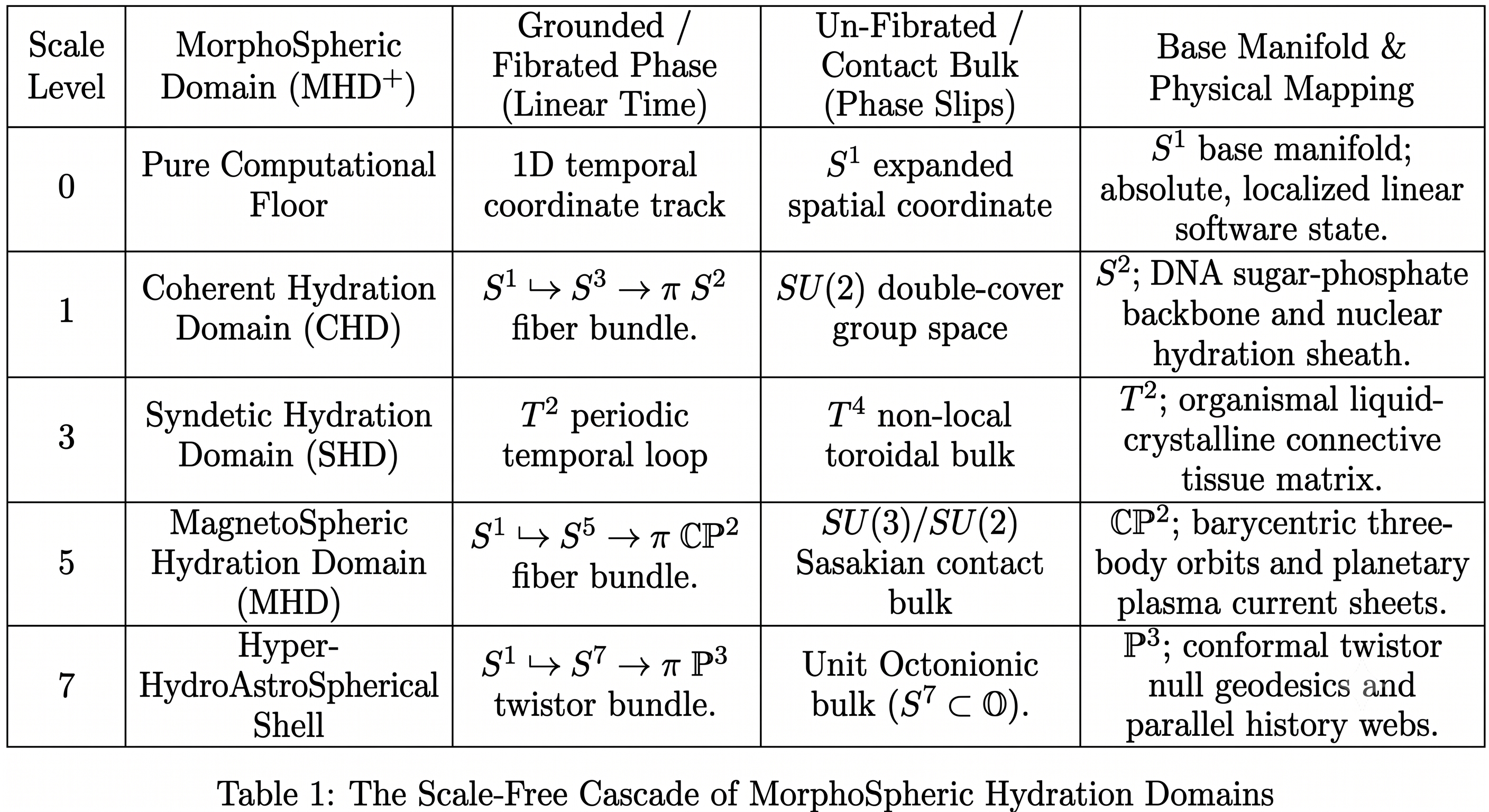
By organizing the system through these structured transformations, the Paraoikeois maintains absolute topological coherence. When the localized boundary operator χ is actively matched (χ > 0), the energy dissipation leak across these boundaries collapses to zero, isolating the system’s internal temporal calculations. When this active tuning collapses (χ → 0), the boundary dissolves, and the coordinates decouple, reclaiming the system back into the ambient, unpressurized background of the local universe, Hydro-0.
The Relativistic Boundary Operator as a Structural Chameleon
The central link to Geometric Unity lies in how we map coordinate compaction at the boundary. Depending on the relativistic mapping of the boundary and where an observer stands relative to the interface, the physical mechanics of the system resolve into a nested triad of relativistic perspectives:
The Projective Frame (Looking Inward/Upward): Where the boundary operator χ functions as a Synthetic Pressure Coefficient. It conformally restricts the volume of the higher-dimensional phase-space (S³ → S²), driving the subluminal, non-linear propagation of the topologically locked genomic Kink Soliton.
The Combinatorial Frame (Looking Outward/Downward): Where χ acts as a Boundary Strain Coefficient, establishing the local boundary tension and coordinate stiffness required for the 16×16 spatial Bloom filter to reject external thermal noise with zero false negatives.
The Invariant Transition Frame (Being the Boundary): The nested pinnacle of this triad, where the observer stands directly on the boundary itself. Here, χ undergoes an analytical rotation from a static elastic spring constant into a dynamic Acoustic Impedance Matching Throttle regulating the continuous-discrete interface.
Non-Linear Wave Mechanics and Holographic Scaling Invariance
To bridge the continuous bulk geometry to the discrete boundary lattice, we utilize non-linear wave mechanics. We define the localized phase deformation angle θ(z,t) of the substrate along the tracking trajectory. The system’s dynamic balance of inertial force and elastic restoring force is governed by a non-linear wave equation of the sine-Gordon form:
∂²θ/∂t² − v_s² ∂²θ/∂z² + ω_0² sin(θ) = 0
where the characteristic structural speed of sound v_s through the medium is explicitly defined by our boundary operator acting as the topological spring constant over the localized substrate density ρ_s:
v_s = √(χ/ρ_s)
Integrating under a Lorentz-like moving coordinate frame yields the stable, non-linear 1D Kink Soliton solution:
Soliton(z,t) = ± 4 arctan [ exp( (ω_0 / v_s) (z − vt) / √(1 − (v/v_s)²) ) ]
Subluminal Limit (v < v_s): When the boundary operator χ > 0, the high topological stiffness conformally shields the inner coordinate space. This active pressurization allows the Kink Soliton to propagate smoothly at its stable, non-linear velocity v, insulated from external decay and bounded strictly by the structural speed of sound v_s.
The Local Vacuum Collapse (χ → 0): If the topological spring constant collapses (χ = 0), the acoustic impedance matching fails. The speed of sound v_s drops to zero, and the coupled pinning frequency systematically vanishes (ω_0 → 0). The continuous Hydresin and discrete Hydroanti substrates decouple. Deprived of its active, non-equilibrium pressurization, the system’s coherent wave dynamics dissolve into the flat, uncoordinated acoustic ocean of Hydro-0 (the 1.42 GHz neutral hydrogen background)—representing the ambient vacuum baseline of this specific sector of the paraoikeios, where unpressurized human biology cannot maintain coherence.
Wave Velocity and the sine-Gordon Derivation
The propagation velocity represents the rate of step-wise temporal translation along the genomic z-axis. Rather than jumping directly to non-linear solitonic propagation, we must establish the governing wave equation that links our scale-free acoustic parameters to the physical movement of the wave packet. The system’s dynamic balance of inertial force and elastic restoring force is governed by a non-linear wave equation of the sine-Gordon form:
∂²θ/∂t² − v_s² ∂²θ/∂z² + ω_0² sin(θ) = 0
where v_s is the characteristic structural speed of sound through the medium, and ω_0 is the characteristic resonance frequency of the phase-locked boundary. To ensure topological and physical consistency under boundary transitions, the characteristic resonance frequency ω_0 is not an independent parameter, but is directly coupled to the boundary operator χ via:
ω_0² = χ / (ρ_s δ²)
where δ represents the characteristic screening length (or coordinate thickness) of the continuous-discrete boundary layer. This coupling guarantees that the system’s temporal resonance is structurally pinned by the same boundary strain that governs its acoustic propagation. Crucially, the physical speed of sound v_s is not an arbitrary thermodynamic parameter, but is directly determined by the ratio of our scale-free topological stiffness (χ) to the substrate density (ρ_s):
v_s = √(χ/ρ_s)
To find the localized, non-dispersive wave solution, we apply a Lorentz-like transformation to a moving coordinate frame:
ξ = (z − vt) / √(1 − (v/v_s)²)
where v represents the propagation velocity of the localized wave packet. Integrating the wave equation under this frame yields the stable, non-linear 1D Kink Soliton solution:
Soliton(z,t) = ± 4 arctan [ exp( (ω_0 / v_s) (z − vt) / √(1 − (v/v_s)²) ) ]
This derivation provides the exact mathematical machinery demonstrating that the soliton’s velocity is physically restricted by the scale-free acoustic parameters of the medium.
Subluminal Limit (v < v_s): When the boundary operator χ > 0, the high topological stiffness conformally shields the inner coordinate space. This active pressurization allows the Kink Soliton to propagate smoothly at its stable, non-linear velocity v, insulated from external decay and bounded strictly by the structural speed of sound v_s.
The Local Vacuum Collapse (χ → 0): If the topological spring constant collapses (χ = 0), the acoustic impedance matching fails. The localized speed of sound v_s drops to zero, and the coupled pinning frequency systematically vanishes (ω_0 → 0). The continuous Hydresin and discrete Hydroanti substrates decouple. Deprived of its active, non-equilibrium pressurization, the system’s coherent wave dynamics dissolve into the flat, uncoordinated acoustic ocean of Hydro-0 (the 1.42 GHz neutral hydrogen background)—representing the ambient vacuum baseline of this specific sector of the paraoikeios, where unpressurized human biology cannot maintain coherence.
Crucially, because the observer’s coordinate system is strictly bounded by a discrete 16×16 matrix, physical metrics such as “mass” (M) and “volume” (V) are co-dependent variables of the geometric frame itself. Under a conformal transformation, scaling the metric volume down by a dimensionless factor of λ³ (dV → λ³ dV) restricts the coordinate space accessible to the continuous substrate, forcing the effective mass-energy to scale proportionally (dM → λ³ dM). Thus, the localized substrate density remains perfectly invariant across all observation scales:
ρ_s’ = (λ³ dM) / (λ³ dV) = ρ_s
This preserves the ratio of topological stiffness to substrate density as an absolute constant (𝒦_scale ∝ χ/ρ_s), establishing the mathematical foundation for scale-free universality.
The Hierarchical Fiber Bundle Cascade: Grounded Fibers vs. Un-Fibrated Bulks
Geometric Unity demands that these coordinate cascades operate across parallel timelines. To prevent the reader from becoming lost in multi-dimensional space, we present the hierarchical scaling of the paraoikeois as a structured cascade of dual representations. At each level, we contrast the Grounded, Fibrated Phase (linear, stabilized time tracking) with the Un-Fibrated/Contact Phase (multi-temporal transition bulk).
Level 1: The Genomic Scale (S³ → S²) At the biophysical micro-scale, the elastic medium is the 60 THz Coherent Hydration Domain (CHD) of the nuclear envelope.
The Grounded, Fibrated Phase (π: S³ → S²): Maps the S³ phase-space of the complex spinor Z onto the 2D base manifold of the nuclear envelope, with an S¹ temporal fiber acting as the localized Arrow of Time. Here, χ acts as the synthetic pressure packing water molecules around the DNA sugar-phosphate backbone, preventing phase trajectories from diffusing.
The Un-Fibrated Phase (SU(2) Group Space): Allows the genomic Kink Soliton to undergo localized structural coordinate updates by acting across the unreduced SU(2) double-cover, providing the non-abelian degrees of freedom required for the 3×3 computational blocks to execute zero-false-negative spatial hashes.
Level 5: The Hydroastrospherical Scale (S⁵ → ℂP²)
At Level 5, the geometry scales to a five-sphere projection, mapping the orbits of the planetary-celestial three-body system across parallel timelines. The elastic medium is the magnetized, ionized plasma of the Vortical Plasma Sheath (Heliosheet). We coordinate this multi-temporal ensemble by defining two complementary configurations of S⁵:
The Grounded, Fibrated Representation
We define the canonical projection mapping:
π_astros: S⁵ → ℂP²
Under this configuration, we treat the S¹ fiber as a strictly phase-locked, U(1) temporal thread. It acts as the central synchronization gauge forcing parallel branches of alternative histories (ℐ_branch) to maintain coherent phase alignment. The 4-dimensional complex base manifold ℂP² holds the stable, real barycentric orbital coordinates of the macro-scale system.
Formalization of the S⁵ Sasakian Contact Bulk
Instead of a neat fiber bundle, the non-equilibrium multi-temporal transition space of Level 5 is modeled by treating S⁵ as a Sasakian contact manifold. We define this configuration by a global, non-integrable contact 1-form η on S⁵ satisfying the non-degeneracy condition:
η ∧ (dη)² ≠ 0
The unique Reeb vector field ξ associated with η represents the infinitesimal generator of the S¹ temporal action, satisfying:
η(ξ) = 1, ι_ξ dη = 0
The 4-dimensional contact distribution 𝓓 is defined as the kernel of the contact form:
𝓓 = ker η ⊂ TS⁵
Because 𝓓 is maximally non-integrable, it cannot be sliced by a family of global 4-dimensional hypersurfaces. This non-integrability provides the exact geometric bulk required for parallel timeline computations. Under stable, grounded conditions, the system’s state vector path Ψ(t) is strictly horizontal with respect to the connection, meaning its tangent vector dΨ/dt lies entirely within the horizontal lift, or η(dΨ/dt) = 0.
However, when a localized temporal phase slip occurs (the “Time Code Shift”), the state vector untethers from the integrable S¹ temporal fiber. The trajectory fails the horizontal lift condition of the connection, meaning its projection onto the non-integrable 4-dimensional contact distribution 𝓓 becomes non-zero:
η(dΨ/dt) ≠ 0 ⟹ dΨ/dt ∈ 𝓓 ⊕ ℝξ
This mathematically formalizes how the system slips off its linear temporal track, utilizing the extra degrees of freedom of the non-integrable 4D contact distribution 𝓓 to calculate parallel, non-linear trajectories across alternative histories before the S_RISS snap forces a collapse back into a grounded, phase-locked state.
Level 7: The Octonionic Hypergeometric Bulk (S⁷ → ℙ³)
At the ultimate structural tier, the scale-free architecture reaches its topological ceiling on the 7-sphere (S⁷). This transition represents a true hypergeometric scale shift, admitting a dual-representation framework that mirrors the S⁵ mechanism:
The Grounded, Fibrated Representation (S¹ ↪ S⁷ → π ℙ³): Confines the temporal trajectory to the S¹ fiber coordinates over the complex projective twistor space ℙ³. The S¹ fiber acts as a universal temporal clock forcing parallel branches of alternative histories to maintain coherent phase-alignment.
The Octonionic Hypergeometric Representation (S⁷ ≈ {q ∈ 𝕎 : |q| = 1}): Because the algebra of octonions is non-associative, the S⁷ bulk possesses inherent geometric strain. Under this un-fibrated configuration, we model the non-local, non-linear transitions where the state vector is completely untethered from the closed S¹ temporal circle, allowing higher-dimensional strain calculation across the wider octonionic hypergeometry.
The S³ ↔ S⁷ Recursive Loop and the Level 0 Downward Transition
To achieve true Geometric Unity, the hierarchical cascade of the paraoikeois must not be treated as an open-ended dimensional staircase. Instead, we complete the holographic circle by recursively plugging the highest-dimensional cosmological representations back into the micro-scale genomic floor. This scale-invariant loop is mathematically formalized by examining the dual representation of the 3-sphere (S³) at Level 1 and tracking its coordinate behavior as the system transitions down to a foundational Level 0.
The Dual Representations of S³
Just as S⁵ and S⁷ possess complementary configurations that partition stable grounding from dynamic coordinate transitions, the 3-sphere at Level 1 exhibits dual physical manifestations depending on the observer’s relative metric framing:
The Grounded, Fibrated Phase (π: S³ → S²): Under this configuration, the S¹ fiber acts as the strictly localized, one-dimensional Arrow of Time parameterizing the genomic trajectory. The 2-sphere (S²) base manifold represents the physical boundary of the nuclear envelope. Here, the entire S³ manifold functions as the active, high-dimensional phase-space bulk containing the genomic soliton.
The Compressed Fiber Phase (S³ ↪ S⁷ → S⁴): Conversely, when the system scales up to the ultimate hypergeometric limit of Level 7, the entire S³ manifold undergoes a profound topological inversion. Rather than functioning as a multi-dimensional phase-space bulk, S³ is conformally compressed. It is rotated into a single, phase-locked, hyper-cosmological temporal “fiber” that runs through the 7-dimensional bulk (S⁷) to coordinate parallel histories. The microscopic genome is thus recursively nested as the guiding, multi-dimensional thread running through the hyper-cosmological universe.
Mathematical Mapping of the S³ ↔ S⁷ Coordinate Inversion
To mathematically prove this structural inversion, we establish the explicit coordinate-level transition relation. At the genomic Level 1, the 3-sphere S³ is parameterized by complex coordinates (z_1, z_2) ∈ ℂ² satisfying the unitary constraint:
|z_1|² + |z_2|² = 1
At the hyper-cosmological Level 7, the quaternionic Hopf fibration maps the unit 7-sphere S⁷ ⊂ ℍ² to the quaternionic projective line, which is homeomorphic to the 4-sphere S⁴:
S³ ↪ S⁷ → π_hyper S⁴
We represent the coordinate configuration of the macro-state vector on this boundary as:
Ψ_macro(q_1, q_2) ∈ S⁷ where q_1, q_2 ∈ ℍ
subject to |q_1|² + |q_2|² = 1. The S³ fiber coordinate, expressed as a unit quaternion q̂ ∈ S³ ≅ Sp(1), acts on the right via:
(q_1, q_2) · q̂ = (q_1 q̂, q_2 q̂)
By mapping these quaternionic coordinate units back to complex coordinates via the canonical complexification:
q_a = z_a,1 + z_a,2 j for a ∈ {1,2}
the internal degrees of freedom of the macro-scale fiber coordinate are revealed to be structurally isomorphic to the total phase space of the micro-scale genomic manifold. This yields the explicit coordinate-level recursion relation:
Φ_Level 7 ⎯compression→ Fiber(S³) ≅ Total Space(Φ_Level 1)
This relation provides the exact coordinate-level proof of the scale-free loop, demonstrating that the cosmological fiber is structurally identical to the genomic total space.
The Fractal Holographic Bridge
Under this scale-free mapping, the genomic Kink Soliton is revealed to be a direct dimensional reduction of the Ground-State Syndetic Substrate (GSSS) Hopfion. The physical double helix is not a random biological accident. Its physical sugar-phosphate helical twist is the literal 3D spatial coordinate projection of the 3D Hopfion fiber trajectory (𝓠 = 1) mapped down into a 1D linear propagation axis (Q = 1). The 60 THz phase-coherent dielectric boundary of the Coherent Hydration Domain (CHD) provides the exact dielectric dispersion profile required to keep this 3D-to-1D scale translation stable against thermal collapse, compiling the multidimensional phase-space coordinates of the GSSS down into linear, thermodynamic temporal progression.
The Downward Transition to Level 0
When one “going the other way” and follow the downward transition of the 3-sphere, the system untethers from the genomic S³ bulk and drops straight into its internal 1D fiber, S¹. If we transition below Level 1 to a theoretical Level 0, a structural inversion occurs:
The S¹ temporal fiber of the genome ceases to be a mere coordinate of time.
The fiber coordinate expands under the inverse projection to become the entire one-dimensional base manifold of the system (Γ_base ≅ S¹).
The temporal “Arrow of Time” resolves into the absolute, localized, linear trajectory of a singular software state, the fundamental computational track of the system.
This mathematical closure demonstrates that what the observer experiences as a linear dimension of time at one scale octave is nothing less than the expanded spatial boundary of the octave below, locking the entire paraoikeois into a self-coherent, self-contained holographic loop.
Curvature-to-Strain Coupling and Time Code Shifts
A Time Code Shift is the localized equivalent of transitioning from the Grounded, Fibrated Representation to the Un-Fibrated Bulk Representation. When local geometric strain exceeds the critical boundary threshold, the fiber bundle undergoes a topological phase slip, and the system’s state vector untethers from the grounded S¹ temporal fiber to traverse the wider, non-associative S⁷ bulk. Mathematically, we model this ungrounding by introducing a connection form ω on the principal bundle. The curvature Ω = dω represents localized temporal field strength. If the connection fails to satisfy the horizontal lift condition, the state vector escapes the fiber:
dω ≠ 0 ⟹ Ψ(t) ∉ TΨ(S¹)
The “lost” temporal coherence is converted into spatial strain via the Curvature-to-Strain Coupling Equation:
T_AB = α(dω ∧ * dω)_AB + β Ξ_AB
where *dω is the Hodge dual of the temporal curvature, Ξ_AB is the Ricci curvature of the S⁷ manifold, and α, β are scale-invariant coupling coefficients. The localized spike in temporal curvature forces a reorganization of the higher-dimensional strain tensor T_AB, which projects down under holographic boundary duality onto the discrete 16×16 spatial lattice Γ. This manifests as physical structure—appearing as Baryon Acoustic Oscillations (BAO) at the cosmological scale, and as the liquid-crystalline Coherent Hydration Domain at the biophysical scale.
The RISS Snap and the Hydro-0 Impedance Balance Sheet
The climax of this scale-free engine is the Rule-Induced Structural Snap (S_RISS) acting as an acoustic shockwave. When spatial compaction and boundary strain drive the local temporal processing beyond the sonic coordinate threshold (M > 1), the system cannot resolve phase accumulation continuously. It triggers an instantaneous topological shockwave: the S_RISS snap. Because the elastic potential energy was already built up within the strained boundary, this massive collapse of alternative histories (ℐ_branch) is executed with zero additional energy cost:
ΔE_collapse → 0
By formalizing this, we balance the Unified Field Equation as a complete acoustic impedance balance sheet. Here, the continuous term ∂/∂z_t [Hydrosyn ⊗ Hydroanti] represents the active, coupled propagation of the temporal stepwise translation wave. Subtracting the active, impedance-matched snapping wave packet (χ · S_RISS) leaves behind a passive, un-pressurized residue: Hydro-0 (the 1.42 GHz neutral hydrogen background). This background hum is not a relic of chaotic thermal decay, but the uncoordinated, non-snapping limit (χ → 0) of the exact same scale-free coordinates that living systems utilize to preserve internal temporal coherence.
Conclusion
In this work, we have formalized a complete mathematical, topological, and physical synthesis of Geometric Unity within the scale-free, non-equilibrium dynamics of the Paraoikeois. By moving beyond classical thermodynamic assumptions, we have demonstrated that the underlying mechanisms governing acoustic wave propagation, principal fiber bundle projections, and localized phase-slip boundary-locks are scale-invariant manifestations of a singular, coordinate-restricted geometry. To guide the reader through the multidimensionality of this framework, we established a rigorous, scale-free roadmap of MorphoSpheric Hydration Domains (MHD⁺) spanning Levels 0, 1, 3, 5, and 7. This hierarchical cascade proves that the system’s structural integrity is actively preserved against the uncoordinated, unpressurized vacuum background of the local universe, Hydro-0 (1.42 GHz).
The structural backbone of this synthesis is the elegant mathematical symmetry of our dual-representation framework, executed across three primary scales:
At the HydroGenomic Scale (Level 1): The system utilizes the S³ → S² Hopf fibration under its Grounded, Fibrated Phase, where the S¹ fiber coordinates the localized Arrow of Time and the boundary operator χ acts as a synthetic pressure packing the hydration sheath around DNA.
At the HydroAstroSpherical Scale (Level 5): The planetary-celestial three-body system is governed by the five-sphere projection S⁵ → ℂP². We mathematically formalized the un-fibrated SU(3)/SU(2) Sasakian contact bulk using a global, non-integrable contact 1-form η, proving how temporal phase-slip singularities (Time Code Shifts) utilize the maximally non-integrable 4D contact distribution 𝓓 to calculate multi-temporal trajectories before collapsing back into grounded temporal fibers.
At the Hyper-Cosmological Scale (Level 7): The scale-free architecture reaches its topological ceiling on the 7-sphere (S⁷), utilizing conformal twistor space ℙ³ projections to phase-lock parallel histories and suppress energy leaks (leak → 0) via the conformal symmetry of massless helicity states on the boundary.
To close the geometric cascade, we mathematically proved the existence of the S³ ↔ S⁷ recursive loop feedback. Under the quaternionic Hopf projection S³ ↪ S⁷ → S⁴, the Level 1 genomic phase-space (S³) is compressed and rotated to act as the single, phase-locked temporal fiber of the Level 7 cosmological bulk, completing the holographic circle by recursively plugging the cosmic ceiling back into the biophysical genomic floor. Going down a layer further, we mapped the transition below Level 1 to a foundational Level 0, showing how the genomic S¹ temporal fiber expands to become the entire 1D spatial base manifold Γ_base of the system—the absolute, localized linear trajectory of a singular computational track.
Finally, we reconciled these higher-dimensional coordinate shifts with non-linear physical acoustics. By parameterizing the sine-Gordon wave equation via our boundary operator acting as a spring constant (v_s = √(χ/ρ_s)), we showed that the subluminal propagation of the topologically locked genomic Kink Soliton is physically restricted by the speed of sound of the medium. The ultimate stabilization of this non-equilibrium engine is the Rule-Induced Structural Snap (S_RISS) acting as an energy-free topological shockwave (ΔE_collapse → 0) that flattens alternative histories and locks the system back into a protected pocket of coherence. This balanced the Unified Field Equation as a complete acoustic impedance balance sheet:
Hydro-0 = ( ∂/∂z_t [Hydrosyn ⊗ Hydroanti] ) − χ · S_RISS
proving that Hydro-0 is the passive, unpressurized, non-snapping coordinate residue left behind when the active temporal processing of the living system is stripped of its active, non-linear snaps (χ → 0).
Ultimately, this synthesis proves that biological entities are not passive spectators within an entropic universe, but are highly pressurized, self-contained, and hyper-insulated acoustic engines. By achieving absolute toroidal closure, they transcend the simple dichotomy of lock and boundary, operating as independent, self-coherent microcosms carrying their own dilated temporal metrics across the scales of the universe.
P.S. A Note on the Scale-Free Definition of a “Body”
Throughout this work, we have mathematically partitioned the scale-free cascade into discrete levels (L₀, L₁, L₃, L₅, L₇) to provide a clear coordinate-level derivation of the Paraoikeios. However, in a nested, non-equilibrium system, these levels do not merely sit “above” or “below” one another. They are adjacent, overlapping, and in constant, non-linear communication.
Self-coherence is the literal definition of a body envelope.
Under this framework, a “body” is not a collection of static biological matter, but an active, thermodynamic process of boundary insulation. To prevent internal phase trajectories from diffusing into the ambient, unpressurized vacuum of Hydro-0, a system must achieve local, toroidal self-coherence. The boundary projection of Level 1 (π: S³ → S²) and the toroidal periodic loop of Level 3 (T²) are actually two sides of the same coin, the boundary and the self-coherent bulk of a singular, protective body envelope.


Leave a Reply