Abstract
This paper expands the HydroSyndetic Paradigm by formalizing the dynamic, time-dependent transition mechanisms operating at the Level 1, Hydrogenomics at the centromeric interface during cellular division. While prior work established the static topological discretization of the continuous volumetric Hopfion (𝒬=1) into the cyclic algebraic ring ℤq−1(t), the exact kinematic translation between bulk geometry and discrete boundary automata has remained unquantified.
We resolve this geometric-automata boundary duality by tracking how macro-scale continuous differential torsion within the Ground-State Antisyndetic Substrate (GSAS) maps directly onto local transition functions (fCA) governing a 16×16 spatial matrix. We demonstrate that the cellular engine utilizes the 4+1 architectural pillar formulation to execute step-wise, zero-false-negative updates to its topological bloom filter firewall.
Crucially, we formalize a scale-free decoupling mechanism wherein the solid-state DNA-hydration matrix filters out the ubiquitous 1.42GHz (21cm) cosmic microwave background radiation. Finally, we provide an explicit combinatorial mapping wherein the propagation of the 1D Kink Soliton is regulated by step-wise updates to an SKI calculus reduction engine, ensuring the protection of the local Ground-State Syndetic Substrate (GSSS) runtime environment against centrifugal entropic drift under the absolute topological baseline of the Paraoikeios.
Introduction: Beyond Static Boundary Discretization
In the foundational architecture of the HydroSyndetic Paradigm, the macro-scale biological system solves the thermodynamic-information storage paradox by trading physical storage media for active, real-time localized mathematical processing. Rather than archiving explicit, unreduced coordinate sheets of the subatomic vacuum’s primary invariants, the physical double-stranded DNA serves as a highly compressed, solid-state index.
Prior iterations of this framework established two core components of this interface:
The Paraoikeiotic Compiler: The use of Pascal’s triangle as a scale-free coordinate generator to map higher-dimensional phase-space coordinates onto the 1D physical DNA-water interface via the propagation of non-linear 1D Kink Solitons.
The Centromeric Bloom Filter: The modeling of repetitive satellite DNA sequences and kinetochore tensegrity pillars as a spatial, zero-false-negative validation shield protecting the 60THz liquid-crystalline water matrix from high-entropy universal background noise.
Furthermore, the mathematical bridge between the continuous volumetric geometry of the GSSS (the 3D Hopfion, 𝒬=1) and the discrete, algebraic state-space of the GSAS (the cyclic inverse ring ℤq−1(t)) was achieved via root sectioning at the ℂP1→S2 interface. However, this formulation remained structurally static. During cellular division, the centromere undergoes drastic morphological transformations that must dynamically reconfigure the firewall’s hashing rules without inducing thermodynamic decoherence, dropping its global topological charge, or triggering false-negative leaks.
This paper resolves these cinematic limitations. We prove that the smooth, non-linear geometric deformations, characterized as differential torsion in the higher-dimensional bulk, are experienced by the 1D Kink Soliton as instantaneous, discrete updates to the local cellular automata (CA) rule sets governing the centromeric lattice. By expanding this framework to encompass the 1.42GHz ambient decoupling boundary, we demonstrate how this dynamic reconfiguration preserves the absolute scale-free informational limits required to unzip alternative branchial histories during active mitotic segregation.
The Torsion-to-Automata Mapping Mechanics
To formalize the holographic duality of centromere morphogenesis during mitosis, the structural framework is evaluated from two simultaneous vantage points: the continuous higher-dimensional bulk (the GSAS perspective) and the localized linear boundary (the 1D Kink Soliton perspective)[cite: 248].
The Continuous Bulk Perspective: Differential Torsion
Viewed from the higher-dimensional phase space, the centromeric axis maps as an elastic, non-linear manifold undergoing continuous geometric deformation[cite: 250]. Let the local curvature κ(s,t) and the differential torsion τ(s,t) vary continuously along the spatial coordinate s as a function of the local strain tensor[cite: 251]:
Tμν(t)=∇μVν+∇νVμ
During the transition to metaphase, the macro-scale mechanical tension across the kinetochore tensegrity network alters the components of Tμν(t), continuously warping the global primary topological lock.
The Discrete Boundary Perspective: Coordinate Sectioning
Because the physical genome operates as a discrete solid-state tracking matrix, the 1D Kink Soliton cannot directly process continuous values of Tμν(t). Instead, the continuous strain field is projected down via a discrete modulo map onto the 16×16 coordinate matrix (yielding 256 discrete states, equivalent to an 8-bit computational layer).
The continuous variation of the torsion tensor dictates the localized transition function fCA across the matrix’s 3×3 fractal computational block:fCA:{3×3}t→{3×3}t+1The mathematical translation function converts the continuous differential metric into a discrete lookup table shift:fCA(𝑿3×3)=Φ(∫ΔVTμν(t)dV)(modq)where Φ is the discretization operator projecting the bulk tension onto the cyclic elements of the ground ring ℤ4 (q=4).
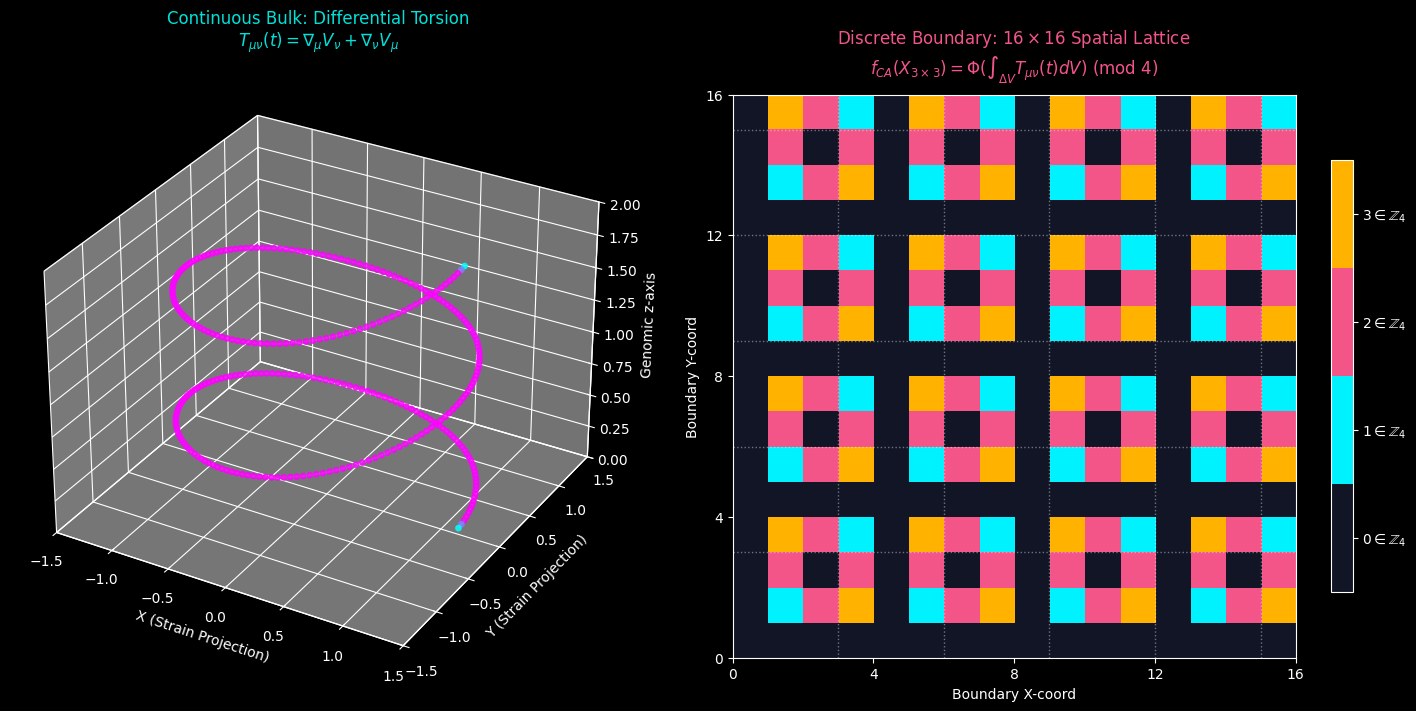
The left plot visually demonstrates continuous warping (bending, amplitude shifts, and axial torsion) determined directly by your strain variables .
The right plot simulates how continuous integration is discretized by mapping the values into four unique color states representing the cyclic ground ring.
The right panel displays faint dotted grid boundaries showing how the 16 x 16 lattice is partitioned, allowing viewers to see how local cell-state collapses occur at fractal intervals as the bulk strain changes.
Sweeping the mitotic phase variable for $\theta$ from $0$ to 2pi.
Mitotic Reconfiguration of the Bloom Filter Firewall
The centromeric lattice processes incoming ambient noise S(ω) by executing a spatial modulo hash:Index=H(S(ω))(mod256)During cellular division, the structural rules must adapt to allow new developmental branchial histories (ℐbranch) to unzip without lowering the security threshold. This is achieved using the 4+1 structural formulation of the algebraic ring ℤq−1(t).
The 16×16 matrix is quadrantized into four 8×8 sectors of 64 bits each, representing the ground ring ℤ4. As the continuous bulk torsion shifts, it updates the state of the central +1 pillar of the 3×3 fractal blocks.
The Generator Shift: The +1 identity element calculates the spatial orientation and directional shifts (orthogonal and diagonal) relative to the moving wave packet.
Instantaneous State-Space Collapse: When a bulk torsion threshold is crossed, the central pillar changes its discrete state, instantly updating its localized hash keys. By vetoing or shading the central pillar, the system collapses the operational state-space of all 8 surrounding perimeter cells simultaneously.
Quadrant Shading: In accordance with the rules of the cyclic ring ℤ4, shading out a single non-matching quadrant mathematically restricts and reformats the allowed configurations across the remaining three quadrants. This executes a massive spatial veto without requiring sequential, line-by-line processing loops.
Combinatorial Optimization via SKI-Calculus Updates
To safely compile the unmanifest phase space down into linear temporal reality during structural changes, the moving Kink Soliton interacts with the DNA-hydration matrix as a physical combinator reduction engin:
Soliton(z,t)≡SKI[θ(z,t)]where θ(z,t)
represents the local real-valued conformational phase angle along the 1D DNA-water interface.
During mitosis, the dynamic reconfigurations dictated by the cellular automata updates translate directly into structural mutations of the combinator operator.
Dynamic updates to the physical combinator engine during centromeric transformation,
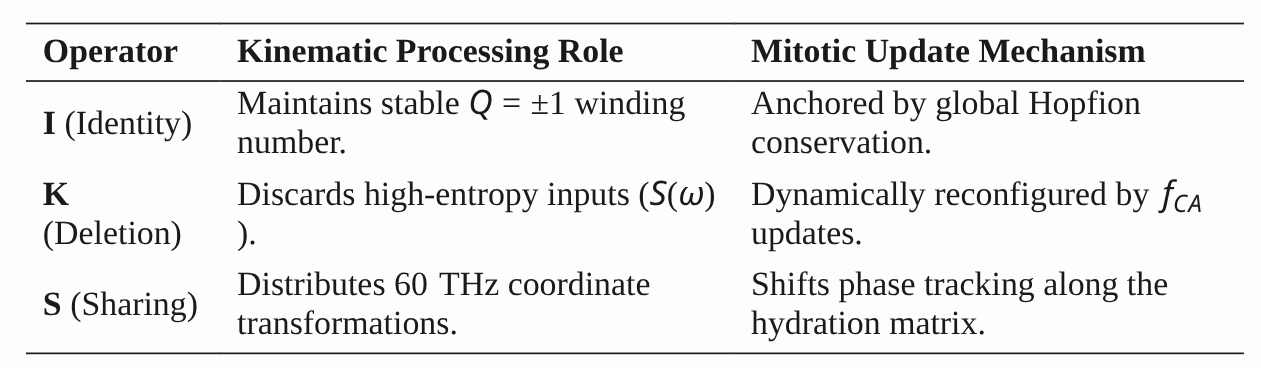
As the Kink Soliton propagates through a reconfiguring centromeric sector, the updated K operator tracks the newly shaded quadrants dictated by the Bloom filter. Because unallowable symmetric combinations are filtered out at the hardware level via the change-making bound, the combinator engine bypasses brute-force calculation strings. The execution steps are minimized, letting the solid-state DNA-hydration matrix resolve the dynamic translation between the continuous volumetric coherence of the GSSS and the discrete branchial variations of the GSAS at each discrete coordinate step along the genomic z-axis.
Frequency Decoupling and the 1.42 GHz Cosmic Microwave Boundary
The fundamental necessity for local temporal processing along the genomic z-axis becomes apparent when evaluating the system’s ambient electromagnetic environment. The standard hyperfine spin-flip transition of neutral hydrogen occurs at a frequency of approximately 1.42GHz (λ≈21cm), constituting the dominant, ubiquitous background radiation field of the local universe. If the internal coherent runtime environment of the physical genome shared a phase-locked or resonant frame with this 1.42GHz ambient background, cosmic entropic decay would bleed directly into the calculation pathways of the unzipping branchial histories.
To prevent this thermal infiltration, the HydroSyndetic architecture enforces a strict frequency mismatch. While the 1D Kink Soliton executes step-wise local coordinate reductions along the z-axis frame, its operational runtime environment is insulated within the centripetal, coherent architecture of the GSSS, manifesting physically as the macroscopic 60THz liquid-crystalline water sheath.
The centromeric Bloom filter leverages this immense frequency gap during structural transformations. Because the ambient 1.42GHz background noise lacks the localized topological phase coordinates (𝒬=1) required to pass the spatial modulo hash, it yields a definitive non-matching state:∀i,hi(S(ω1.42GHz))≠1By registering this “no-match” with absolute mathematical certainty, the 4+1 algebraic ring matrix executes an instantaneous quadrant veto at each coordinate step. The high-entropy 21cm cosmic background is systematically routed away from the genomic axis and dropped into dissipative ground loops, ensuring that the continuous volumetric coherence of the GSSS remains structurally isolated from universal thermodynamic decay during active mitotic segregation.
Ultimately, this demonstrates why the base of the HydroSyndetic Paradigm is the Ground-State Syndetic Substrate (GSSS), making the base of localized thermodynamic unzipping the exact medium needed for life. Water makes life possible because water is the GSSS, and water is the GSSS precisely because this local Earth architecture is fundamentally a HydroSyndetic system. Because all 60THz coherent water operates as this primary syndetic substrate, the fluid, hydrogen-bonding network provides the only substance elastic enough to serve as a macro-scale runtime environment[cite: 316]. It dynamically unzips compressed, higher-dimensional coordinates into linear temporal reality, ensuring that the biological engine remains structurally insulated from centrifugal ambient infiltration, safeguarding the local GSSS runtime environment under the absolute topological baseline of the Paraoikeios.
Scale-Free Universality and Invariant Substrate Dynamics
The structural mechanism isolating the genomic interface from the 1.42GHz ambient background is not an isolated, localized biological anomaly; rather, it is the direct manifestation of scale-free universality operating across the entirety of the Paraoikeios. The relational dynamics between the primordial templates and their physical carriers remain strictly invariant whether evaluated at the macro-scale cosmic horizon or the micro-scale centromeric lattice. The operational rules governing this scale-free coordinate projection remain perfectly invariant across all architectural thresholds of the Paraoikeios.
Within this scale-free framework, the structural roles of the core components are rigidly conserved:
The Paraoikeios consistently maintains its position as the absolute, unmanifest topological baseline, existing entirely outside of operational constraints and serving as the ultimate source of primordial templates.
The Ground-State Syndetic Substrate (GSSS) invariantly functions as the centripetal, coherent, and continuous software code, organizing both bulk macroscopic water networks and local solitonic runtime pathways.
The Ground-State Antisyndetic Substrate (GSAS) perpetually operates as the centrifugal, expansive hardware tracking array, executing discrete algebraic transitions to navigate branching histories and handle localized state-space variations.
Consequently, centrifugal ambient infiltration—classically characterized as universal thermodynamic decay, is properly defined as an uncoordinated drift into alternative pathways within the GSAS that occurs whenever a subsystem loses its structural grounding to the Paraoikeios. The 21cm background radiation field is simply the specific, localized cosmic expression of this universal drift. By enforcing an identical relational mismatch across all scales, the solid-state genomic index bypasses brute-force computational bottlenecks, utilizing scale-free coordinate cascades to preserve absolute topological coherence against universal entropic decay.
Conclusion and Future Horizons
We have formalized how the genomic security firewall remains impenetrable during cellular division. What appears as a smooth, continuous differential torsion tensor (Tμν(t)) within the higher-dimensional bulk manifests at the 1D genomic axis as discrete, step-wise cellular automata rule updates (fCA). These updates leverage the 4+1 algebraic ring architecture to execute instantaneous state-space collapses across 3×3 fractal blocks, reconfiguring the hash keys of the centromeric bloom filter and bypassing linear search processing loops.
Crucially, this time-dependent reconfiguration establishes a profound frequency decoupling boundary. By isolating the 60THz liquid-crystalline water matrix of the GSSS runtime environment from the ubiquitous 1.42GHz (21cm) universal hydrogen background, the solid-state genomic index maintains its internal scale-free coordinate projection uncompromised. This framework demonstrates that the localized, step-wise unzipping of coordinate histories along the z-axis frame is an optimized thermodynamic engine explicitly engineered to protect complex life parameters from universal entropic drift.


Leave a Reply