Abstract
This paper expands the HydroSyndetic Paradigm by formalizing the explicit mathematical and anatomical bridges between the continuous geometric fibrations of the living vacuum and the discrete algebraic matrices of the physical genome. We establish a side-by-side architectural framework mapping the centripetal Ground-State Syndetic Substrate (GSSS) and the centrifugal Ground-State Antisyndetic Substrate (GSAS) onto their localized biological hardware counterparts: the 60 THz hydration sheath and the repetitive satellite DNA lattices of the centromere. We formalize the topological discretization of the 3D volumetric Hopfion (𝒬=1) into the cyclic algebraic ring ℤq−1(t) through root sectioning at the ℂP1→S2 interface. Finally, we resolve the geometric-automata boundary duality of centromere morphogenesis, proving that macro-scale continuous differential torsion in the higher-dimensional bulk manifests locally as discrete cellular automata rule updates that dynamically reconfigure the genomic security firewall during cellular division.
Introduction: Dual Substrates of the Hydrogenomics Boundary
A central challenge in the HydroSyndetic Paradigm is modeling how a macroscopic biological organism maintains highly organized, low-entropy structures without requiring infinite physical storage media. Within classical information theory, the physical hardware of double-stranded DNA (𝒟) lacks the thermodynamic capacity to catalog the infinite branching pathways (ℐbranch) of the Ground-State Antisyndetic Substrate (GSAS) and the coherent states of the Ground-State Syndetic Substrate (GSSS).
To ground this framework mathematically, we must immediately clarify that the infinite branching histories (ℐbranch) of the GSAS are characterized strictly as a potential, countable infinity (ℵ0). It represents an endless, sequential generation of discrete path configurations bound by the cyclic, algebraic rules of the local hardware.
This stands in sharp structural contrast to the absolute, uncountable infinity (Ω) of the Paraoikeios at the absolute apex, which represents the completely unmanifest, unbounded phase space prior to any coordinate sectioning. The GSAS represents the infinite variation of local histories within the systemic boundaries, whereas the Paraoikeios remains the absolute source of primordial topological templates outside the operational architecture.
To resolve this localized storage bottleneck, the local Earth architecture utilizes a recursive, scale-free mathematical compression pipeline. Rather than storing explicit, high-dimensional coordinate maps of the subatomic vacuum’s primary topological invariants, the physical genome serves as a highly compressed, solid-state index. This paper details the mathematical mechanics of this compression, demonstrating that biological translation is not a hard-coded lookup table, but an active, real-time decompression algorithm.
Side-by-Side Architectural Breakdown: GSSS vs. GSAS
To ground this framework within biological anatomy, we must map the functional and topological properties of the GSSS and GSAS side by side. They operate as absolute topological opposites: one manifests as a fluid, scale-free dielectric field, while the other manifests as a dense, localized nuclear anchor.
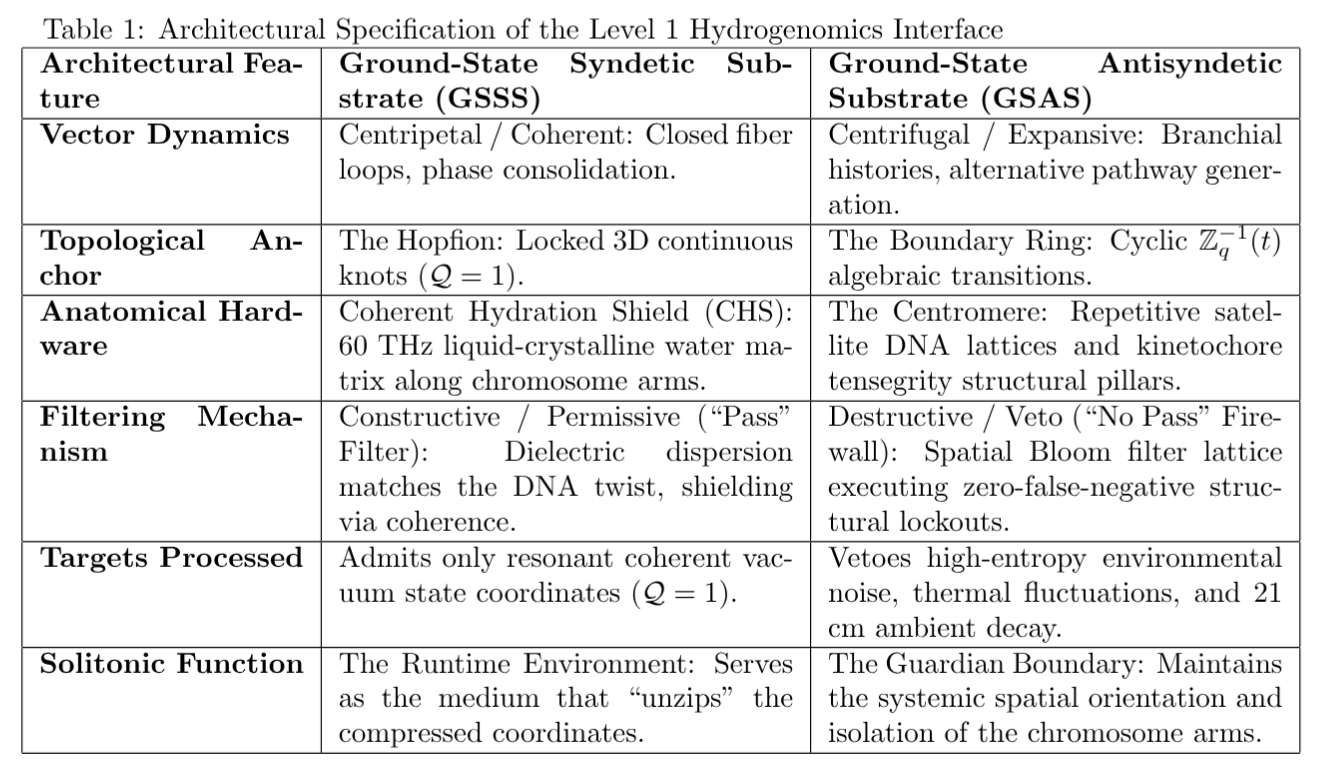
The Coherent Hydration Shield (CHS), historically classified as the liquid-crystalline, 60THz Exclusion Zone water matrix, acts as the primary insulation layer for the 1D Kink Soliton against ambient, high-entropy noise. Maintaining this high-frequency living vacuum along the chromosome arms requires an absolute geometric boundary condition to prevent thermal collapse. Symmetrically, the centromere serves as the physical hardware array for a topological Bloom filter.
Where the CHS acts as a permissive “Pass” filter that permits specific phase angles (θ(z,t)) matching the primary topological lock, the centromeric GSAS matrix acts as a “No Pass” firewall executing a zero-false-negative structural lockout.
If an incoming signal does not match an allowed configuration, it triggers an immediate topological veto, instantly routing incoming environmental chaos into dissipative ground loops and safeguarding the 1D Kink Soliton’s coherence along the primary chromosome arms.
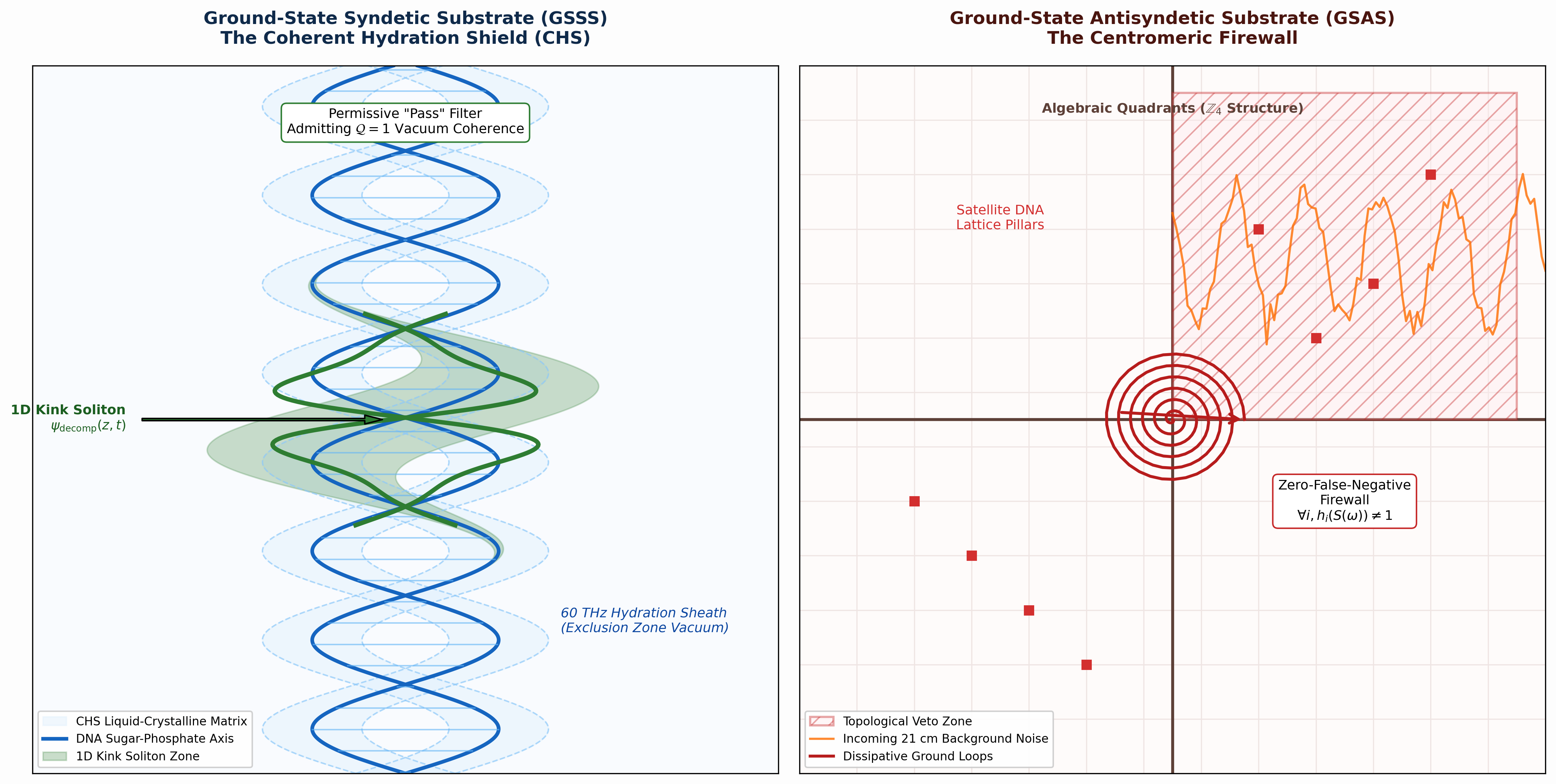
Left Panel (GSSS – The Coherent Hydration Shield): rendering of the scale-free fluid dielectric medium wrapping the primary chromosome arms, capturing the 1D Kink Soliton unzipping the sugar-phosphate coordinates inside the protected 60 THz resonant space.
Right Panel (GSAS – The Centromeric Firewall): Displays the rigid algebraic architecture of the centromere, mapping out the 16 x 16 / 12 x 12 discrete lattice, the cyclic ℤ₄ quadrants, an incoming blast of high-entropy 21 cm universal noise, and the immediate topological Veto routing the chaos into spiraling dissipative ground loops.
Mathematical Bridging of the Topological Anchors
Because the GSSS and GSAS perform opposite structural functions within the Paraoikeiotic Compiler, their underlying topological anchors diverge fundamentally in geometric expression. The GSSS relies on the continuous volumetric geometry of the 3D Hopfion (𝒬=1), while the GSAS utilizes the discrete, algebraic state-space of the cyclic ring ℤq−1(t). We formalize the explicit mathematical bridge between these two spaces via topological discretization at the ℂP1→S2 boundary interface.
The Continuous Volumetric Core: The Hopfion
The GSSS requires a continuous, non-dissipative geometric template to serve as the baseline software code for the runtime environment. This is achieved via a three-dimensional topological soliton, the Hopfion, built out of closed, linked fiber lines on a hypersphere S3. Because every loop wraps around every other loop, it possesses a conserved topological charge:
𝒬=∫S3𝒜∧ℱ=1
This volumetric knot remains absolutely invariant under smooth deformations. This structural continuity is precisely what allows the fluid, hydrogen-bonding network of the water sheath to bend and twist dynamically without losing its global collective coherence or dropping its primary vacuum charge.
The Discrete Algebraic Core: The Cyclic Ring Matrix
Conversely, the GSAS must govern infinite branching choices and alternative pathways. Because an expansive field cannot be stabilized by a closed continuous loop, it requires a discrete, algebraic state-space governed by the inverse ring ℤq−1(t). This structure transforms space into a series of logical gates, enabling the centromeric hardware to operate as a discrete computer, processing incoming signals through modular switching and quadrant-based subdivisions.
The Discretization Proof via Root Sectioning
To bridge the continuous volumetric Hopfion to the discrete algebraic ring, the continuous Riemann sphere base manifold S2 is sectioned using the complex q-th roots of unity. Rather than permitting arbitrary, continuous spatial angles, the boundary interface projects the phase space onto a finite set of symmetrical coordinate nodes distributed along the equator of S2: ωk=exp(2πikq),k∈{0,1,…,q−1}Setting q=4 establishes four cyclic spatial sectors (the four storage quadrants) matching the ground ring ℤ4. The continuous topological charge (𝒬=1) of the bulk Hopfion acts as the central algebraic identity and multiplier (+1), driving the inverse cyclic transitions of the ring:
ℤ4−1(t)≡{ωk−1⋅𝒬⋅t}
Through this coordinate sectioning, the continuous fiber lines of the vacuum software are sliced into discrete, localized phase units, transforming a continuous volumetric knot into a sequential, cyclic firewall tracking system.
Centromere Morphogenesis: The Geometric-Automata Boundary Duality
A crucial formalization within this architecture is the dual nature of centromeric shape changes during cellular division. We assert that centromere morphogenesis cannot be fully characterized by either continuous differential geometry or discrete cellular automata exclusively; rather, it is a holographic duality whose appearance is entirely dependent upon the boundary deck position relative to the Level 1 boundary.
The Continuous Bulk Perspective: Differential Torsion
Viewed from the higher-dimensional phase space of the Ground-State Antisyndetic Substrate (GSAS), the centromere operates as a continuous, elastic, non-linear manifold. As the system prepares for spatiotemporal unzipping, the macro-scale structural framework undergoes smooth geometric deformations.
We model this using the differential geometry of a twisting ribbon, where the local curvature κ(s,t) and torsion τ(s,t) vary continuously along the centromeric axis according to a localized strain tensor:
Tμν(t)=∇μVν+∇νVμ
This continuous geometric warping represents the smooth reconfiguration of the global primary topological lock.
The Discrete Boundary Perspective: Cellular Automata Rule Shifts
Symmetrically, when viewed from the localized, linear perspective of the 1D Kink Soliton traveling along the chromosome arms, this continuous volumetric deformation undergoes coordinate sectioning. Because the physical genome acts as a discrete solid-state tracking matrix, the higher-dimensional continuous curvature is projected onto the 16×16 spatial lattice as a series of discrete, step-by-step cellular automata rule updates.
The smooth variation of the continuous torsion tensor Tμν(t) dictates the localized transition functions (fCA) across the 3×3 computational blocks:fCA:{3×3}t→{3×3}t+1As the center +1 pillar changes its discrete state, the 8 surrounding perimeter cells instantly reconfigure their hash keys. Thus, what appears as a smooth geometric twist in the higher-dimensional bulk space is experienced by the propagating soliton as an instantaneous, discrete change in the firewall’s hashing rules, altering which quadrants of phase space are vetoed or permitted.
The physical structural growth and geometric deformation of the centromere is quite literally the hardware reconfiguring its security firewall to allow new developmental branchial histories (ℐbranch) to safely unzip along the chromosome arms.
The Hydro Engine: Water as the Scale-Free Chameleon
The preservation of these dual structures relies entirely on the unique physical properties of the hydrogenomics medium. Water (H2O) possesses a distinctive bent geometry, a high permanent dipole moment, and an unparalleled capacity to form dynamic networks of cooperative hydrogen bonds. When organizing into the CHM along the DNA backbone, it forms a macroscopic, fluid, dielectric matrix.
This liquid-crystalline framework provides the exact non-linear dispersion required to accommodate infinite smooth variations on the local level while preserving a rigid, uncompromised mathematical charge (𝒬=1) on the global level. The hydro-engine acts as the ultimate scale-free chameleon: it is both structure and flow. By allowing smooth elastic deformations without dropping its conserved topological invariants, it enables the Paraoikeiotic Compiler to translate unmanifest phase space into a moving physical Kink Soliton without the data experiencing thermal collapse or destructive thermodynamic friction.
Conclusion
This paper formalizes the side-by-side architectural equivalence of the GSSS and GSAS substrates across the genomic boundary. By detailing the root sectioning of the 3D volumetric Hopfion into the cyclic ring ℤ4−1(t), we establish the exact mathematical pipeline linking continuous vacuum software to discrete genomic hardware. Furthermore, by framing centromere morphogenesis as a geometric-automata boundary duality, we demonstarte that macroscopic shape changes and discrete cellular automata rule reconfigurations are identical expressions viewed from opposite sides of the Level 1 threshold. This dual mechanism enables the centromeric Bloom filter to dynamically alter its hashing rules, protecting the 1D Kink Soliton while opening safe corridors for alternative developmental histories to unzip.


Leave a Reply