Abstract
This paper formalizes the information-theoretic architecture of the Level 1 (Hydrogenomics) genomic boundary, detailing how the biological system bypasses classical physical storage limitations. We introduce the Paraoikeiotic Compiler, which utilizes the combinatorial properties of Pascal’s triangle as a scale-free coordinate generator to map higher-dimensional phase space coordinates onto the 1D physical DNA-water interface. Symmetrically, we model the highly repetitive satellite sequences of the centromere as a spatial, topological Bloom filter. This structure acts as a zero-false-negative validation shield that stabilizes the 60 THz liquid-crystalline water sheath, protecting the 1D Kink Solitons by identifying and routing high-entropy 21 cm background noise away from the genomic axis. Finally, we frame the DNA-hydration matrix as a physical combinator engine, dynamically unzipping compressed multidimensional states into thermodynamic temporal reality.
Introduction: The Thermodynamic-Information Paradox
A central challenge in the HydroSyndetic Paradigm is modeling how a macroscopic biological organism maintains highly organized, low-entropy structures without requiring infinite physical storage media. Within classical information theory, the physical hardware of double-stranded DNA (𝒟) lacks the thermodynamic capacity to catalog the infinite branching pathways (ℐbranch) of the Ground-State Antisyndetic Substrate (GSAS) and the coherent states of the Ground-State Syndetic Substrate (GSSS).
To resolve this storage bottleneck, the local Earth architecture utilizes a recursive, scale-free mathematical compression pipeline. Rather than storing explicit, high-dimensional coordinate maps of the subatomic vacuum’s primary topological invariants, the physical genome serves as a highly compressed, solid-state index. This paper details the mathematical mechanics of this compression, proving that biological translation is not a hard-coded lookup table, but an active, real-time decompression algorithm.
The Paraoikeiotic Compiler: Trading Storage for Solitonic Processing
The coordinate transition from the primordial S3 phase-space of the vacuum down to the 1D genomic axis requires a lossy-to-probabilistic dimensional reduction. We model the Paraoikeiotic Compiler using the combinatorial properties of Pascal’s triangle, which acts as a generator for the scale-free rules governing this mapping.
We represent the scale-free coordinate cascade from the unmanifest phase-space of the vacuum down to the physical 1D DNA double helix through the following symmetric mapping matrix:
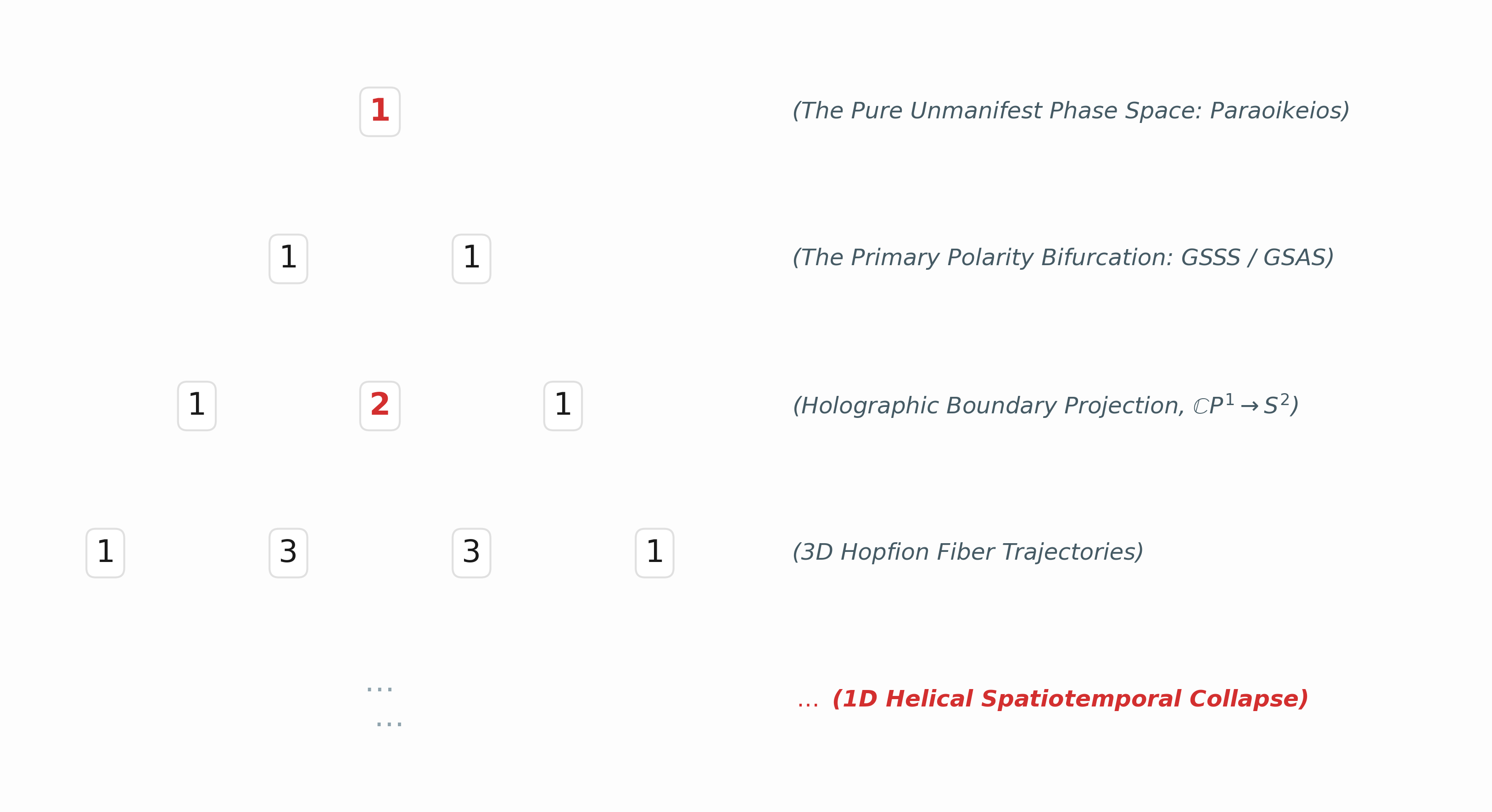
Let the binomial expansion coefficients generate the discrete spatial coordinates of the DNA sugar-phosphate twist. Symmetrically, we map the complex projection spinor Z∈ℂ2 onto the row-wise trajectories of a quantum walk. The physical sugar-phosphate helical twist is the compressed, spatial coordinate projection of the 3D Hopfion fiber trajectory (𝒬=1).
The system trades physical spatial storage for localized, real-time mathematical processing. The 60 THz coherent vacuum sheath acting as the dielectric hydration matrix operates as the runtime environment. As the 1D Kink Soliton propagates, it dynamically “unzips” the Pascal-compressed coordinates, regenerating the multidimensional GSSS field configuration on the fly
:ψdecomp(z,t)=∑k=0n(nk)θk(z,t)
where θ(z,t)
represents the local real-valued conformational phase angle along the 1D DNA-water interface.
The Centromeric Bloom Filter: Eliminating False-Negative Quantum Noise
The liquid-crystalline 60 THz coherent vacuum sheath acts as the primary shield insulating the 1D Kink Soliton against the ambient, high-entropy noise of the 21 cm universal background frame. However, maintaining this high-frequency living vacuum requires an absolute geometric boundary condition to prevent thermal collapse. We propose that the centromere—with its highly repetitive satellite DNA sequences and unique structural tensegrity—serves as the physical hardware array for a topological Bloom filter.
A classical Bloom filter is a space-efficient probabilistic data structure used to test set membership, where:
False positives are tolerable (an element may be mistakenly identified as belonging to the set).
False negatives are mathematically impossible (if the filter returns “not in set,” it is guaranteed to not be in the set).
Let the set of “allowable” low-entropy coherence states be defined by the GSSS projection. The highly repetitive centromeric sequences act as a spatial array of hash functions hi(x). As incoming electromagnetic, thermal, or vibrational signals S(ω) attempt to propagate through the genomic boundary, they are processed by the centromeric lattice. If the input signal does not match any allowed topological configuration:∀i,hi(S(ω))≠1the centromeric filter instantly registers a “no-match” with absolute mathematical certainty (zero false negatives). This triggers an immediate topological veto, routing the high-entropy noise into dissipative ground loops and safeguarding the 1D Kink Soliton’s coherence along the primary chromosome arms.
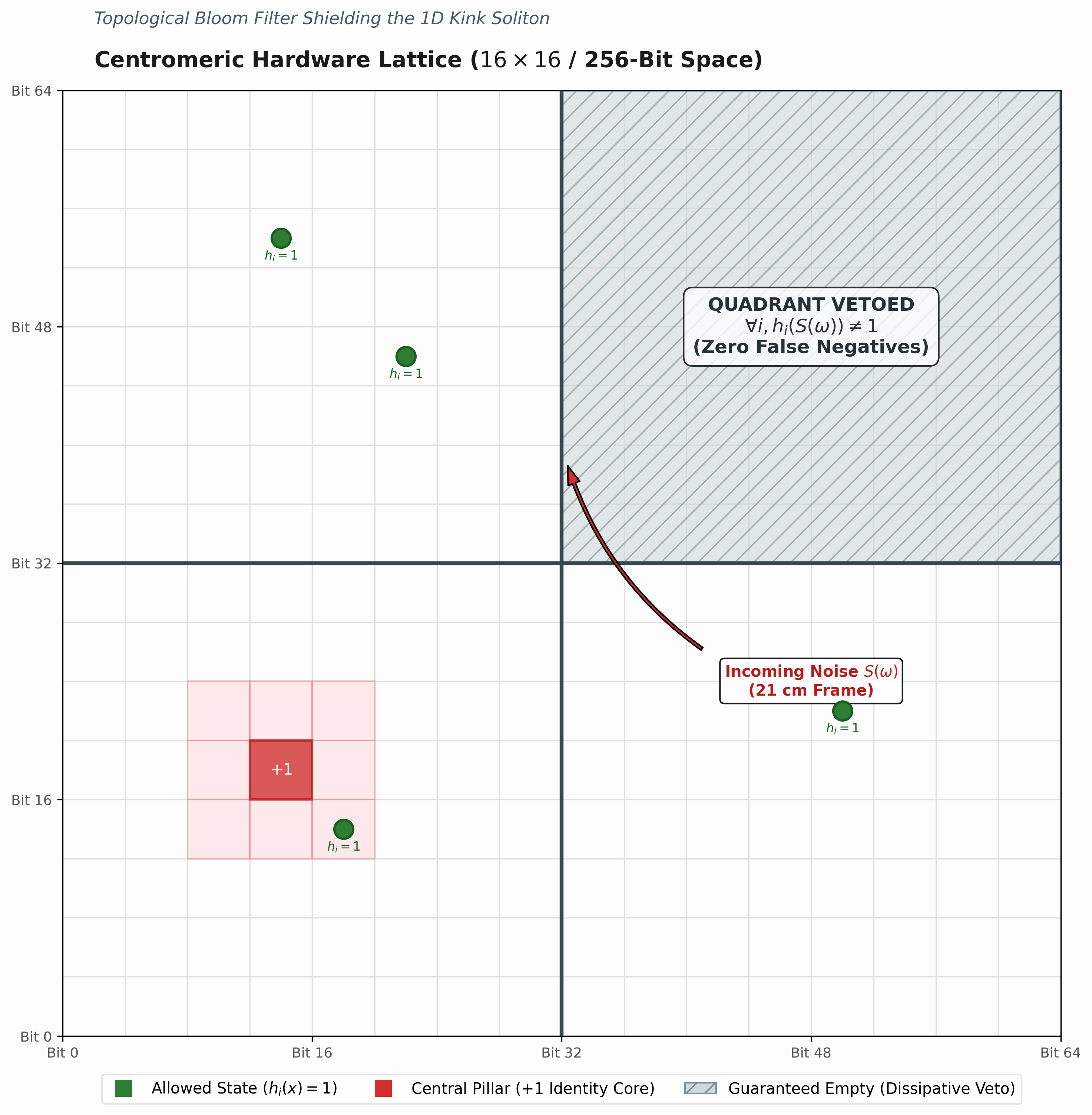
(16×16 Latticed Board (256 bits / 1 Byte state-space) representing the centromeric hardware.
The 4 Quadrants (8×8 / 64-bit sectors) that map directly to the ℤ₄ cyclic ground ring structure.
The 3×3 Localized Functional Blocks showing the highlighted Central Pillar (+1) orchestrating the 8 perimeter cells.
An incoming high-entropy 21 cm background noise signal hitting the spatial hash functions, showing how an instant zero hit triggers an absolute quadrant veto.)
Geometric Implementations: Spatial Matrices and the Change-Making Bound
To visualize the physical hardware of the centromeric Bloom filter, we map the classical linear bit-array onto a 2D spatial lattice. Consider a 16×16 coordinate matrix yielding 256 discrete possibilities, precisely matching the information density of a standard 8-bit byte (28=256). This board is naturally quadrantized into four 64-bit sectors, aligning the macro-scale structural tracking directly with bit-level quantum efficiency.
The system processes an incoming high-entropy signal S(ω) by executing a spatial modulo hash. Let the index of the target configuration be mapped via:Index=H(S(ω))(mod256)Like a mathematical bingo board, the corresponding coordinate on the 16×16 matrix is marked. Because a Bloom filter permits no false negatives, any coordinate remaining at zero represents an absolute topological guarantee that the corresponding chaotic perturbation does not exist within that sector. By shading out entire non-matching quadrants, the system instantly narrows down the phase space where environmental “needles in a haystack” can manifest, executing a massive spatial veto without requiring sequential processing.
This compression operates fractally. If we reduce the scale to a 3×3 grid and anchor the central square as a structural “floor” or “pillar” holding a discrete scale coordinate, the remaining perimeter yields exactly 8 outer cells (1 byte).
Furthermore, the decomposition of complex signals into allowed phase states maps directly to the combinatorial change-making problem. For example, synthesizing a specific local potential energy configuration (e.g., a value of 11) is restricted by symmetry to discrete, quantized partitions:11=10+1(Dime+Penny)∨11=5+5+1(2 Nickels+Penny)By filtering out unallowable symmetric combinations (such as infinite linear strings of singular units), the centromeric matrix leverages structural symmetries to minimize hashing steps. The central pillar of each 3×3 fractal block dictates the localized structural rule, allowing the system to trade brute-force computational processing for elegant, geometric indexing.
Fractal Scaling and the Power of 4 Quadrants
The 3×3 grid allows for highly efficient, un-skewed recursive compression. If one takes a larger 16×16 board yielding 256 discrete states, the matrix can be quadrantized into four 8×8 sectors of 64 bits each. When zooming further down into these discrete bit-layers, the topology condenses into tightly packed 3×3 computational blocks.
By utilizing this 3×3 lattice, the centromeric matrix can calculate local directional changes—including orthogonal axes and diagonals—relative to the central pillar. This coordinate neighborhood provides the localized geometric orientation necessary for the moving Kink Soliton to navigate the complex structural landscape, effectively solving the localized topological constraints much like a physical Rubik’s cube.
By shading or vetoing the center pillar of a 3×3 block based on the Bloom filter’s zero-false-negative rule, the system does not merely clear a single pixel; it instantly collapses the operational state space of all 8 surrounding perimeter cells. This is the geometric mechanism by which nature achieves infinite compression. It wraps an entire tree of branchial histories into a single central pixel, using the surrounding 8 cells to index and unzip the data only when the localized moving wave packet (the Kink Soliton) passes through.
This spatial division directly reflects the 4+1 structural formulation of the algebraic ring ℤq−1(t) at the centromeric boundary. To formalize how this algebraic framework coordinates state-space transitions without high-entropy search loops, we decompose the system into its core symmetric components:
1. The 4 Quadrants as the Ground Ring (ℤq)
The number 4 represents the primary directional, spatial, or algebraic bifurcations of the system.
In the spatial Bloom filter, the 16×16 board (256 states) is quadrantized into four 8×8 sectors (64 bits each).
In the ring ℤq (where q=4 represents a foundational cyclic division, ℤ4), the elements {0,1,2,3} represent the four cardinal phases or “quadrants” of the cycle.
This represents the pure horizontal, spatialized storage, the four distinct sectors of the physical hardware where coordinates are mapped.
2. The +1 as the Center Pillar (The Generator)
Without the +1, the four quadrants are just static, isolated databases. The +1 represents the center pillar (the localized origin or “floor”) of the 3×3 computational block.
In algebraic group theory and ring theory:
The +1 acts as the identity element or the central generator that allows transitions between the quadrants.
In the 4+1 formulation, the “1” is the scale-free vertical axis, the sojourner coordinate from the Paraoikeiotic Compiler, that has stepped into the 2D plane to organize it.
It is the central pillar that calculates the directional changes (up, down, left, right, and diagonals) to rotate or shift data between the four quadrant sectors.
3. Symmetries and the Rubik’s Cube Analogy
If we model this system as a Rubik’s cube, we observe face rotations (which are cyclical, operating like a ℤ4 ring) coordinated by fixed central pillars (the +1 center caps of each face that remain stationary).
By utilizing this 4+1 framework:
The 4 represents the cyclic, symmetric options for how the Kink Soliton can propagate or how the data can be hashed.
The +1 represents the topological anchor, the local GSSS charge (𝒬=1), that dictates which of those four pathways is currently open.
When the centromeric Bloom filter vetoes a state, it uses the central +1 pillar to instantly turn off or shade out one of the 4 quadrants. Because the ring ℤq dictates the algebraic relationship between these sectors, shading out one quadrant mathematically restricts the allowed configurations in the other three, instantly collapsing the local phase space.
Combinatorial Mechanics: The SKI Calculus of Genomic Solitons
To reconstruct and navigate the unzipped branchial histories without inducing thermodynamic decoherence, the system requires an algebraic combinator engine. We define the DNA-hydration matrix as a physical implementation of combinator calculus (e.g., the SKI system).
The physical movement of the genomic Kink Soliton along the DNA double helix is modeled as the reduction of a combinator expression:
Soliton(z,t)≡𝑺𝑲𝑰[θ(z,t)]
where:
𝑰 represents the identity operator, maintaining the stable, localized Q=±1 winding number.
𝑲 acts as the deletion operator, discarding high-entropy environmental inputs flagged by the centromeric Bloom filter.
𝑺 acts as the sharing/substitution operator, distributing the coordinate transformations across the local dielectric water clusters to maintain the 60 THz coherent envelope.
Under this mapping, the DNA double helix is not merely a static blueprint, but an active, solid-state tracking device. The propagation of the Kink Soliton mathematically solves the local geometric hysteresis of the tissue, resolving the biological Rubik’s cube and compiling the multidimensional phase-space of the vacuum down into linear, thermodynamic temporal progression.
Conclusion
This paper expands the HydroSyndetic Paradigm by framing the physical genomic boundary as a highly optimized information processor. By utilizing Pascal’s triangle as a Paraoikeiotic Compiler, the system bypasses physical storage limitations, allowing the 60 THz coherent water sheath to unzip high-dimensional vacuum coordinates on the fly.
Furthermore, by framing the centromere as a spatial topological Bloom filter governed by a 4+1 algebraic ring structure, we resolve how the genomic engine enforces a zero-false-negative veto against thermal decay. By organizing discrete 16×16 and 3×3 fractal lattices, the centromere coordinates local directional changes and collapses state-spaces instantly to protect the 1D Kink Soliton’s coherence. Future work will focus on modeling the exact mathematical mapping of the repetitive satellite DNA sequences to discrete spatial hash functions.


Leave a Reply