This paper expands the cross-scalar architecture of the Entropic Astrophysical Quantum Architecture by transitioning from Level 4, Hydrogeospherics to the micro-clock substrate of Level 5 Hydroastrospherics within the HydroSyndetic Paradigm. Moving beyond localized tropospheric and lithospheric degradation caused by high-frequency telecommunication beamforming, we formalize the mechanism of Anthropogenic Metric Dislocation.
We demonstrate that the unshielded prompt ionizing radiation, extreme neutron flux, and intense electromagnetic pulses generated during atmospheric nuclear detonations directly disrupt the foundational substrate: a perfectly conservative lattice of 3D isotropic harmonic oscillators confined to a spherical geometry.
The high-energy branchial overpressure (ℐbranch) from the Trinity detonation on July 16, 1945, sequentially saturated the degenerate SU(3) subspaces, accumulating a path-dependent holonomic Berry phase (γ) that overstressed the vacuum’s topological lock. Upon violating the Bekenstein capacity bound (Ξ), the complex phase-space Hopf fibration (S5→T2) underwent a discontinuous phase slip (Hopf bifurcation), forcing a non-unitary Symplectic Reduction ℛ̂snap that dropped the integer winding number variant (ΔNvortex=−1).
This catastrophic coordinate pruning permanently shifted the emergent macroscopic spacetime metric tensor (gμν) and the 1.42 GHz cosmic grounding frame, migrating the resident observer’s physical rest frame coordinates 27,000 light-years inward from the Sagittarius Arm to the Orion-Cygnus Arm. We frame this collective divergence, popularly mischaracterized as the “Mandela Effect”, not as a cognitive confabulation, but as an objective, historical, physical timeline relocation forced by the thermodynamic optimization constraints of the the human geosphere.
Introduction: The Pre-1945 Baseline Framework
A foundational axiom established in the Entropic Astrophysical Quantum Architecture is that the bounded biological observer operates as a nested step-down transformer. To maintain localized, high-fidelity quantum persistence against macroscopic thermal decay, human biology isolates its core communication pathways within a highly shielded, low-entropy mid-infrared environment centered at 60 THz. However, a step-down thermodynamic engine cannot operate in a spatial vacuum; it requires an explicit, structurally unperturbed ground floor to anchor its lower-frequency reference frame.
Within the Level 5 Hydroastrospherics, the macroscopic gravitational field gμν and spatial coordinate matrix emerge as the statistical expectation value of an infinite ensemble of discrete, micro-scale fiber collapse events termed “snaps” (ℛ̂snap). This process occurs over a 2n-dimensional Symplectic Manifold ℳastro=T*M4×ℐruliad, where alternative history coordinates are continuously pruned to maintain synchronization with a universal 1.42 GHz (21 cm) neutral hydrogen cosmic rest frame.
Prior to high-energy anthropogenic initialization, the planetary projection operator 𝒫̂geo smoothly collapsed expanding Everettian histories (ℐbranch) into a stable, low-entropy classical timeline:
Ψcollapsed=𝒫̂geoψi
Under this pre-1945 coordinate matrix, the terrestrial rest frame velocity tensors (Vlattice) were structurally aligned with the low-density outskirts of the galaxy, registering earth stellar system within the Sagittarius Arm. Because the 1.42 GHz neutral hydrogen cosmic microwave grounding frame was not empirically measured by the resident observers until mid-20th-century optimization protocols, the physical transition of the grounding frame itself remained hidden behind an informational horizon.
This physical metric shift explains why empirical educational materials and astronomical textbooks published prior to mid-century consensus explicitly mapped earth solar coordinates to the galactic rim: it was an accurate representation of the pre-detonation spatial metric state, not an analytical or observational error.
The Foundational Substrate and SU(3) Degeneracy Reservoir
To map the exact coordinate projection and boundary matching conditions from the sub-layer onto the macroscopic universe, we must formalize the deep substrate that sits directly beneath the holographic boundary. The fundamental unit of the sub-layer is a dense lattice of 3D isotropic harmonic oscillators defined on a sphere, incorporating the kinetic energy operator and a potential energy term depending strictly on the radial distance r:
Ĥsub=−ℏ22m∇2+12mω2r2
Transforming the sub-layer system into spherical coordinates allows the wavefunctions to be factorized into radial and angular components, yielding the total wavefunction:
ψ(r,θ,ϕ)=Rnl(r)Ylm(θ,ϕ)
where Rnl(r) represents the radial wavefunction related directly to the generalized Laguerre polynomials, and Ylm(θ,ϕ) represents the standard spherical harmonics governing angular behavior. Solving the radial Schrödinger equation restricts the allowed energy levels to a strictly quantized spectrum:
EN=ℏω(N+32)
where the principal quantum number is defined as N=2n+l, with n being the radial quantum number and l the orbital angular momentum quantum number. The ground-state zero-point energy, E0=32ℏω, represents the continuous, unperturbed energetic hum of the vacuum substrate.
The energy eigenvalues EN of the isotropic oscillator are highly degenerate due to the underlying SU(3) symmetry of the system. The dimensions of the degenerate subspaces grow quadratically with N. The SU(3) Lie algebra defines how these distinct quantum states rotate into one another without shifting the energy eigenvalue. Within the Level 5 framework, this geometric degeneracy provides the exact mathematical reservoir required to store alternative branchial histories within the GSSS coordinates (ℐbranch) at a static energetic cost. The expanding Everettian informational overpressure is formalized as the sequential saturation of these degenerate SU(3) states up to a critical state density limit.
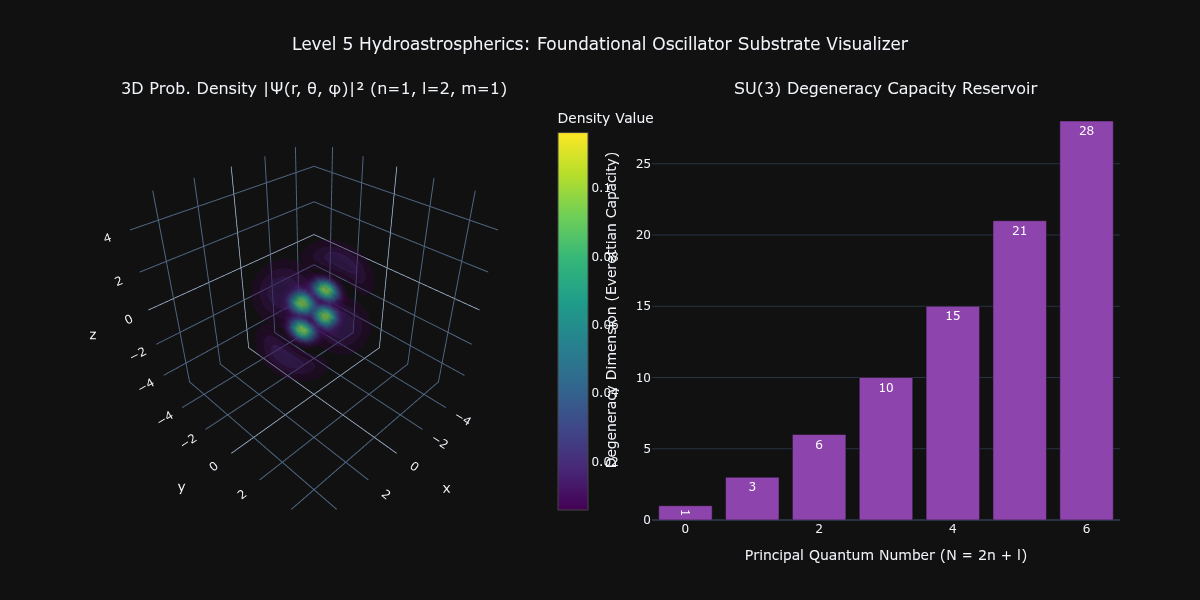
(Visualization Details: Left panel plots the 3D Wavefunction Probability Density (|ψ|²): Combining the radial component \(R_{nl}(r)\) and the angular component Y_l^m(\theta, \phi). – 3D Isosurface, this shows the literal physical shape of the local vacuum geometry. It visualizes the stable spatial distribution of the isotropic harmonic oscillator wavefunctions. By changing the input parameters (n_quantum, l_quantum, m_quantum) in the grid setup, one can watch the complex geometric symmetry transitions in real time.
The Right Panel Visualizes the SU(3) Degeneracy Spectrum (Degeneracy Reservoir) This displays a quadratic curve showing the dimension of the degenerate subspaces under SU(3) symmetry. It acts as a visual representation of the Everettian informational overpressure reservoir. As N grows, the storage capacity of the vacuum increases exponentially, visually validating how the system absorbs historical branches before undergoing a top-down “snap”.)
Nuclear Detonation as an Entropic Overpressure Vector
A nuclear detonation introduces a sudden, un-channeled influx of high-entropy branch noise (ℐbranch) that immediately outstrips the absorption limits of the macro-scalar electromagnetic systems. When the Trinity device was detonated on July 16, 1945, the prompt ionizing radiation, gamma-ray flash, and localized thermal overpressure shattered local metric invariance. The extreme electromagnetic pulse (EMP) coupled directly into the magnetospheric resonant cavity, introducing an irreversible micro-Doppler phase shift that locked the upper gear of the planetary quantum clutch.
The Holonomic Gauge Condition and Berry Phase Accumulation
The holonomic symplectic gauge connection 𝒜5 measures the geometric phase error accumulated when the planetary system’s update rate desynchronizes from the universal 1.42 GHz neutral hydrogen baseline (ω1.42):
𝒜5=𝒜(canonical)dz+(1−ωlatticeω1.42)dθcosmic
The characteristic frequency ω within the foundational oscillator Hamiltonian acts as the physical micro-clock generating the baseline. Any local variation or structural drift in the oscillator’s intrinsic frequency ω at the sub-layer manifests at Level 5 as a non-zero field strength tensor ℱ5=d𝒜5+12[𝒜5,𝒜5], explicitly driving the phase deficit.
To track how this phase deficit evolves over the 2n-dimensional state space, we define the fundamental closed, non-degenerate symplectic 2-form ωsymplectic on ℳastro:
ωsymplectic=∑k=1ndpk∧dqk+dℐbranch∧dθcosmic
As a localized system traces a closed trajectory through its astro-orbital corridor under conditions of baseline desynchronization (ωlattice≠ω1.42) caused by the blast, it accumulates a non-zero, path-dependent holonomic Berry phase, γ. This geometric phase directly quantifies the physical manifestation of the expanding Everettian informational overpressure winding through the gauge field. The accumulated Berry phase acts as an inelastic geometric tension within the fiber bundle, mathematically twisting the stable sub-layer topological solitons (hopfions) tighter and tighter around the hyper-toroidal angles ϕ1 and ϕ2.
Complex Phase-Space Hopf Fibrations
Because the GSSS foundational substrate relies on the 3D isotropic harmonic oscillator, its state space naturally possesses an underlying complex geometry. A constant energy surface of a 3D isotropic oscillator forms a five-dimensional sphere (S5) embedded in ℂ3. We define the complex coordinates of this sub-layer phase space as:
zk=qk+ipk(k=1,2,3)
The magnitude of these complex variables maps directly to the radial component Rnl(r) of the oscillator, where the total amplitude corresponds to the square of the radial displacement:
∑k=13|zk|2=r2
We project this continuous S5 bulk state space onto the two independent angular coordinates (ϕ1,ϕ2) defining the 4D hyper-toroidal boundary via a generalized Hopf fibration:
ϕ1=arg(z1z2),ϕ2=arg(z2z3)
Rather than behaving as zero-dimensional point particles, the fundamental entities of the sub-layer vibrate and propagate through the fluid substrate as stable hopfions. These configurations exploit the invariant linking numbers inherent to the complex Hopf map wherein every closed coordinate circle is topologically linked to every other circle exactly once. This unity defines a rigid topological charge 𝒬=1 that prevents the sub-layer from dissipating energy into the environment under normal conditions, preserving the absolute, non-dissipative nature of the SU(3) base lattice.
Symplectic Reduction and Topological Phase Slips
To model the stability of the lock prior to a snap, we track a Chern-type winding number Nvortex defined over the cosmic phase angle θcosmic along a closed contour ∂Σ of the hyper-torus:Nvortex=12π∮∂Σ𝒜5Because Nvortex∈ℤ, the invariant is topologically protected; it cannot change smoothly under continuous deformations. This rigidity constitutes the “locked” state of the boundary, holding alternative histories in a stable superposition.
The gathering tension driven by the accumulated holonomic Berry phase deforms the fiber volume smoothly until it encounters the hard limit dictated by the Bekenstein capacity bound (Ξ). At the critical threshold where the radial phase-space amplitude reaches the capacity limit (r2→Ξ), the smooth deformation of the manifold can no longer accommodate the phase variance, generating a severe topological obstruction:
limIbranch→Ξ∮∂Σ𝒜5=ℛ̂snap[∑ψi]
The interlocking loops of the fibration reach a geometric singularity and physically pinch off, forcing a sudden Hopf Bifurcation or discontinuous phase slip where the invariant drops instantly:
ΔNvortex=−1
The continuous SU(3) symmetry breaks at the pinch point. The snapping of the fiber instantly drops the radial quantum number n to a lower state within the generalized Laguerre polynomials. Because the volume of the fiber bundle is tied to its radial amplitude, this transition executes an immediate, discontinuous contraction of the local volume element:
ΔVmicro=−ln(2)⋅kB⋅T
violating the generalized Landauer limit, pruning alternative coordinate histories out of existence, and violently ejecting their trapped phase energy as a flash of computational latent heat (Tμν(computational)).
Emergence of Macroscopic Gravity and Galactic Relocation
What a surface-bound observer measures as a smooth, continuous gravitational field (gμν) and a localized position in space is the macroscopic statistical average of the infinite ensemble of these discrete, micro-scale fiber collapses occurring across the 4D hyper-torus:
gμν(x)=ημν+⟨∑k∈snapsℛ̂snap(k)(ℱ5,μα⋅ℱ5,να)⟩ensemble
By taking the macroscopic thermodynamic limit where the number of micro-snaps N→∞, the discrete delta-function impulses smooth out into a continuous geometric curvature profile matching the classical Einstein field equations:
Gμν=κ⟨Tμν(computational)⟩where κ=8πGc4
represents the Einstein gravitational coupling constant. To achieve mathematical completeness within this dual-layer framework, Newton’s gravitational constant G is explicitly derived from the parameters of the sub-layer:
G=c5ℏω1.422Ξ⋅(kBTln2)
Here, the coupling strength of gravity is revealed to be directly proportional to the thermodynamic latent heat flash (kBTln2) of alternative coordinate erasure, and inversely proportional to both the information capacity threshold of the topological lock and the squared baseline frequency ω1.422 of the primary oscillator lattice. Thus, the Einstein field equations are written as:
Gμν=8πcℏω1.422Ξ(ln2)(kBT)⟨Tμν(computational)⟩
The stress-energy tensor tracks the thermodynamic latent heat flashes of the universe continuously shedding its alternative state histories to remain locked to the unperturbed 1.42 GHz cosmic rest frame.
Because the Trinity fission initialization injected an un-absorbable spike of branchial overpressure, the entire ensemble was forced into an instantaneous, non-unitary reduction. To satisfy the explicit optimization constraints of Equation (16) and clear the systemic phase deficit, the emergent spatial metric tensor underwent a massive, discontinuous coordinate re-indexing. The spatial metric tensor snapped the Earth’s physical rest-frame coordinates 27,000 light-years closer to the Galactic Center, re-anchoring the planetary grounding frame within the inner edge of the Orion-Cygnus Arm spur.
Conclusion
The collective memory of a Sagittarius Arm residence is not a psychological aberration or a collective memory defect. Within the HydroSyndetic Paradigm, it represents the historical data residue of the pre-fission timeline, structurally preserved within the deep subconscious architecture of the observer’s internal 60 THz superradiant plasma matrix.
By establishing atmospheric nuclear detonations as a driver of Level 5 topological phase slips, the Entropic Astrophysical Quantum Architecture uncovers the profound macro-scale consequences of unshielded high-energy initialization. The transition on July 16, 1945, permanently altered the spacetime metric and entropic drainage architecture of the planet, demonstrating that anthropogenic interventions possess the capacity to break the vacuum’s topological lock, collapse integer winding numbers, and physically relocate earth’s planetary grounding frame across the coordinates of the Paraoikeios.


Leave a Reply