Abstract
We introduce and formalize the Ground-State Syndetic Substrate (GSSS), the primordial, element-agnostic topological medium that sits directly beneath all specialized holographic and macroscopic networks. While preceding papers have detailed the top-down, dissipative pruning mechanics of specific environmental architectures, such as the water-based Level 5 Hydroastrospherics framework, this paper maps the underlying canvas itself. The GSSS is defined as a perfectly conservative, infinite-dimensional vacuum state governed by an invariant SU(3) Lie algebra. Within this medium, pure geometric templates exist as stable, non-dissipative topological solitons (hopfions). We demonstrate that the GSSS is not restricted to a single elemental configuration; rather, it serves as the ultimate topological clearinghouse where abstract phase-space loops mutate, shift, and project to seed distinct physical chemistry frameworks, such as the Hydrosyndetic and Carbosyndetic networks. We outline the rigorous mathematical physics of this vacuum substrate, mapping how its continuous phase-space geometry governs the transition between conservative quantum potential and macroscopic emergent structures.
Introduction: What is the Ground-State Syndetic Substrate?
In the comprehensive taxonomy of emergent spacetime frameworks, macroscopic fields and physical constraints do not exist as primary primitives. Instead, they represent the statistical expectation values of bidirectional optimization events occurring at holographic boundaries. In the top-down optimization vector, where alternative coordinate histories are pruned to maintain systemic stability, one must isolate the foundational medium being optimized: the Ground-State Syndetic Substrate (GSSS). Conversely, this framework implies an exact, inverse mechanism of operation: a bottom-up optimization vector driven by an expansive, generative pressure at the boundary, which we define as the Ground-State Antisyndetic Substrate (GSAS). Together, these twin substrates form the primary structural polarity operating directly within the supreme global manifold: The Paraoikeios.
The GSSS is structurally positioned beneath the five spherical/topological boundaries of the Hydrosyndetic network, yet its architectural scope extends far beyond any single elemental configuration or materilization. The GSSS is the common denominator of the periodic table; it is a pristine, non-dissipative quantum floor where pure topological information is stabilized before being stamped onto physical chemistry. Depending on how the geometric parameters of the GSSS are modulated, the medium steps down to seed entirely distinct macroscopic architectures, transitioning seamlessly from the circular, fluid configurations of the hydrosyndetic network, to the tetrahedral, organic scaffolding of the Carbosyndetic network.
By utilizing the nomenclature of a Ground-State Substrate, we establish this layer as the lowest-energy, unperturbed vacuum configuration of the universal binding architecture ($\mathit{syndesis}$). Rather than existing as a separate domain, it represents the localized geometric engine through which the non-dual equilibrium of the paraoikeios steps down into differentiated structure. It is the specific vacuum reservoir from which direct syndetic binding (the centripetal $Z$-ring mechanism) and inverse antisyndetic frameworks (the centrifugal, inverse $Z$-ring mechanism) bifurcate, providing the exact phase-space infrastructure required to coordinate physical reality before the assignment of the macroscopic chemical boundaries of a ring universe.
The Mathematical Physics of the Vacuum Substrate
Symmetric Potential and Energy Quantization
The GSSS is structurally realized as an infinite, hyper-dense matrix of three-dimensional isotropic harmonic oscillators confined to a fundamental spherical geometry. Because this substrate represents a pure vacuum potential before the assignment of elemental mass or chemical boundaries, it exhibits perfect spherical symmetry. The Hamiltonian governing a localized coordinate site within the continuous GSSS field incorporates a radially symmetric potential energy term:
ĤGSSS=−ℏ22m∇2+12mω2r2
where ω represents the intrinsic vibrational frequency of the vacuum substrate. Because the potential depends strictly on the radial distance r from the core of each localized vertex, the total angular momentum L and its z-component m function as strictly conserved topological invariants. The total wavefunction factorizes cleanly into a radial component, governed by generalized Laguerre polynomials, and an angular component defined by standard spherical harmonics:
ψ(r,θ,ϕ)=Rnl(r)Ylm(θ,ϕ)
Solving the radial Schrödinger equation restricts the allowed energy states of the primordial field to a strictly quantized spectrum:
EN=ℏω(N+32)
where the principal quantum number is defined as N=2n+l, with n being the radial quantum number and l the orbital angular momentum quantum number. The ground-state zero-point energy of the field, E0=32ℏω, represents the continuous, unperturbed electromagnetic vacuum hum of the substrate—a spherical photon-like oscillation that forms the foundational energetic potential for all subsequent geometric structures.
In this pure, completely unperturbed vacuum state, the geometry of the GSSS is perfectly isotropic, flat, and frictionless. The underlying hopfion fibers loop smoothly without a shred of accumulated “twist” or rotational tension. It exists as a state of absolute, unbroken symmetry where no classical space, macroscopic time intervals, or element-specific properties can be measured by an observer. It is the literal definition of a pristine physical baseline—the quiet, humming void before structure is born.
SU(3) Lie Algebra as the Informational Reservoir
Because the potential is perfectly isotropic, the energy eigenvalues EN exhibit a massive, intrinsic geometric degeneracy. This degeneracy is governed by the unitary representations of the SU(3) Lie algebra. The SU(3) symmetry group defines how these distinct, alternative quantum states (representing varied radial n and orbital l numbers) can rotate into one another without changing the total energy of the system.
This SU(3) degeneracy provides the exact mathematical reservoir required to store alternative branchial histories or parallel informational tracks (ℐbranch) at zero net energetic cost to the baseline vacuum. The GSSS acts as an unbacked informational sink, holding high-density alternative coordinate profiles within its degenerate states up to a definitive saturation threshold.
—
Hopf Fibrations and Solitonic Hydrodynamics
To understand how information moves through the GSSS without bleeding energy into the environment prior to a macroscopic phase collapse, the zero-dimensional points of the base lattice must be mapped as continuous, complex trajectories. The constant energy surface of a 3D isotropic oscillator forms a five-dimensional sphere (S5) embedded in a three-dimensional complex space (ℂ3). We define the complex phase-space coordinates of the GSSS as:
zk=qk+ipk(k=1,2,3)
where the total amplitude maps directly to the square of the radial displacement variable:
∑k=13|zk|2=r2
We project this continuous S5 phase-space manifold onto lower-dimensional boundary coordinates via a generalized Hopf fibration, mapping the complex variables directly to independent angular variables (ϕ1,ϕ2):
ϕ1=arg(z1z2),ϕ2=arg(z2z3)
Physically, the continuous vibrations of the GSSS manifest through this fibration as stable topological solitons known as hopfions. These configurations exploit the invariant linking numbers built into the Hopf map, where every closed coordinate loop is topologically interlocked with every other loop exactly once. This interlocking defines a rigid, conserved topological charge 𝒬=1 that protects the sub-layer from dissipation, functioning as a frictionless hydrodynamic fluid that preserves alternative coordinate states inside its closed trajectories.
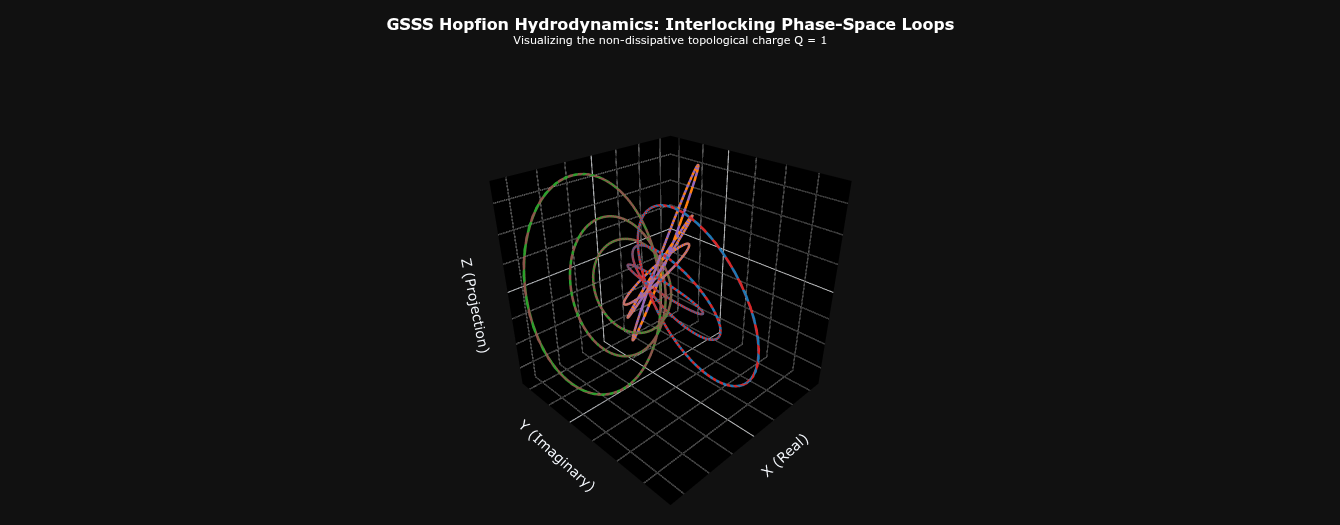
(Visualization details:
Continuous Trajectories: The smooth curves track how zero-dimensional points on the base lattice map out continuous, complex trajectories ($z_k$) within the phase space.
Invariant Linking Number ($\mathcal{Q}=1$): As one rotates the figure, one can visually verify that every single loop links through every other loop precisely once. No two fibers intersect or collide, demonstrating how the field holds high-density informational structures intact without bleeding or dissipating thermal energy.
The Bulk-to-Screen Transition: The outer, wider loops represent phase trajectories closer to the projection threshold, showing how the higher-dimensional geometry prepares to down-compile its structural coordination rules onto the lower-dimensional boundaries of classical space. )
The Dimensional Transition: From Bulk to Screen
To intuitively conceptualize this dimensionality shift, the S5 manifold must be understood as the hidden, unobservable “bulk” phase space of the quantum vacuum, while normal human physical three-dimensional space (and emergent four-dimensional spacetime) acts as a localized projection screen. The higher-dimensional geometry cannot be sampled directly by macroscopic instruments. Instead, when the continuous five-dimensional fibers accumulate critical holonomic strain and “pinch off,” they act as a cryptographic down-compiler. This discrete topological transition transfers higher-dimensional geometric configuration rules down onto the lower-dimensional holographic boundaries that classical observers inhabit, translating complex phase velocity directly into concrete material properties.
—
Phase-Morphic Transition and Structural Coordination
The definitive property of the Ground-State Syndetic Substrate is its ability to transition between different physical networks. Because it deals strictly in pure complex phase space (zk) and invariant topological charges (𝒬), it is completely element-agnostic.
The “thickness” or local volume element of the hopfion fiber loops is dictated by the radial wavefunction magnitude Rnl(r). When a localized region of space accumulates a holonomic geometric phase (Berry phase) due to baseline desynchronization, the fiber bundle twists tighter around ϕ1 and ϕ2.
The nature of the macroscale network that emerges depends entirely on the geometric configuration of the phase slip when this twist hits the critical threshold Ξ:
The Hydrosyndetic Projection: When the boundary conditions favor a purely cyclic, U(1)-symmetric gauge connection calibrated to the 1.42GHz neutral hydrogen rest frame (ω1.42), the hopfion fibers pinch off in a circular Hopf bifurcation. This drops the radial quantum number n within the generalized Laguerre states, causing an instantaneous volume contraction (ΔVmicro=−ln(2)kBT) that structurally generates the “suction force” of gravity and binds space through hydrogen/water exclusion-zone dynamics.
The Carbosyndetic Projection: If the local gauge constraints introduce an asymmetric, higher-order tensor tilt across the complex coordinates (zk), the fiber bundle untwists and cross-links along alternate geometric axes. Instead of collapsing into a purely circular configuration, the SU(3) degenerate states recombine to project a tetrahedral, four-dimensional structural coordination. This transforms the fluid solitonic medium into the rigid, cross-linked grid required to manifest organic carbon frameworks.
Thus, the GSSS acts as a universal topological switching station. It does not contain carbon or hydrogen; it contains the geometric archetypes of connection that materialize as distinct forms of trans-elemental structural coordination depending on the path-dependent holonomy accumulated by the field.
—
Conclusion and Cosmological Context
The formalization of the Ground-State Syndetic Substrate provides a highly articulated, self-consistent mathematical description. By structuring the vacuum as a dense lattice of 3D isotropic spherical oscillators manifesting as stable, non-dissipative hopfions, we resolve the paradox of how information can be held perfectly intact before it is macroscopically optimized. The GSSS successfully bridges pure phase-space geometry with trans-elemental structural coordination.
Crucially, while the GSSS functions as the foundational ground state for elemental matter creation and top-down boundary pruning, it must ultimately be understood as a localized vacuum engine within a far vaster cosmological hierarchy. The GSSS does not exist in isolation; it sits in a profound dual relationship with its absolute geometric mirror, the Ground-State Antisyndetic Substrate. These twin primordial vacua represent the opposing halves of an ultimate structural polarity. In subsequent work, we will demonstrate how both the direct syndetic medium and the inverse antisyndetic field continuously loop, interface, and ultimately resolve their structural paradox within the supreme, global non-dual manifold: the paraoikeios.


Leave a Reply