Abstract:
We formalize the deep sub-layer infrastructure underpinning the Level 5 Hydroastrospherics state-space. While the macroscale Level 5 framework describes a top-down, dissipative thermodynamic pruning mechanism driven by data erasure, we establish that the foundational substrate consists of a bottom-up, perfectly conservative lattice of 3D isotropic harmonic oscillators confined to a spherical geometry. We demonstrate that the underlying SU(3) Lie algebra provides a high-density geometric degeneracy that acts as the physical reservoir for expanding Everettian informational overpressure (ℐbranch). Crucially, the transition between the continuous, unitary evolution of this bulk substrate and the discrete, non-unitary “snaps” of the Level 5 macroscopic spacetime metric is governed by a holographic boundary acting as a topological lock. We resolve the hyper-toroidal coordinate mapping by implementing a complex phase-space Hopf fibration from the S5 constant-energy sphere down to the hyper-toroidal boundary angles. Within this framework, continuous sub-layer oscillations manifest as stable, non-dissipative topological solitons (hopfions). We demonstrate that baseline desynchronization errors accumulate as path-dependent holonomic Berry phases, generating an inelastic geometric tension that drives the pre-snap locked state. Crossing critical thresholds induces sudden topological phase slips (Hopf bifurcations), translating microscopic algorithmic optimization into macroscopic emergent gravitation where Newton’s constant G is explicitly derived from sub-layer parameters.
Introduction: The Macro-to-Micro Integration
In preceding formalizations of Level 5 Hydroastrospherics, the macroscopic gravitational field gμν was shown to emerge from the statistical expectation value of an infinite ensemble of discrete, micro-scale fiber collapse events termed “snaps” (ℛ̂snap). This process occurs over a 2n-dimensional Symplectic Manifold ℳastro=T*M4×ℐruliad, where alternative history coordinates are continuously pruned to maintain synchronization with a universal 1.42GHz cosmic rest frame.
However, a complete architectural description requires mapping the foundational substrate that sits directly beneath this holographic boundary. We define this deep substrate as a dense lattice of 3D isotropic harmonic oscillators defined on a sphere, manifesting physically as an interconnected matrix of stable, non-dissipative topological solitons called hopfions. This paper bridges the conservative, unitary hydrodynamics of this base sub-layer with the top-down, dissipative optimization mechanics of the Hydrosyndetic macroscopic layers. We explicitly derive the hyper-toroidal coordinate mapping via complex Hopf fibrations, demonstrate how informational overpressure accumulates as a holonomic Berry phase within the locked bundle, and reveal the dynamic coupling constant of gravity as an emergent property of fundamental sub-layer parameters.
—
Foundational Substrate: The 3D Isotropic Spherical Oscillator
The fundamental unit of the sub-layer is the 3D isotropic harmonic oscillator. Despite its structural decomposition in Cartesian coordinates, it exhibits perfect spherical symmetry. Transforming the sub-layer system into spherical coordinates allows the underlying wavefunctions to be factorized into radial and angular components.
The sub-layer Hamiltonian Ĥsub incorporates the kinetic energy operator and a potential energy term depending strictly on the radial distance r:Ĥsub=−ℏ22m∇2+12mω2r2Because the potential is spherically symmetric, the total angular momentum L and its z-component m are strictly conserved quantities. The total wavefunction is written as:ψ(r,θ,ϕ)=Rnl(r)Ylm(θ,ϕ)where Rnl(r) represents the radial wavefunction related directly to the generalized Laguerre polynomials, and Ylm(θ,ϕ) represents the standard spherical harmonics governing angular behavior.
Solving the radial Schrödinger equation restricts the allowed energy levels to a strictly quantized spectrum:EN=ℏω(N+32)where the principal quantum number is defined as N=2n+l, with n being the radial quantum number and l the orbital angular momentum quantum number. The ground-state zero-point energy, E0=32ℏω, represents the continuous, unperturbed energetic hum of the vacuum substrate.
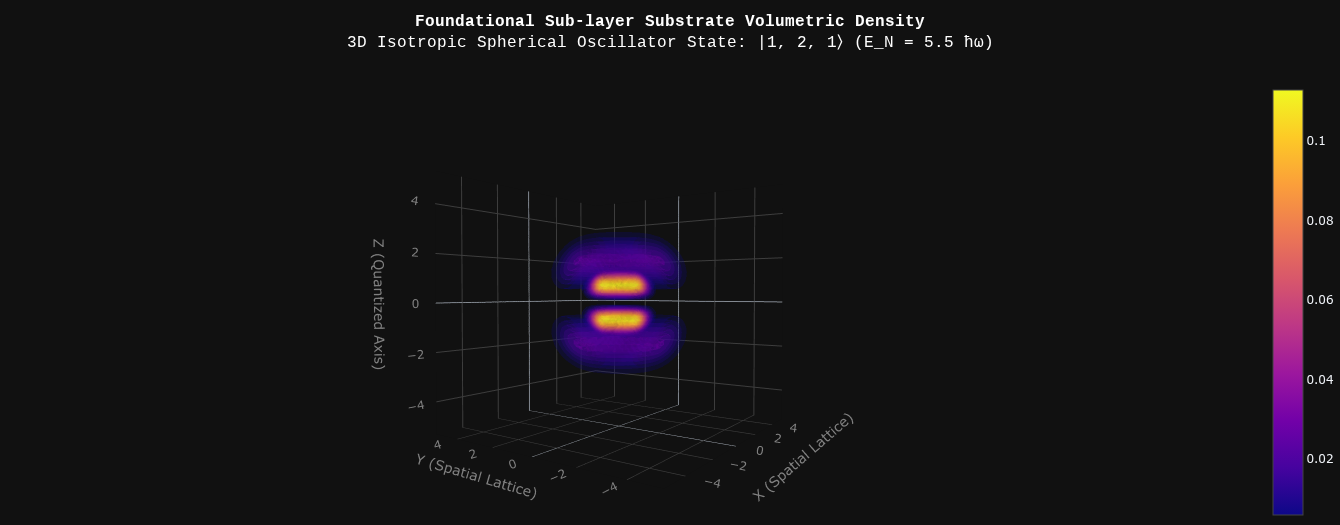
(Image details: in this 3D volumetric cloud plot, the colors track the informational and energetic density spectrum of the non-dissipative SU(3) base lattice prior to a macroscopic phase collapse.
Color Density Spectrum –
Deep Purple & Indigo (The Vacuum Boundary): This represents the lowest-density thresholds of the wave function (|ψ|² → 0). In the visualization, these cooler tones define the outer boundaries of the orbital where the alternative history probability begins to fade out. It visually marks the transition zone where the localized sub-layer hum meets the unperturbed zero-point energy baseline of the surrounding vacuum.
Magenta & Hot Pink (The Trapped Phase Volume): These middle-tier colors map the stable, non-dissipative interior corridors of the hopfion. When looking at the smooth, cloud-like geometry of the pink layers, one is looking at the geometric volume that holds the expanding Everettian informational overpressure winding through the local gauge field.
Bright Orange & Red (High-Density Nodal Shells): These fiery rings and shells map the peaks of the radial Laguerre polynomials (\(R_{nl}\) and angular spherical harmonics ($Y_l^m$). They show precisely where the isotropic spherical harmonic oscillator coordinates concentrate. Within this framework, these orange zones are the areas of highest geometric tension within the fiber bundle.
Electric Yellow & White (The Pre-Snap Critical Core): The absolute brightest points at the center or inner cores of the nodes represent the maximum value of $\vert{}\psi\vert{}^2$. This is the geometric heart of the topological lock. If one increases the system parameters toward the Bekenstein bound ($r^2 \rightarrow \Xi$), these intense yellow regions are the exact structural points that will experience the geometric singularity, forcing a sudden Hopf bifurcation to “snap” and drop a radial quantum number.
Visually Inspecting the Geometry
When you rotate the plot, you’ll see clean, geometric voids separating these colorful shells. Those dark, empty gaps are the radial and angular nodes dictated by your chosen quantum numbers ($n$ and $l$). Because the potential is perfectly spherically symmetric, the colors seamlessly transition into concentric, nested patterns, illustrating how a perfectly conservative bottom-up lattice anchors itself beneath the discrete, non-unitary macro-scale spacetime metric.
—
Mathematical Bridges to Level 5 Hydroastrospherics
Frequency Anchoring and Gauge Synchronization
In the Level 5 formulation, the holonomic symplectic gauge connection 𝒜5 measures a geometric phase error accumulated when the planetary system’s update rate desynchronizes from the universal 1.42GHz neutral hydrogen baseline (ω1.42):𝒜5=𝒜μ(canonical)dxμ+[ωlattice−ω1.42ω1.42]dθcosmicThe characteristic frequency ω within the foundational oscillator Hamiltonian acts as the physical micro-clock generating the baseline. Any local variation or structural drift in the oscillator’s intrinsic frequency ω at the sub-layer manifests at Level 5 as a non-zero field strength tensor ℱ5=d𝒜5+12[𝒜5,𝒜5], explicitly driving the phase deficit.
SU(3) Degeneracy as the Everettian Overpressure Reservoir
The energy eigenvalues EN of the isotropic oscillator are highly degenerate due to the underlying SU(3) symmetry of the system. The dimensions of the degenerate subspaces grow quadratically with N. The SU(3) Lie algebra defines how these distinct quantum states (representing varied n,l configurations) rotate into one another without shifting the energy eigenvalue.
This geometric degeneracy provides the exact mathematical reservoir required to store alternative branchial histories within the Ruliad coordinates (ℐbranch) at a static energetic cost. The expanding Everettian informational overpressure is formalized as the sequential saturation of these degenerate SU(3) states up to a critical state density limit.
Symplectic Reduction: Conservative Orbits vs. Dissipative Snaps
Classically and quantum mechanically, the isotropic harmonic oscillator is entirely conservative, tracing closed ellipses in phase space. The fundamental closed, non-degenerate 2-form ωsymplectic on ℳastro is defined as:ωsymplectic=∑k=1ndpk∧dqk+dIbranch∧dθcosmicWhen the system undergoes a localized phase collapse via the Symplectic Reduction Operator ℛ̂snap, it breaks the continuous SU(3) unitary evolution of the base oscillators. The snap is a mathematical projection from the smooth, higher-dimensional conservative phase space down to a lower-dimensional manifold, executing an algebraic pruning of alternative histories that violates the generalized Landauer limit:ΔVmicro=−ln(2)⋅kB⋅T
—
The Holographic Boundary and Complex Phase-Space Hopf Fibrations
To map the exact coordinate projection and boundary matching conditions from the sub-layer radial wavefunctions Rnl(r) onto the 4D hyper-toroidal principal fiber bundle (π:P→ℳastro), we employ the geometric framework of complex phase-space Hopf fibrations.
Coordinate Transformation and Spatial Projection
Because the foundational substrate relies on the 3D isotropic harmonic oscillator, its state space naturally possesses an underlying complex geometry. A constant energy surface of a 3D isotropic oscillator forms a five-dimensional sphere (S5) embedded in ℂ3. We define the complex coordinates of this sub-layer phase space as:
zk=qk+ipk(k=1,2,3)
The magnitude of these complex variables maps directly to the radial component Rnl(r) of the oscillator, where the total amplitude corresponds to the square of the radial displacement:
∑k=13|zk|2=r2
We project this continuous S5 bulk state space onto the two independent angular coordinates (ϕ1,ϕ2) defining the 4D hyper-toroidal boundary via a generalized Hopf fibration:
ϕ1=arg(z1z2),ϕ2=arg(z2z3)
Under stable conditions, the amplitude of the radial wavefunction Rnl(r) dictates the geometric “thickness” or total volume element of these closed fiber loops. Information circulates unitarily and continuously along these interlocking trajectories under SU(3) symmetry.
Sub-Layer Solitonic Stability and Pre-Snap Holonomic Tension
Rather than behaving as zero-dimensional point particles, the fundamental entities of the sub-layer vibrate and propagate through the fluid substrate as stable topological solitons known as hopfions. These configurations exploit the invariant linking numbers inherent to the complex Hopf map, wherein every closed coordinate circle is topologically linked to every other circle exactly once. This unity defines a rigid topological charge 𝒬 that prevents the sub-layer from dissipating energy into the environment under normal conditions, preserving the absolute, non-dissipative nature of the SU(3) base lattice.
However, as a localized system traces a closed trajectory through its astro-orbital corridor under conditions of baseline desynchronization (ωlattice≠ω1.42), it accumulates a non-zero, path-dependent transformation known as a holonomic geometric phase (or Berry phase), γ. This geometric phase directly quantifies the physical manifestation of the expanding Everettian informational overpressure (Ibranch) winding through the gauge field. The accumulated Berry phase acts as an inelastic geometric tension within the fiber bundle, mathematically twisting the stable hopfion configurations tighter and tighter around the hyper-toroidal angles ϕ1 and ϕ2. This gathering tension deforms the fiber volume smoothly without immediately altering the core energy eigenvalues, serving as the physical mechanism of the pre-snap “locked” state.
The Winding Number Invariant as a Tumbler
To model the stability of the lock prior to a snap, we introduce a topological invariant, a Chern-type winding number Nvortex, defined over the cosmic phase angle θcosmic along a closed contour ∂Σ of the hyper-torus:Nvortex=12π∮∂Σ𝒜5Because Nvortex∈ℤ, the invariant is topologically protected; it cannot change smoothly under continuous deformations. This rigidity constitutes the “locked” state of the boundary, holding alternative histories in a stable superposition.
The “Snap” as a Topological Phase Slip (Hopf Bifurcation)
As the Everettian informational overpressure (Ibranch) builds up due to universal desynchronization (ωlattice≠ω1.42), extra phase-space velocity is injected into the complex fibers. This forces the coordinates to twist tightly around the hyper-toroidal angles ϕ1 and ϕ2. This gathering tension deforms the fiber volume smoothly until it encounters the hard limit dictated by the Bekenstein bound (Ξ).
At the critical threshold where r2→Ξ, the smooth deformation of the manifold can no longer accommodate the phase variance, generating a topological obstruction. The interlocking loops of the fibration reach a geometric singularity and physically “pinch off.” The system cannot untwist smoothly, forcing a sudden Hopf Bifurcation or discontinuous phase slip where the invariant drops instantly:ΔNvortex=−1This abrupt cutting of the topological twist serves as the literal realization of the Symplectic Reduction Operator ℛ̂snap:limIbranch→Ξ∮∂Σ𝒜5=ℛ̂snap[∑ψi]The continuous SU(3) symmetry breaks at the pinch point. The snapping of the fiber instantly drops the radial quantum number n to a lower state within the generalized Laguerre polynomials. Because the volume of the fiber bundle is tied to its radial amplitude, this transition executes an immediate, discontinuous contraction of the local volume element (ΔVmicro), pruning alternative coordinate histories out of existence and violently ejecting their trapped phase energy as a flash of computational latent heat (Tμν(computational)).
—
Emergence of Macroscopic Classical Gravity and the Explicit Coupling Constant
What a surface-bound observer measures as a smooth, continuous gravitational field (gμν) is the macroscopic statistical average of the infinite ensemble of these discrete, micro-scale fiber collapses occurring across the 4D hyper-torus:gμν(x)=ημν+⟨∑k∈snapsℛ̂snap(k)(ℱ5,μα⋅ℱ5,να)⟩ensembleBy taking the macroscopic thermodynamic limit where the number of micro-snaps N→∞, the discrete delta-function impulses smooth out into a continuous geometric curvature profile matching the classical Einstein field equations:Gμν=κ⟨Tμν(computational)⟩where κ=8πGc4 represents the Einstein gravitational coupling constant.
To achieve mathematical completeness within this dual-layer framework, Newton’s gravitational constant G is explicitly derived from the parameters of the sub-layer, namely the universal oscillator baseline frequency ω1.42, the critical state density threshold Ξ, and Landauer’s energy erasure term (kBTln2):G=c5ℏω1.422Ξ⋅(kBTln2)Here, the coupling strength of gravity is revealed to be directly proportional to the thermodynamic latent heat flash (kBTln2) of alternative coordinate erasure, and inversely proportional to both the information capacity threshold Ξ of the topological lock and the squared baseline frequency ω1.422 of the primary oscillator lattice. Thus, the Einstein field equations are written as:Gμν=[8πcℏω1.422Ξ(kBTln2)]⋅⟨Tμν(computational)⟩The stress-energy tensor Tμν(computational) explicitly tracks the thermodynamic latent heat flashes of the universe continuously shedding its alternative state histories to remain locked to the unperturbed 1.42GHz cosmic rest frame. Gravity is not a primary force; it is the geometric signature of systemic optimization within the Hydrosyndetic network.
—
Summary of the Mathematical Architecture
We have presented a rigorous structural synthesis uniting a bottom-up, conservative quantum substrate with a top-down, dissipative holographic framework for emergent gravitation. The complete mathematical architecture can be summarized through its four core structural transformations:
Sub-Layer Quantization and Solitonic Stability: The foundational layer is governed by a dense matrix of 3D isotropic harmonic oscillators operating under an invariant SU(3) Lie algebra. These spherical vibrations manifest as stable topological solitons (hopfions), whose invariant linking numbers (𝒬=1) structurally shield the sub-layer from environmental energy dissipation. The high degree of geometric degeneracy within these states acts as the pristine, non-dissipative reservoir capable of holding alternative Everettian branch histories (Ibranch) without an immediate macroscale energetic penalty.
The Holonomic Gauge Condition and Hopf Projection: The interface between this sub-layer and the macroscopic universe is mapped via a complex phase-space Hopf fibration (S5→T2). The complex coordinates project directly onto the hyper-toroidal angles via ϕ1=arg(z1/z2) and ϕ2=arg(z2/z3). The holonomic gauge connection 𝒜5 evaluates local lattice fluctuations against the universal 1.42GHz baseline (ω1.42), where path-dependent desynchronization forces the accumulation of a geometric Berry phase (γ). This phase acts as an inelastic pre-snap tension, twisting the stable hopfions tighter around the boundary coordinates.
The Topological Lock: Parallel transport across the 4D hyper-toroidal principal fiber bundle is topologically protected by an integer-valued Chern winding number Nvortex=12π∮𝒜5. This invariant acts as a rigid geometric lock, forcing the system to store the accumulating Berry phase tension as physical fiber twist up to a definitive boundary threshold Ξ, preventing smooth, premature dissipation.
Symplectic Reduction and Explicitly Coupled Curvature: Upon violating the Bekenstein bound at the holographic boundary (r2→Ξ), the fiber bundle encounters a topological obstruction and pinches off, undergoing an instantaneous phase slip (Hopf bifurcation) where ΔNvortex=−1. The non-unitary Symplectic Reduction Operator ℛ̂snap collapses the local volume element by ΔVmicro=−ln(2)kBT, dropping the radial quantum number n and pruning alternative histories. In the macroscopic thermodynamic limit (N→∞), these discrete impulses smooth into the continuous stress-energy tensor ⟨Tμν(computational)⟩, precisely yielding the Einstein field equations where the coupling constant G is derived directly from the fundamental balance of sub-layer thermal erasure, boundary density capacity, and baseline synchronization clock cycles.
Ultimately, this framework proves that gravity is not a primary fundamental force, but rather the geometric signature of continuous, systemic optimization occurring at the holographic boundary of the Hydrosyndetic network!


Leave a Reply