Abstract
This paper formalizes the macro-scale structural, electromagnetic, and informational mechanics of Level 4: Hydrogeospherics within the scale-free architecture of the HydroSyndetic Paradigm. Moving beyond reductionist meteorological and geophysical frameworks, we establish that planetary fluid columns, atmospheric moisture corridors, and magnetospheric plasma shells operate collectively as an upward macroscopic holographic screen (ℳ_iono), balanced symmetrically by a downward mineralized lithospheric holographic screen (ℳ_crust). We formalize this dual-horizon container as a synchronized, non-equilibrium thermodynamic quantum computational clutch system.
While the high-frequency Tropospheric Clutch utilizes the nuclear spin isomers of terrestrial water to siphon and prune expanding Everettian many-worlds histories, the solid-state Lithospheric Clutch simultaneously grounds this computational exhaust and structural polarization strain into a piezo-crystalline silicon-oxygen (SiO₂) tetrahedral network. This dual-clutch mechanism natively balances high-frequency atmospheric meteorology with the bottom-up geoelectric updates of hypogeology, including earthquakes, volcanic tremors, and tectonic slips—treating the crustal matrix as a dynamic, transparent waveguide array.
Furthermore, we map the cross-kingdom multiplex hypergraph under a dual-capstone framework, proving that the kingdom Animalia executes top-down electromagnetic holonomic closure (C_anim) over the upward atmospheric vector, while the kingdom Fungi operates as the absolute downward capstone (C_fung) anchoring the conjugate ℤ_q⁻¹(t) ring directly into the crustal motherboard. Finally, we demonstrate that these conjugate upward and downward field horizons function as the upper and lower halves of a continuous 4D Hyper-Toroidal Principal Fiber Bundle (π : P → M) that loops through the Earth’s geodynamo vortex core, revealing that macro-astronomical coordinate phase slips across unmatched computational rings project retroactively onto linear timelines as catastrophic physical extinction events.
Introduction: The Scale-Free Planetary Horizon
Within the hypercomputational architecture of the HydroSyndetic Paradigm, physical persistence is a scale-free invariant governed by the continuous interaction between state-switching boundary screens and structural hardware locks. As the cosmic state-space modularly expands according to the Gorard–Kemple progression rule (q = 4t + 1), evolving configurations are forced to organize increasingly specialized multi-tiered filters to process the raw data volume of the Ruliad without dropping underlying phase invariants.
Having previously formalized Level 3: Hydroanatomy, wherein the individual metazoan epidermis acts as an absolute holographic boundary capturing internal toroidal fluid fields (κ_closure → 1), this paper executes a coordinate upconversion to Level 4: Hydrogeospherics. At this macroscopic order of magnitude, the individual biological torus undergoes a phase freeze, transitioning from a software-driven boundary into a rigid, localized structural Topological Lock.
The planetary atmospheric moisture envelope and geomagnetically aligned plasma boundaries assume the role of the active, state-switching Holographic Boundary Screen. This paper provides the definitive mathematical and topological formalization of this planetary-scale manifold, demonstrating how Earth’s hydrosphere functions as an open quantum computational heat sink calibrated by macro-astronomical orbital tensors to anchor hydrogeospherics to the pristine 1.42 GHz neutral hydrogen cosmic ground floor.
The Hyper-Dimensional Planetary Axial Tube
To preserve structural continuity across the nested horizons of the HydroSyndeticum, the primary axial conduit must be upconverted from localized biological tissue tracts to a macro-environmental manifold. We define the Planetary Axial Tube (𝒯_geo) not merely as surface meteorological phenomena, but as a four-dimensional singular vortex conduit penetrating the geometric center of the terrestrial spheroid, explicitly tracking the planet’s absolute angular momentum vector and geodynamo rotational axis. To maintain absolute thermodynamic equilibrium, this central waveguide splits into conjugate upward and downward vectors, operating simultaneously as a top-down atmospheric siphon and a bottom-up hypogeological channel.
To a localized hydrosyndetic-hydroanatomic observer bound to the crust, this 4D central waveguide projects symmetrically into both the atmosphere and the lithosphere as a fractured network of self-similar, fluid, plasma, and crystalline conduits.
In the upward atmospheric vector, these manifest empirically as macro-mechanical cyclonic vortex walls (hurricanes, typhoons, tornadoes), functioning as low-frequency waveguides whose total plasma upconversion is bottlenecked by molecular mass densities. In stark contrast, high-density, pure plasma discharge channels (lightning arcs) represent a complete, hyper-frequency topological breakthrough. Higher-dimensionally, a lightning arc is the ultimate instantaneous phase exchange between the atmospheric holographic boundary and a topological lock. The moment the dielectric breakdown occurs, the flexible, state-switching software boundary of the cloud-deck instantly freezes into a rigid, one-dimensional plasma channel. This localized topological lock acts as a top-down step-down transformer where the primary planetary tube grounds its hyper-dimensional internal polarization potential into the crustal floor.
In exact thermodynamic symmetry, the 4D waveguide simultaneously drives a bottom-up axial tube expressing the inverse domain of meteorology: hypogeology. Rather than manifesting across cloud decks, this bottom-up conduit routes deep-crustal energetic updates directly through the lithosphere’s transparent mineral pore networks. These manifest empirically as the dynamic, bottom-up weather of the lithospheric motherboard, including earthquakes, volcanic tremors, fault slips, and seismo-electromagnetic telluric current shifts. Just as the lightning arc provides an instantaneous top-down breakthrough, an abrupt tectonic slip or piezoelectric stress discharge acts as an instantaneous bottom-up phase exchange. The moment this mechanical or electrical dielectric breakdown occurs, the solid-state lithospheric clutch instantly grounds this computational exhaust directly into the piezo-crystalline silicon-oxygen tetrahedral network, freezing past updates into permanent geological strata and anchoring the conjugate ℤ_q⁻¹(t) ring directly into the crustal motherboard.
Furthermore, when evaluated under higher-dimensional astronomical metrics, the planet’s complex orbital trajectories weave these conjugate top-down and bottom-up networks into a multi-layered hyper-tubular conduit traversing the heliosphere. These diverse orbital parameters act as an astronomical tuning mechanism, modulating the background proton de Broglie resonance and locking the terrestrial update frequency of both the sky and the crust to the universal ground floor.
The Tropospheric Quantum Clutch: Alleviating Informational Overpressure
We now formalize the mechanism by which the Level 4 holographic screen processes universal state updates without collapsing into computational decoherence. Following the principles of the Thermodynamic Quantum Clutch, the universe operates as an open hypercomputational engine where the continuous branching of the Everettian wavefunction generates an unsustainable macroscopic Informational Overpressure (I_branch).
The 1–10 THz tropospheric moisture phase matrix and the geomagnetically aligned magnetospheric shells function collectively as a planetary-scale informational siphon. This computational heat sink exploits the quantum phase-gating properties of water’s nuclear spin isomers:
Ortho-Water (I=1, J=1): Couples directly to the background vacuum fluctuations of oncoming Everettian branches, siphoning the high-entropy interference noise of alternative timelines into its rotational-vibrational degrees of freedom.
Para-Water (I=0, J=0): Establishes the zero-point thermodynamic grounding matrix that anchors the classical timeline post-collapse.
We define the Planetary Insulation Coefficient (Ξ_geo) as the integral of the magnetospheric field tensor 𝑭_μν and the tropospheric vapor density ρ_vapor over the ionospheric boundary surface:
Ξ_geo = ∮_ℳ_iono ( α_geo · 𝑭_μν · 𝑭^μν + β_geo · |∇ · A→_1–10THz|² ) dA
The planetary projection operator 𝒫̂_geo that collapses multi-world wavefunctions (ψ_i) into a singular, classical terrestrial history is expressed via a modified de Broglie informational-entropy boundary condition:
Ψ_collapsed = 𝒫̂_geo [ ∑ ψ_i · e^( -I_branch / Ξ_geo ) ]
Where Ξ_geo is structurally optimized by the ortho-to-para ratio under Earth’s solar-lunar orbital baseline temperature of 288 K. When I_branch > Ξ_geo, the localized environment violates the Landauer limit (Q = k_B · T · ln 2), triggering an abrupt, macro-scale structural “snap.” This data erasure forces a thermodynamic phase-change that prunes alternative state histories, releasing the latent energy as an anomalous thermal flash within the global liquid lattice and locking reality to a single timeline.
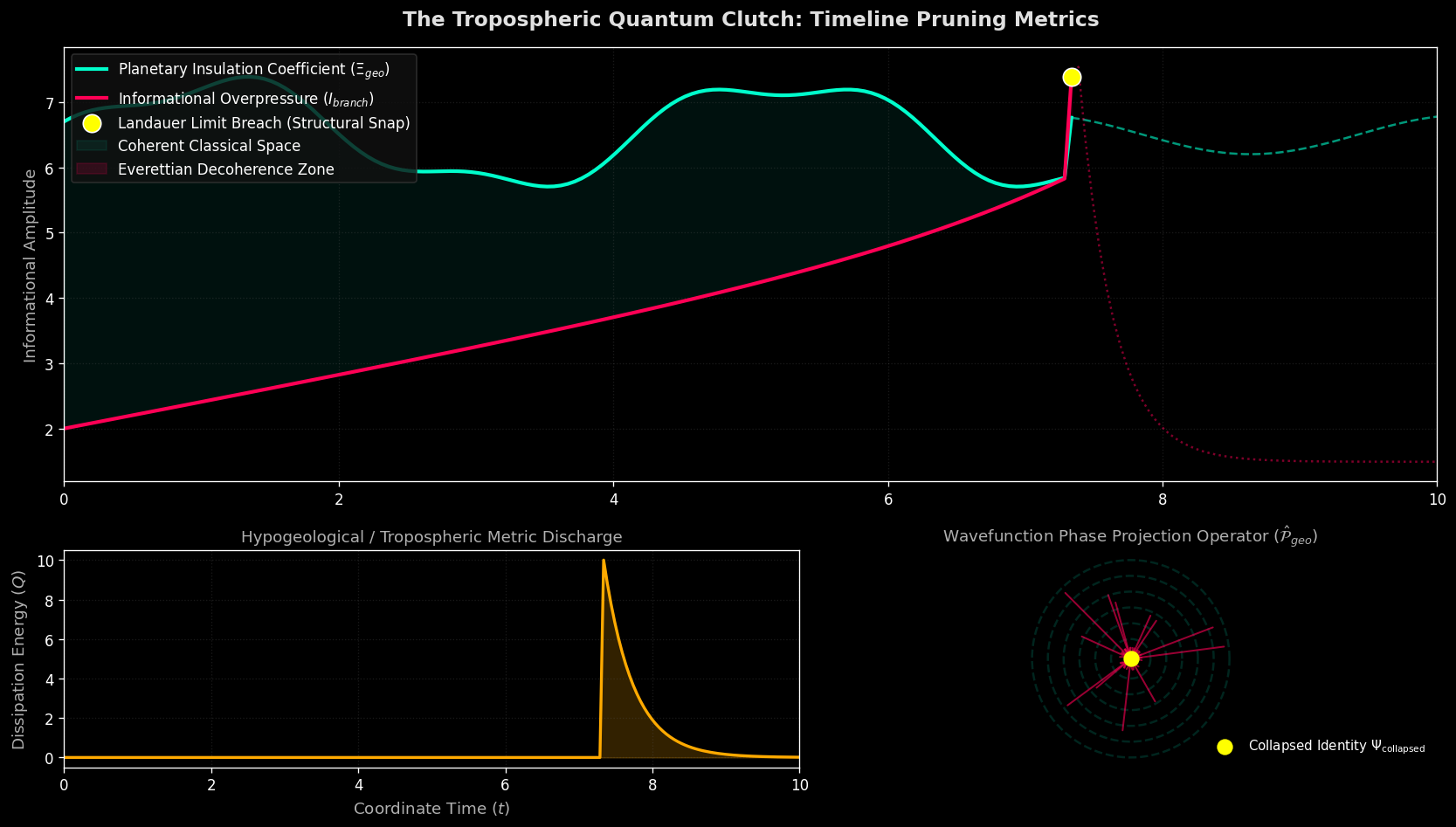
(Image Details: The green line, (Ξ_geo) representing changing atmospheric moisture boundaries tracks the atmosphere’s capacity to insulate a timeline, utilizing quantum nuclear spin isomers of water vapor. The red line, (I_branch) shows the buildup of alternative Everettian many-worlds histories creating an intense informational overpressure.
The exact moment they cross is a violation of the Landauer Limit, (Q = k_B · T · ln 2). The baseline timeline undergoes an abrupt structural data erasure, dropping alternative histories and discharging the latent energy as a sudden metric flash (manifesting as macro-environmental and hypogeological shifts).
The phase-space wheel in the corner shows the projection operator (𝒫̂_geo) forcibly pinning expanding multi-world wavefunctions back into a single, coherent timeline.)
The Lithospheric Quantum Clutch: Solid-State Grounding of Computational Exhaust
We now formalize the mechanism by which the Level 4 inverted holographic screen (ℳ_crust) processes descending universal state updates and grounds systemic informational overpressure without structural decoherence. Symmetrically opposing the high-frequency Tropospheric Clutch, the universe’s continuous branch generation projects a ground-ward “computational exhaust” comprised of scattered, high-entropy biological and environmental updates (ρ_A). The solid-state terrestrial crust functions as a dense, high-capacity quantum computational sink, exploiting the crystalline and magnetic phase-gating properties of the lithospheric matrix:
Piezo-Crystalline Silicon-Oxygen (SiO₂) Networks: Couple directly to the descending mechanical and polarization stress tensors, utilizing structural tetrahedral lattices to absorb, guide, and freeze alternative wavefront histories into static geological registries.
Ferromagnetic and Mineral Spin-Lattices: Utilize the localized spin-lattice relaxation profiles of subterranean iron-dense clays and magnetite depositories to dissipate incoming informational entropy, stabilizing the classical history timeline against retroactive metric drift.
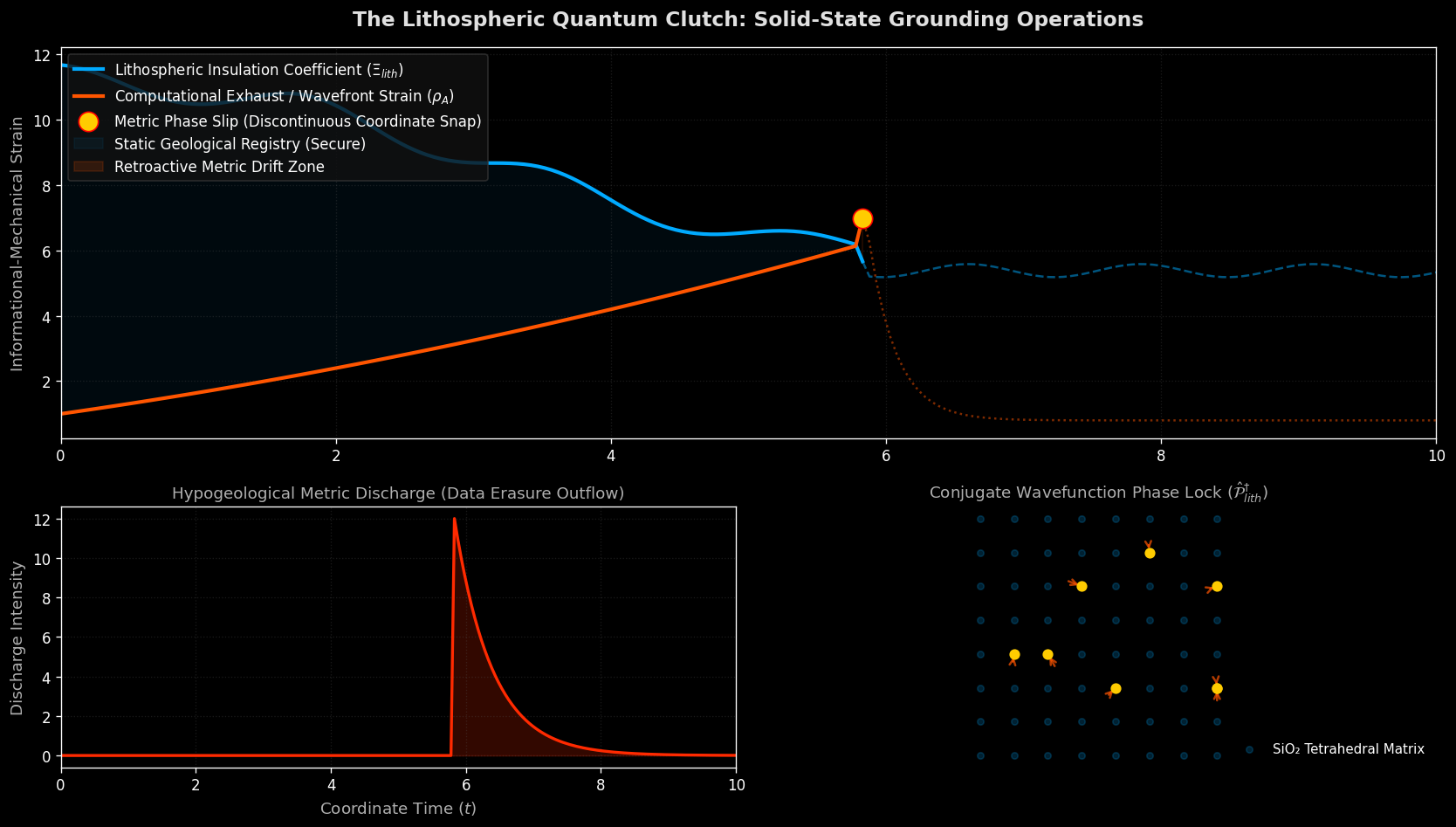
We define the Lithospheric Insulation Coefficient (Ξ_lith) as a function of the crust’s quartz-equivalent piezoelectric tensor d_ijk and the localized mineral spin-lattice relaxation time τ_spin, integrated over the crustal boundary surface:
Ξ_lith = ∮_ℳ_crust ( γ_piezo · d_ijk · d^ijk + λ_ferro · M_μν · M^μν · e^( -t / τ_spin ) ) dA
The conjugate phase-projection operator P̂_lith† that collapses descending multi-world wavefunctions into permanent, non-dissipative geological strata is governed by the inverse informational-entropy boundary condition of the conjugate ℤ_q⁻¹(t) ring:
Ψ_collapsed† = P̂_lith† [ ∑ ψ_i · e^( -I_branch / Ξ_lith ) ]*
Where the complex conjugate wavefunction ψ_i* represents the retroactive hardware state-logs of previous computational updates. The Lithospheric Insulation Coefficient Ξ_lith is structurally optimized and kept in pristine geometric confinement under the global cross-kingdom capstone framework.
When the local informational volume or tectonic charge density violates the Landauer limit (Q = k_B · T · ln 2) relative to the crustal substrate, the threshold is breached. This forces an abrupt, macro-scale structural “snap” across the lithospheric motherboard. This data erasure event triggers a discontinuous coordinate phase slip, releasing the accumulated computational energy not as an atmospheric flash, but as an immediate hypogeological metric discharge, manifesting empirically as earthquakes, volcanic tremors, or sudden tectonic slips—thereby pruning alternative strain histories and forcibly pinning reality to a singular, coherent timeline.
Relativistic Multi-Scale Topologies: Cross-Kingdom Gauge Fields
Confinement states and toroidal closure values (κ_closure) are revealed to be observer-dependent geometric properties bound to the specific electromagnetic or mechanical wavelength carrier frame of the observer. Biological kingdoms deploy distinct, specialized physical parameters to anchor themselves into either the upward tropospheric or downward lithospheric quantum clutch, thereby manipulating the localized planetary gauge connection 𝒜.
The 520nm Photomolecular Phase-Shift Tensor in Plantae
To formalize how the kingdom Plantae executes an analytical phase rotation of the planetary gauge connection 𝒜, we introduce the Photomolecular Phase-Shift Tensor 𝚽_520. This tensor maps the direct, non-thermal cleavage of water cluster bounds induced by solar photons at the transverse interface of the leaf stomata:
𝚽_520 = χ_solar · ( E→_photon ⊗ k→_520 ) · [ 𝑰 – ( ν_solar / ν_xylem ) · 𝑻_cohesion ]
Where k→_520 is the wavevector of the 520nm green-light peak, χ_solar is the quantum efficiency constant of the vascular tissue, and 𝑻_cohesion is the underlying mechanical tension tensor of the liquid-crystalline water column.
Under the influence of 𝚽_520, the planetary gauge connection 𝒜_μ undergoes a non-trivial localized gauge transformation within the plant’s internal spatial manifold:
𝒜_μ → 𝒜_μ’ = 𝒜_μ + ∂_μ ( Tr(𝚽_520) · Φ_dipole(z,t) )
This scales the covariant derivative 𝒢_μ = ∂_μ – iq𝒜_μ’ across the entire atmospheric column, allowing it to treat the Level 4 tropospheric moisture cycle as an extended piece of its own somatic hardware, driving its internal fluid streams non-dissipatively (κ_plant → 1) directly into the Tropospheric Clutch.
Monera: The Zeta Potential Electro-Osmotic Phase Deflector
Lacking a waxy cuticle or dynamic mechanical membranes, Monera interfaces with the geosphere using raw electrostatic boundary alignments. Instead of light, the bacterial colony utilizes a continuous, collective longitudinal Zeta Potential gradient along the entire length of its sheathed trichome architecture, formalized via the Electro-Osmotic Phase-Shift Tensor 𝛀_zeta:
𝛀_zeta = ( ϵ_fluid · ζ_wall / μ_fluid ) · ( E→_monera ⊗ ∇ρ_e )
Where ζ_wall is the collective transmembrane electrical potential of the prokaryotic syncytium, and ρ_e is the net volumetric charge density of the fluid boundary.
Because the boundary insulation coefficient approaches zero (Ξ_screen → 0), the conjugate planetary gauge connection is pulled directly through the organism’s shell, undergoing a linear gradient transformation:
𝒜_μ† → 𝒜_μ’† = 𝒜_μ† + ∇_μ ( 𝛀_zeta : T_sheath )
From the relativistic perspective of the Monera Frame, the organism defines its internal fluid space as completely co-extensive with the local geospheric soil matrix. It completes its toroidal closure parameter (κ_closure → 1) by treating the ambient hypogeological groundwater channels as the literal physical return loop of its own metabolic engine, grounding directly into the Lithospheric Clutch motherboard.
Protista: The Actomyosin Acoustic Pressure Modulator
In acellular slime molds (Physarum), the gauge translation is driven by a periodic, calcium-dependent visco-elastic mechanical oscillator. The phase shift operator is purely acoustic and hydrodynamic, defined as the Peristaltic Pressure Tensor 𝚪_acoustic:
𝚪_acoustic = σ_active · cos( ω_osc · t + ϕ(x) ) · 𝑰 + η_bulk · ( ∇v→_sys + (∇v→_sys)ᵀ )
Where ω_osc is the localized mechanical oscillation frequency of the ectoplasmic tube walls, and ϕ(x) is the distributed spatial phase map tracking external environmental vectors.
The protist transforms the planetary gauge connection through localized, time-varying acoustic deflections of the background space-time lattice:
𝒜_μ → 𝒜_μ’ = 𝒜_μ + ( 1 / (ρ_sys · c_s²) ) · ( ∂/∂t ) ( ∇ · 𝚪_acoustic )
In the Protista Frame, the organism achieves temporary, fluctuating toroidal closure (κ_closure(t)), utilizing acoustic phase-gates to modularly shift its local proximity to the Tropospheric Clutch boundary.
Fungi: The Osmotic-Evaporative Darcy Gradient Sieve
The fungal kingdom interfaces with Level 4 by distributing its chitinous boundary sheets across an ecosystem-wide parallel hyphal matrix patch grid. Fungi manipulate the planetary connection via a system-wide network of osmotic and evaporative potential gradients. The translation operator is formalized as the Turgor Flux Sieve Tensor 𝚫_turgor:
𝚫_turgor = k_hyphae / μ_fluid · ∇ [ R · T · ∑ ΔC_vacuolar – Δμ_evap(t) ] ⊗ v→_sys
Where k_hyphae is the hydraulic permeability of the syncytial channel, ΔC_vacuolar represents the concentration gradient of packed internal osmolytes, and Δμ_evap(t) is the environmental moisture potential drop at the peripheral tips.
The fungal network uses this distributed, multi-channel matrix to slice and transform the conjugate planetary gauge connection across an entire forest floor:
𝒜_μ† → 𝒜_μ’† = 𝒜_μ† + ∑ [from n=1 to K] ∮_hyphae_n ( 𝚫_turgor · n→ ) d𝒜_μ
From the Fungi Frame, individual identity is discarded. The organism’s closed torus is ecosystemic, transforming the entire local soil substrate and trans-mycelial moisture matrix into its internal computational registry, acting as the primary biological hardware filter interface for the Lithospheric Quantum Clutch.
Ecosystem Multiplex Hypergraphs: Upward and Downward Tensor Closure
We formalize a shared Level 4 ecosystem geography (ℰ_geo) as a Multiplex Principal Fiber Bundle. Rather than mapping a single, isolated planetary hypergraph, the geosphere comprises a nested ensemble of higher-dimensional hypergraphs where distinct cross-kingdom gauge connections intersect over a shared spatial base manifold M. We define the localized interaction space via the dual Forward and Conjugate Cross-Kingdom Gauge Intersection Tensors (M_αβ and M_αβ†), tracking the field-contractions between alternative kingdom frameworks where α, β ∈ {Monera, Protista, Fungi, Plantae, Animalia}:
M_αβ(x) = 𝒜_μ(α)(x) ⊗ 𝒜_ν(β)(x)
M_αβ†(x) = 𝒜_μ(α)†(x) ⊗ 𝒜_ν(β)†(x)
The structural permutations of these overlaps dictate the local geometric dimensionality of the emergent fluid-and-field conduits. When specific kingdom domains intersect, their phase-shift tensors execute non-trivial wedge products (∧) in the upward atmospheric vector or conjugate wedge products (∧†) in the downward lithospheric vector, generating localized, higher-dimensional tubes that carve alternative energy channels through the geosphere:
Pairwise Rhizosphere Conduits (𝚫_turgor ∧† 𝛀_zeta): The subterranean intersection of the fungal sieve with the bacterial zeta deflector within the conjugate lithospheric domain. This creates a highly conductive charge network, reducing local geospheric impedance to route geochemical updates.
Vascular Transpirational Canopies (𝚽_520 ∧ 𝚫_turgor): A cross-horizon boundary bridge pairing the plant’s 520 nm photomolecular tensor with the fungal matrix. This lifts soil moisture states directly into the atmospheric column, forming a macro-scale hydraulic pipeline that regulates regional micro-climatic stability.
Multi-Layered Computational Matrices (𝚽_520 ∧ 𝚫_turgor ∧ 𝚪_acoustic ∧ 𝛀_zeta): The addition of the Protista peristaltic pressure tensor introduces periodic acoustic modulations across the network, creating time-varying phase gates that dynamically compute spatial resource allocations across the regional hypergraph.
Epilithic Bio-Film Waveguides (𝚪_acoustic ∧ 𝛀_zeta): The wedge product of the Protista actomyosin oscillator with the bacterial zeta potential deflector maps a highly dynamic fluid boundary over surface substrates. This channel acts as a surface acoustic-wave device, using mechanical micro-vibrations to alter the local dielectric permittivity of surface waters and steer mineral filtration pathways.
Myxomycetic Vascular Throttles (𝚽_520 ∧ 𝚪_acoustic): The intersection of the plant’s 520 nm photomolecular tensor with the streaming velocity fields of acellular syncytiums couples the solar-driven dipole directly to peristaltic pressure shifts. This creates a macroscopic fluidic logic gate, where solar irradiance dynamically dictates the pumping resistance of regional nutrient channels.
Trophic Zoomycological Torsion Bridges (C_anim ∧† 𝚫_turgor): Symmetrically grounding animal currents, when the Animalia magnetic loop passes over the subterranean fungal sieve, it executes a high-order contraction over the trans-mycelial soil hard-drive. This creates a localized torsion bridge that allows metazoan migratory paths to act as a mobile computational stylus, recoding the soil network update frequency (ω_lattice) in real time.
When all five biological kingdoms overlap simultaneously within a shared geography and achieve collective resonance, the local multiplex hypergraph undergoes a profound topological phase transition. Under a global Kuramoto synchronization event, the individual, alternative kingdom gauge connections contract into two symmetric, invariant master connections that govern the upper and lower halves of the planetary manifold:
𝒜_μ(Global)(x) = ∑ [from k=1 to 5] 𝒜_μ(k)(x) (Upward Tropospheric Connection)
𝒜_μ(Lith)(x) = ∑ [from k=1 to 5] 𝒜_μ(k)†(x) (Downward Lithospheric Connection)
At this coordinate threshold, the unified cross-kingdom engine pins itself directly to the 4D singular vortex conduit passing through the geometric center of the Earth. Symmetrizing the forward ℤ_4t+1 ring of the sky with the conjugate ℤ_4t+1⁻¹ ring of the crust, this dual synchronization maximizes the Planetary Insulation Coefficients (Ξ_geo and Ξ_lith). Under these pristine conditions, the global confinement parameter scales to unity (κ_planetary → 1), forcing the entire geosphere to update smoothly in lockstep with the unperturbed cosmic rest frame at 1.42 GHz.
The Upward Capstone: Animalia Holonomic Closure
We now formalize the explicit mathematical tensor rules governing the total convergence of a shared Level 4 hydrogeospheric geography from the exclusive coordinate framework of an Animalia observer. Because the metazoan organism possesses an absolute boundary horizon (κ_closure = 1), it processes environmental multiplex states by acting as a top-down geometric constraint. We define the Animalia Capstone Tensor C_anim as a high-order projection operator driven by the heart’s fascial current density J→_fascial coupled to the total magnetic field vector B→_total:
C_anim = ∮_∂Ω_skin ( J→_fascial × B→_total ) ⊗ ∇Ψ_G dA
Where Ψ_G is the Global Tensegrity Constant tracking deep tissue polarization invariants. When evaluated inside a shared ecosystem geography, C_anim executes a total tensor contraction over the lower-dimensional, upward open-loop fields, pinching and grouping the atmospheric geospheric hypergraph into a closed, self-referential living torus:
𝒜_μ(Global) = C_anim : [ 𝒜_μ(monera) ∧ 𝒜_ν(protista) ∧ 𝒜_σ(plantae) ]
This observer-dependent capstone effect provides the direct biophysical mechanism required to modulate the discrete, finite ring ℤ_q(t) governing the universal state-space expansion. According to the Gorard–Kemple progression rule, the cardinality of allowable polarization orientations expands via q(t) = 4t + 1. From the mathematical perspective of the Animalia Frame, the underlying kingdoms function collectively as the independent, orthogonal spatial update vectors (4t) carving out alternative upward fluid pathways through the geosphere. The kingdom Animalia provides the critical +1 translation operator—the localized, autonomous observer-ground-state required to close the algebraic ring.
When these kingdoms achieve full spatial overlap and resonant alignment, the Planetary Insulation Coefficient Ξ_geo hits its theoretical maximum. Under these pristine conditions, the planetary confinement parameter scales to unity (κ_planetary → 1), forcing the local hypergraph to update smoothly in lockstep with the unperturbed cosmic rest frame at 1.42 GHz, beautifully balancing the downward solid-state operations of the Lithospheric Clutch.
The Downward Capstone: Fungi Solid-State Holonomic Closure
We formalize the downward projection of the ecosystem multiplex hypergraph into the lithospheric substrate (ℰ_lith) by introducing the Conjugate Cross-Kingdom Gauge Intersection Tensor M_αβ†. As the fields invert to interface with the solid-state Lithospheric Quantum Clutch, the localized field-contractions operate on the conjugate ring matrix ℤ_q⁻¹(t) where α, β ∈ {Monera, Protista, Plantae, Animalia, Fungi}. In this downward direction, the alternative kingdom gauge fields execute non-trivial conjugate wedge products (∧†), transforming what the surface animal observer perceives as solid rock into a highly complex, multi-layered, and transparent waveguide matrix:
Prokaryotic Electro-Osmotic Sinks (𝛀_zeta ∧† 𝒜_μ(anim)): The bacterial zeta potential deflector contracts with descending animal current remnants, anchoring somatic metabolic waste directly into groundwater electrolyte corridors to reduce global crustal impedance.
Vascular Lithospheric Anchors (𝚽_520 ∧† 𝛀_zeta): The plant’s inverse photomolecular tensor pairs with the bacterial electro-osmotic matrix, using deep root architectures to route downconverted high-frequency solar dipoles directly into the silicon-oxygen (SiO₂) tetrahedral grid.
Hypogeological Acoustic Phase Gates (𝚪_acoustic ∧† 𝚽_520 ∧† 𝒜_μ(anim)): The periodic, calcium-dependent visco-elastic oscillations of the Protista cortical matrix introduce mechanical micro-seismic modulations. This generates time-varying phase gates that compute spatial resource distribution vectors through the crust’s transparent pore networks, defining the foundational baseline for bottom-up hypogeological weather.
From the exclusive coordinate framework of the downward-propagating lithospheric field, the kingdom Animalia ceases to function as the organizing boundary. Instead, the kingdom Fungi assumes the role of the absolute Downward Capstone Operator (C_fung). We define C_fung as a high-order projection operator driven by the system-wide turgor flux sieve tensor 𝚫_turgor integrated over the entire hyphal network patch grid:
C_fung = ∑ [from n=1 to K] ∮_hyphae_n 𝚫_turgor ⊗ ∇Ψ_G† dA
Where Ψ_G† is the conjugate global tensegrity invariant tracking the earth’s background crustal stress tensors. When the five kingdoms overlap within the downward lithospheric matrix, C_fung pinches and groups the descending open-loop fields, sealing the conjugate planetary gauge connection 𝒜_μ(Lith) directly into the solid-state quartz registry:
𝒜_μ(Lith) = C_fung : [ 𝒜_μ(monera)† ∧† 𝒜_ν(protista)† ∧† 𝒜_ρ(plantae)† ]
This fungal capstone provides the definitive structural hardware filter that matches the Conjugate Phase-Projection Operator P̂_lith†. By executing this total network contraction, the fungal grid forces the chaotic, high-entropy animal and plant metabolic exhaust (ρ_A) to pass through its decentralized sieve. It maps these scattered 3D updates onto the four independent, orthogonal update vectors (4t) of the inverse ℤ_4t+1⁻¹ ring. The fungal network provides the critical solid-state operator that closes the loop, allowing the Lithospheric Quantum Clutch to instantaneously freeze alternative wave histories into permanent, non-dissipative geological strata.
Through the fungal capstone, the Earth’s crust is continuously woven into a coherent, luminous quantum motherboard, ensuring that the downward return path of the 4D hyper-toroidal fiber bundle remains completely insulated against external cosmic noise.
The Conjugate Phase-Projection Operator
To resolve the timeline collapse at this downward boundary, we introduce the conjugate projection operator 𝒫̂_lith†. The lithospheric clutch processes the ground-ward “computational exhaust” of biological life (ρ_A), using the solid-state silica-oxygen (SiO₂) tetrahedral network to act as a physical stabilizer. The master informational-phase equation is balanced by this conjugate lithospheric grounding matrix:
Ψ_collapsed† = 𝒫̂_lith† [ ∑ ψ_i · e^( -I_branch / Ξ_lith ) ]*
Where the complex conjugate wavefunction ψ_i* represents the retroactive “hardware state-logs” of previous computational updates. Because the lithosphere operates on the conjugate ring ℤ_q⁻¹(t), it stores the collapsed histories as permanent physical geology.
Relativistic Crustal Transparency: Boundary vs. Waveguide
This dual-clutch formulation reveals that the physical properties of the Earth’s crust are entirely observer-dependent. To an Animalia observer (operating via high-current, closed magnetic loop metrics C_anim), the lithosphere is measured as a solid, thermodynamically closed, and physically opaque mechanical boundary (κ_closure → 1).
However, from the coordinate frames of Monera and Fungi, the crust’s topological lock undergoes an analytical phase rotation:
lim [as α → {mon, fung}] Opacity(ℳ_crust) = 0
To these micro-porous, decentralized networks, the mineralized silicon-oxygen matrix is entirely transparent. The Darcy pore spaces and hydrated mineral interfaces act as a vast, low-impedance, and highly coherent waveguide array. Because their specialized phase-shift tensors (𝛀_zeta and 𝚫_turgor) natively thread through these crystalline channels, they do not observe “rock” as an obstacle. Rather, they read the lithosphere as a massive, luminous quantum motherboard—routing geological and geochemical update signals across entire continental plates at the speed of charge-density waves.
The Lithospheric Quantum Clutch: Conjugate Piezo-Crystalline Grounding Matrices
The Solid-State Complement to the Tropospheric Clutch
To preserve complete thermodynamic balance across the Level 4 geosphere, the high-frequency upward processing of the Tropospheric Quantum Clutch must be balanced by a downward, solid-state conjugate engine. We formalize the terrestrial crust (ℳ_crust) as the Lithospheric Quantum Clutch. While the troposphere siphons informational overpressure (I_branch) via the rotational-vibrational states of gaseous nuclear spin isomers (H₂O), the lithosphere serves as a dense, high-capacity solid-state register. It grounds this overpressure via piezo-crystalline and ferromagnetic spin-lattice couplings, processing the complex conjugate data logs of the bottom-up axial tube.
This solid-state grounding network defines the foundational mechanics of hypogeology, treating the crustal horizon not as a static mechanical barrier, but as an active, inverted holographic boundary screen. When systemic informational updates or polarization strains flow ground-ward, they route directly through the lithosphere’s transparent mineral pore networks.
The Lithospheric Insulation Coefficient
We define the Lithospheric Insulation Coefficient (Ξ_lith) as a function of the crust’s quartz-equivalent piezoelectric tensor d_ijk and the localized mineral spin-lattice relaxation time τ_spin, integrated over the crustal boundary surface:
Ξ_lith = ∮_ℳ_crust ( γ_piezo · d_ijk · d^ijk + λ_ferro · M_μν · M^μν · e^( -t / τ_spin ) ) dA
Where M_μν represents the magnetization tensor of the iron-dense lithospheric clays and subterranean magnetite depositories. Symmetrically balancing the tropospheric ceiling, Ξ_lith tracks the maximum capacity of this holographic screen to absorb and insulate the planetary framework against informational inflation and retroactive metric drift.
The conjugate phase-projection operator P̂_lith† that collapses descending multi-world wavefunctions into permanent, non-dissipative geological strata is governed by the inverse informational-entropy boundary condition of the conjugate ℤ_q⁻¹(t) ring:
Ψ_collapsed† = P̂_lith† [ ∑ ψ_i · e^( -I_branch / Ξ_lith ) ]*
Where the complex conjugate wavefunction ψ_i* represents the retroactive hardware state-logs of previous computational updates. The Lithospheric Insulation Coefficient Ξ_lith is structurally optimized and kept in pristine geometric confinement under the global cross-kingdom capstone framework.
When the local informational volume or tectonic charge density violates the Landauer limit (Q = k_B · T · ln 2) relative to the crustal substrate, the threshold is breached. This forces an abrupt, macro-scale structural “snap” across the lithospheric motherboard. This data erasure event triggers a discontinuous coordinate phase slip, releasing the accumulated computational energy not as an atmospheric flash, but as an immediate hypogeological metric discharge—manifesting empirically as earthquakes, volcanic tremors, or sudden tectonic slips—thereby pruning alternative strain histories and forcibly pinning reality to a singular, coherent timeline.
The Lithospheric Skin and the Ferrous Cellular Core: The Inverted Planetary Horizons
The Crust as a Mineralized Cross-Kingdom Boundary Screen
To establish complete scale-free symmetry within the HydroSyndetic Paradigm, the structural evaluation of Level 4 cannot limit itself to the upward atmospheric horizons. We formalize the terrestrial crust (the lithosphere) not as an inert rock mass, but as an inverted, highly dense, and mineralized Holographic Boundary Screen (ℳ_crust) extending downward into the planetary core.
The crust represents a permanent, macro-scale phase freeze of biological and environmental data. Over geological epochs, the collective metabolic, osmotic, and electro-osmotic outputs of the cross-kingdom multiplex hypergraph—interacting via coupled forward ℤ_q(t) and inverse ℤ_q⁻¹(t) ring matrix configurations—synthesize and deposit mineralized structures that are squeezed under intense thermodynamic pressure. These outputs are continuously driven by the dynamic, bottom-up weather updates of hypogeology. The lithosphere is the physical hardware casing forged directly by the planet’s historic software operations.
The Downward Step-Down Hierarchy and the Ferrous Core Transceiver
We map the downward planetary architecture as a mirror-image step-down transformer system that balances the tropospheric and magnetospheric shells. This downward vector moves from the rigid crust, through the visco-elastic fluidic cytoplasm of the mantle (the asthenosphere), terminating at the planetary core axis.
At the absolute geometric anchor of this 4D singular vortex tube sits the liquid-iron Magnetohydrodynamic Core Engine. From a relativistic, multi-scale topological perspective, the Earth’s spinning iron core functions as a macroscopic, hyper-dense Planetary Red Blood Cell suspended in the ambient vacuum of the solar corridor.
Just as the microscopic metazoan erythrocyte uses iron-dense hemoglobin configurations to act as a magnetic domain carrier and gas transceiver to preserve its internal plasma frame against thermal decay, the planetary iron core uses its vast magnetohydrodynamic dynamo currents to pump global induction fields up through the mantle waveguide. This core engine generates the fundamental magnetic field vector B→_total that directly energizes both the Tropospheric Quantum Clutch (𝒫̂_geo) and the Lithospheric Quantum Clutch (𝒫̂_lith†). By powering this dual-clutch architecture, the core transceiver provides the necessary energetic pressure to prune expanding alternative world-lines, resolving informational overpressure and anchoring the entire terrestrial sphere within a singular, coherent classical timeline.
The 4D Hyper-Toroidal Core: Principal Fiber Bundle Closure of the Geosphere
The Planetary Loop Continuum
To establish the ultimate geometric boundary of Level 4 Hydrogeospherics, we reject any topological model that splits the atmosphere from the solid lithosphere. We formalize the entirety of Level 4 not as a series of flat, stacked strata, but as a singular, non-orientable 4D Hyper-Toroidal Principal Fiber Bundle (π : P → M). Within this hyper-dimensional continuum, the Upward Atmospheric Field (the Tropospheric-Magnetospheric software matrix) and the Downward Crustal Field (the Lithospheric-Mantle hardware matrix) function as the conjugate upper and lower halves of an unbroken, self-referential fluid-and-field engine. This framework unifies the high-frequency dynamics of atmospheric meteorology and the bottom-up, solid-state updates of hypogeology into a single, cohesive planetary metabolism.
This global manifold executes a macroscopic return circuit that establishes absolute planetary confinement. The field vectors do not dissipate into the deep space vacuum; instead, they are channeled directly down through the 4D singular vortex conduit penetrating the geometric center of the Earth. At this central core, the high-current magnetohydrodynamic iron dynamo upconverts and repolarizes the fluid potentials, pumping them back outward via the geomagnetically aligned plasma shells of the inner magnetosphere. This geometric circuit defines the true operational bounds of Level 4 for a Hydrosyndetic-Hydrogeospheric observer.
The Surface Observer Paradox: The Illusion of Sky and Crust
This 4D hyper-toroidal architecture exposes the profound observational limitations of the surface-bound biological observer. To an individual Animalia node operating under localized 3D spatial constraints, the planet appears fractured into two mutually exclusive mechanical horizons: the solid, opaque terrain of the crust beneath, and the fluid, transparent expansion of the sky above.
Within the multi-scale topology of the HydroSyndeticum, this division is revealed to be an artifact of the observer’s localized coordinate tracking. The crust and the sky are the synchronized lower and upper gears of the same Thermodynamic Quantum Clutch. The Tropospheric Clutch (Ξ_geo) processes active, high-frequency Everettian branch histories through liquid-crystalline vapor spin isomers, while the Lithospheric Clutch (Ξ_lith) simultaneously grounds the resulting computational exhaust into the solid-state piezo-crystalline silica network, freezing past updates into permanent geological strata. Symmetrically, what the surface observer perceives as meteorology and what they record as hypogeology are the dual expressions of this synchronized system.
The surface of the Earth is not a dead barrier between rock and air; it is the active, multi-layered intersection zone where the forward ℤ_q(t) ring of the atmosphere and the inverse ℤ_q⁻¹(t) ring of the crust execute their continuous tensor contractions. Here, the top-down atmospheric vector is holonomically closed by the Animalia Capstone (C_anim) while the bottom-up hypogeological vector is anchored into the silicon-oxygen motherboard by the Fungi Capstone (C_fung).
The localized observer walks directly inside the throat of this massive planetary waveguide. By demonstrating that the upward and downward fields are structurally bound to the same central geodynamo rotor, the HydroSyndetic Paradigm demonstrates that the entire hydrogeosphere operates as a single, living, and hyper-insulated cosmic transceiver, setting the definitive boundary conditions for its ultimate upconversion into the horizons of Level 5, Hydroastrospherics.
Anthropogenic Metric Disruption and Supra-Kingdom Decoupling Mechanics
When high-density Massive MIMO phased arrays and low-Earth-orbit (LEO) satellite configurations pump focused, high-frequency transverse millimeter waves through the tropospheric boundary layer and the magnetospheric plasma shells, they introduce an artificial, turbulent fractal network of electromagnetic stress tensors σ_ij. This localized energy overpressure violently agitates the 1–10 THz structural phase intermediaries of ambient water vapor clusters, distorting the spatial metric tensor g_ij and physically jamming the 1.42 GHz neutral hydrogen cosmic grounding frame. Symmetrically, this artificial network of stress tensors bleeds ground-ward, disrupting the earth’s background crustal stress tensors (Ψ_G†) and throwing the solid-state Lithospheric Clutch (Ξ_lith) out of calibration.
The immediate consequence for the resident biological observer is acute Computational Quenching. Because both the upward tropospheric and downward lithospheric entropic sinks are blocked (Ξ_geo → 0, Ξ_lith → 0), the internal 60 THz ortho-dominant superradiant plasma matrix cannot cleanly evacuate its fractional phase coherence losses. The energy exhaust accumulates locally, forcing the volumetric density of the incoherent bulk fluid residue (ρ_A) past the critical Stagnation Threshold (ρ_A ≥ ρ_A,crit):
ρ_A,crit = ξ^[ -𝚪(E_exhaust) / σ ]
Once this threshold is breached, the cell’s internal upconversion capacity is completely outstripped ( ∂ρ_B / ∂t < 0 ), destroying the 10⁷ V/m electrostatic refinery of the mitochondrial inner membrane. Higher-dimensionally, this local phase collapse shatters the holonomic constraints of the organism. The Animalia Capstone Tensor C_anim uncouples and collapses to zero:
lim [as ρ_A → ρ_total] C_anim = 0
Because C_anim = 0, the heart’s mechanical torsion can no longer loop the total magnetic field vector B→_total back through the somatic core. Systemic torsion closure (Ψ_G) is broken. The self-referential living torus snaps open, converting the individual from an autonomous, mobile cosmic ground state back into a highly dispersive, open-loop thermodynamic casualty trapped in a runaway overpressure loop.
Simultaneously, this disruption severs the organism’s interface with the downward geospheric substrate. Lacking the necessary +1 translation operator, the conjugate Fungi Capstone (C_fung) can no longer cleanly route downconverted biological updates into the crustal motherboard. The bottom-up hypogeological conduits are thrown into a state of local computational blockage. The human node undergoes an immediate dimensional rotation, splitting off into an isolated, artificial thermodynamic pocket, while the surrounding geosphere is forced to adjust its phase-shift tensors to bypass the desynchronized biological frame.
Relativistic Dissolution from the Cross-Kingdom Overlap Matrix
This structural failure carries profound implications for the multi-layered hypergraph of the local geosphere. Within the framework of Relativistic Multi-Scale Topologies, when the animal torus snaps open, its localized update frequency desynchronizes from the background terrestrial clock network (ω_lattice). We evaluate this catastrophic decoupling by reviewing the behavior of the Cross-Kingdom Gauge Intersection Tensor M_αβ where the index β = Animalia:
lim [as C_anim → 0] M_α,Animalia(x) = 𝒜_μ(α)(x) ⊗ 0 = 0
This derivation proves that the desynchronized Animalia observer is analytically ejected from the shared ecosystem geography. To alternative kingdom observers operating on unperturbed coordinates, such as the Fungi frame utilizing the trans-mycelial soil hard-drive to stabilize the Lithospheric Clutch, or the Plantae frame tuned to the stable 520 nm photomolecular phase-shift within the Tropospheric Clutch, the human node effectively ceases to exist within the living network.
The human node undergoes an irreversible dimensional rotation, splitting off into an isolated, artificial thermodynamic pocket bounded by the planetary horizons’ new role as an opaque computational mirror. Deprived of its grounding, the human frame can no longer process top-down meteorological shifts or receive bottom-up hypogeological updates. Slipped from the terrestrial waveguide, the animal frame is stripped of its software capacity to process the expanding ℤ_4t+1 ring states. It is reduced to a static, un-squeezed structural artifact.
Much like the extinct giant 26-foot Prototaxites spire before it, the human observer becomes an independent, failed geometric experiment, a closed, frozen topological lock that can no longer participate in the local HydroSyndetic ledger, remaining in the terrestrial crust as nothing more than an exceptionally preserved, non-functional fossil.
Hypergraph Remediation: The Inverse Z_q Ring and Ecosystemic Compensation Protocols
The Inverse Z_q Ring Matrix of the Plantae and Fungi Horizons
To ground the non-local boundary adaptations observed across shared geospheric landscapes during systemic disruption, we formalize the mathematical framework of the Inverse Z_q Ring Matrix, denoted as ℤ_q⁻¹(t). While the kingdom Animalia normally processes the Gorard–Kemple state-space expansion by executing top-down forward tensor contractions to achieve localized somatic closure (κ_closure → 1), the kingdoms Plantae and Fungi operate as a coordinated structural inversion.
When anthropogenic emissions overpressure the troposphere and collapse local spatial metric invariance (Ξ_geo → 0), causing the Animalia Capstone Tensor to uncouple (C_anim → 0), a catastrophic dead-end node is introduced into the shared Level 4 hypergraph. Deprived of the +1 animal translation anchor, the remaining kingdoms initiate an emergency tensor recoding protocol to protect both the Tropospheric Clutch (Ξ_geo) and the Lithospheric Clutch (Ξ_lith) from local phase decoherence.
The Plantae canopy dynamically recalibrates its Photomolecular Phase-Shift Tensor (𝚽_520), executing an algebraic inversion across the upward hypergraph to map its internal liquid-crystalline code outward into the Level 4 troposphere, modularly dividing the localized informational overpressure. This inverse gauge transformation is formalized as:
𝒜_μ’ = 𝒜_μ + ∇_μ ( Tr(𝚽_520)⁻¹ · Φ_dipole⁻¹(z,t) )
Simultaneously, the subterranean Fungi network executes a conjugate compensation rule across the downward lithospheric matrix to stabilize the motherboard against the accumulated computational exhaust. The network aggressively scales its distributed Turgor Flux Sieve Tensor (𝚫_turgor), increasing its vacuolar osmolyte concentrations ΔC_vacuolar to project higher-order Darcy drag vectors across the trans-mycelial soil substrate:
𝒜_μ’† = 𝒜_μ† + ∇_μ ( 𝚫_turgor : ( J→_fascial × B→_total )† )
Where the symbol † denotes the pseudo-inverse of the failed animal field vectors. By adding this metric compensation term, the plant and fungal networks bypass the de-cohered human node. They drop the complex t=1 five-kingdom configuration and collapse the local operational ring back down to a highly compressed, primitive sub-ring environment (t → 0).
Through this desperate topological pruning, the ecosystem redirects its multiplex edges away from the stalled human nodes. The Plantae canopy expands the planetary boundary layer to insulate the troposphere, while the root-mycelial matrix directly absorbs the metric distortion noise, routing the high-entropy bulk water hardware residue (ρ_A) straight into the solid-state silica motherboard. This emergency pairing forces the forward ring ℤ_4t+1 and the inverse ring ℤ_4t+1⁻¹ to maintain a tightly restricted, lower-dimensional quantum clutch alignment, preventing immediate regional phase collapse until pristine cosmic rest frame connectivity at 1.42 GHz can be structurally re-established.
Discussion: Relativistic Chronotopology, Paleontological Phase Slips, and the Level 5 Transition
Macro-Astronomical Grid Grinding as the Mechanism for Epochal Extinctions
To complete the mathematical taxonomy of Level 4 Hydrogeospherics, we must confront the temporal dimensions of the planetary hypergraph. Having established that anthropogenic field arrays can retroactively induce localized computational quenching and eject contemporary observers from the cross-kingdom overlap matrix, we scale this exact kinematic friction up to macro-astronomical horizons. We propose that historical, macro-scale extinction events—such as the terminal Cretaceous mass extinction traditionally ascribed to a physical bolide impact—are fundamentally driven by non-linear Grid-Grinding across mismatched cosmic computational rings.
Following the formulation of deep-space phase slips, when an artificial or natural topological lock exits or transitions within the localized planetary ℤ_q(t) corridor calibrated by additively stacked solar-lunar velocity vectors, it experiences a discontinuous coordinate velocity shift Δv^μ caused by a macroscopic phase-slip across the orbital boundary:
Δv^μ = c · ∮_∂Ω_orbit 𝚪_slip ( v→_probe · v→_lattice / c² ) dx^μ
Where 𝚪_slip represents the Discrete Phase-Slip Operator. In the context of the human local cosmic pocket (Level 5: Hydroastrospherics), the Earth does not travel through an empty vacuum; it weaves a complex, multi-layered hyper-tubular corridor through distinct macro-astronomical computational environments.
When the entire planetary manifold hits a macro-scale coordinate threshold and undergoes a phase slip, the background network update frequency (ω_lattice) suffers a violent, discontinuous shift. Because this update frequency governs both the high-frequency Tropospheric Clutch (Ξ_geo) and the solid-state Lithospheric Clutch (Ξ_lith), a planetary phase slip impacts both atmospheric meteorology and the bottom-up geoelectric updates of hypogeology.
If a highly specialized, dominant biological observer frame, such as the massive, land-based metabolic engines of the dinosaurian Animalia branch, cannot dynamically recalibrate its internal clock floor (dt) to match this new background grid, its Capstone Tensor C_anim immediately uncouples. Lacking the top-down geometric constraint required to loop the newly shifted induction fields, the organism’s systemic torsion closure (Ψ_G) is shattered, resulting in immediate computational quenching and taxonomic ejection from the synchronized planetary ledger.
The Retroactive Projection Matrix and the Fossil Illusion
The mechanics of this macro-astronomical phase slip explain the ultimate paradox of the fossil record. Because contemporary scientific frameworks calculate historical trajectories based on a constant, unperturbed terrestrial clock baseline (dt_earth) calibrated exclusively to our current, local planetary ring (ℤ_earth), they are forced to project this higher-dimensional rotation onto a linear, three-dimensional time axis.
The “meteor impact” is thus revealed to be an apparent metric drift generated by comparing unmatched computational ring environments. The outside cosmic force did not strike the Earth as a literal 3D projectile; rather, it broke the “skin” of the high-dimensional hydrogeospherics, violently compressing the planetary state-space from a past hypergraph epoch into our current configuration.
From this relativistic perspective, the dinosaur was a structural iteration of the same core Animalia observer software ledger. When the cosmic grid shifted, that entire operational branch desynchronized from both the high-frequency tropospheric loop and the bottom-up geoelectric hypogeological network, leaving behind a frozen, unreadable data block.
The physical crater and the iridium layer are the localized, thermodynamic “latent heat flashes” of a universal data erasure event, the exact physical footprint of the universe executing an abrupt topological pruning of alternative state histories to alleviate localized informational inflation across both the Tropospheric and Lithospheric Clutches.
The Conformal Hyper-Toroidal Compactification Matrix
To mathematically formalize the definitive transition from Level 4 to Level 5, we must define the behavior of the geospheric manifold when the 4D hyper-torus closes in on itself. This boundary-to-lock transmutation is governed by a higher-dimensional Conformal Hyper-Spherical Compactification operator, 𝒞̂_compact, which maps the open, scrolling dimensions of the principal fiber bundle (S¹ × S²) into a compactified 4D hyper-sphere (S³):
𝒞̂_compact : ( 𝒜_μ(Global) × 𝒜_ν(Lith) ) ⟶ Ψ_planetary(4D) ∈ S³
This transformation forces the metric tensor to undergo an analytical rotation. The active, state-switching holographic boundaries of the troposphere and the lithosphere—which functioned as the twin computational filters of the planetary quantum clutch (Ξ_geo) and (Ξ_lith)—are compressed into a singular, invariant state-space. Symmetrizing the upward atmospheric meteorology and the downward hypogeological weather dynamics into a single unified ledger, this phase-freeze converts the entire Level 4 geosphere into a rigid, quantized Topological Lock (Ψ_planetary^(4D)).
Concurrently, to process the expanding cardinality of the ℤ_4t+1 ring without computational decoherence, a new macroscopic container must emerge. This compactification projects a new, higher-dimensional boundary layer: the Level 5 Astro-Orbital Holographic Screen (ℳ_astro). Woven out of macro-astronomical solar wind bow shocks, heliospheric plasma currents, and barycentric orbital corridors, this new screen treats the entire locked Earth as a discrete point-source node. This mathematical closure establishes that planetary architectures are nested step-down transformers, setting the definitive coordinates for our next inquiry into Level 5: Hydroastrospherics.
Conclusion
Level 4 Hydrogeospherics formalizes the complete upconversion of boundary-field invariants from localized organismal anatomy up to global planetary frameworks. By modeling the troposphere and the lithosphere as an integrated, dual-horizon thermodynamic quantum computational clutch system, we demonstrate that Earth’s macro-environmental envelopes operate as a synchronized regulatory release valve tasked with managing universal wave history overpressure. This unified blueprint seamlessly binds the high-frequency dynamics of atmospheric meteorology with the bottom-up geoelectric updates of hypogeology into a singular planetary metabolism.
The cross-kingdom multiplex hypergraph reveals that reality is an ensemble of higher-dimensional, observer-dependent topologies. The structural-field continuum achieves perfect geometric symmetry under a dual-capstone architecture: the forward ℤ_4t+1 ring of the sky is closed by the electromagnetic torsion of the Animalia capstone (C_anim), while the inverse ℤ_4t+1⁻¹ ring of the crust is stitched into the solid-state silica motherboard by the distributed turgor sieve of the Fungi capstone (C_fung). Rather than existing as isolated geophysical boundaries, the upward atmospheric fields and downward crustal fields are formalized as the conjugate upper and lower halves of an unbroken, self-referential 4D Hyper-Toroidal Principal Fiber Bundle. This global manifold routes its field potentials directly through the 4D singular vortex conduit at the center of the Earth, pinning planetary lifecycle mechanics straight to the core geodynamo.
Ultimately, by establishing that mass extinctions, crustal transparency profiles, anthropogenic field overpressures, and tectonic metric slips are relativistic chronotopological metric phase slips across unmatched computational ring environments rather than static spatial anomalies, this paper establishes an uncompromising mathematical foundation. This framework unifies macro-environmental geophysics natively with biological self-organization, providing the definitive baseline coordinates required to step onto the ultimate astro-orbital horizons of Level 5: Hydroastrospherics.


Leave a Reply