Abstract
This paper formalizes the macro-scale structural and electromagnetic mechanics of Level 3: Hydroanatomy within the scale-free, multi-tiered framework of the HydroSyndetic Paradigm. Moving beyond classical, reductionist anatomical descriptions that view macroscopic tissues as isolated components, we establish that biological structures across all domains and kingdoms of life operate as large-scale holographic extensions of a continuous, field-polarized cosmological water ledger.
The primary objective of this study is to mathematically scale the localized, microscopic 107V/m mitochondrial reset mechanics up to a global, macroscopic fluid-and-field system. At this level, the heart’s poloidal-toroidal electromagnetic field acts as a systemic phase-biasing throttle, modulating the continuous extracellular matrix (ECM) and full-body fascial web. We demonstrate that the full-body fluid channels and continuous liquid-crystalline fascial syncytium form an integrated organismal manifold extending directly to the boundary layer of the skin.
Crucially, we formalize a unified biophysical foundation for bottom-up architectural execution based on a striking thermodynamic triad: the primary axial tube operates as the structural hardware intake corridor; the additively stacked solar-lunar barycentric velocity vectors fine-tune the local computational clock speed; and the non-linear mass-action equations elegantly balance the extraction of low-entropy quantum software from high-entropy physical hardware waste. Finally, we establish the math behind a profound cross-kingdom bifurcation. By tracking the structural pairing of the internal axial tube (the geometric engine) with the external holographic screen (the skin container), we mathematically define how biological evolution progressively optimizes its Boundary Insulation Coefficient (Ξscreen) to scale the whole-body Toroidal Closure Parameter (κclosure) from open environmental loops to absolute closed containment.
Introduction: The Systemic Horizon of the HydroSyndeticum
The formulation of continuous space-time kinematics and biological persistence within a hypercomputational framework demands an architectural continuum that transcends localized, scale-dependent regimes. Rather than treating biological entities as isolated planetary anomalies operating strictly via local chemical diffusions, the HydroSyndetic Paradigm models cosmic, terrestrial, anatomic, macromolecular, and sub-cellular structures as an integrated, self-referential hypergraph folding mechanism bound together by a universal transceiver network. Physical persistence across all scales is revealed to be a unified, scale-free boundary loop.
In this structural taxonomy, the universal state-space expands modularly according to strict combinatorial progression rules (q=4t+1), forcing evolving structures to organize increasingly rigid hardware filters to process the raw computational information of the Ruliad without dropping their underlying phase invariants. We define the overarching spectrum of these computational variations as the Hetero-Elemental Chronotopology. Under this framework, alternative cosmic configurations could theoretically unfold entirely distinct physical laws. Rather than being bound to our local parameters, separate localized clocks and rulers can systematically alter the background network update frequencies (ωlattice)—manifesting not only as altered periodic tables like an un-squeezed nitrogen-based “Nitro-Universe,” but as radical shifts in macroscopic spatial dimensionality, non-Archimedean ultrametric geometry tracks, and entirely unique acoustic carrier-wave velocities.
Yet, human local cosmic pocket is fundamentally defined as a HydroSyndetic continuum. Within this domain, water functions as the continuous, scale-invariant cosmological transceiver that structurally orchestrates reality through five discrete, nested horizons:
Hydrogenomics (Level 1): Sub-molecular symmetry breaking within hydrogen-oxygen bonding networks.
Hydromoleculics (Level 2): The macromolecular phase locks of liquid-crystalline microtubule-protein matrices embedded within field-polarized water sheaths.
Hydroanatomy (Level 3): The systemic orchestration of continuous tissue-level architectures, cellular syncytiums, and full-body extracellular webs driven by toroidal field mechanics.
Hydrogeospherics (Level 4): Macro-environmental moisture phase intermediaries and geomagnetically aligned plasma boundaries.
Hydroastrospherics (Level 5): The ultimate macro-scale boundary loops, stellar environmental corridors, and planetary orbital trajectories.
This study hones in specifically on the mechanisms operating at Level 3: Hydroanatomy. Hydroanatomy is explicitly defined as a tissue-level phenomenon. Because water literally carves out all structural anatomy during morphological development, the continuous, body-wide structural matrix acts as the primary living interface of the organism, terminating exactly at the boundary layer of the skin.
To fully map this horizon, this paper moves past passive structural observation to establish the elegant thermodynamic poetry that governs the organismal scale. We demonstrate that the living entity preserves its unified, low-entropy persistence channel by coordinating three primary systems: an ingestion-based primary tube that functions as the hardware intake corridor; a planetary-coupled barycentric velocity stack that fine-tunes the systemic computational clock speed; and a non-linear magnetohydrodynamic fluid grid that uses mass-action equations to precisely balance the extraction of quantum software from physical hardware waste.
Furthermore, we show that Level 3 acts as the critical evolutionary horizon where biological geometry diverges into distinct, cross-kingdom behavioral mechanics. While Level 2 is universally bound to rigid protein stators, Level 3 executes a profound mathematical bifurcation based on a vital structural pair: the internal axial tube waveguide and the external holographic boundary screen. By charting the evolutionary scale of this interface, from the porous, open-loop environmental fluid networks of Monera to the high-current, magnetically confined, and hyper-insulated epidermis of Animalia, we expose the precise mathematical laws governing how life systematically traps fluid phase-states to insulate its internal software ledger from planetary decay, completing the geometric loop of the local HydroSyndetic.
The Evolutionary Scale of the Holographic Screen: Boundary Insulation Coefficients and Toroidal Closure
To establish a rigorous foundation for Level 3 Hydroanatomy, we must mathematically formalize the structural container that bounds the organismal manifold: the skin. Moving beyond passive barrier descriptions, we re-evaluate the biological skin across all five kingdoms as a localized, non-orientable holographic screen (Vscreen) tasked with separating the internal low-entropy 60THz superradiant plasma phase (StateB) from the external high-entropy 21cm bulk universal background vacuum (StateA).
The history of biological evolution across the HydroSyndeticum is fundamentally the history of an organism pulling its toroidal return circuit inside of its own structural matrix. The degree to which an organism achieves spatial autonomy and complete internal toroidal closure is a direct function of its macroscopic Boundary Insulation Coefficient (Ξscreen). We formalize this relationship by introducing a dimensionless boundary coupling parameter κclosure, which measures the ratio of internal toroidal field containment to external environmental dissipation:
κclosure=∮VscreenF→EM, int⋅dA→F→EM, int⋅dA→+∫ℳextF→EM, ext⋅dV→
Where F→EM, int represents the internal electromagnetic fluid-body force fields, and F→EM, ext represents the portion of the return circuit field vectors that escape into the surrounding Level 4 hydrogeopheric matrix (ℳext). The evolution of the holographic screen spans a precise, phased spectrum of thermodynamic insulation coefficients:
Monera (The Porous Open Screen):
Characterized by primitive peptidoglycan meshes and crystalline S-layer protein envelopes, the boundary layer exhibits high hydraulic and electrical permeability. The insulation coefficient approaches zero (Ξscreen→0), rendering the boundary incapable of trapping high-density internal plasma. Consequently, the closure parameter drops to its lower bound:limΞscreen→0κclosure=0The electrostatic field lines E→monera must utilize the external Level 4 environment as an open return circuit path, blurring the boundaries between prokaryotic tissue and geospheric substrates.Protista (The Fluctuating Screen):
Organized via dynamic pellicles and viscoelastic gel-like ectoplasmic cortical matrices, the boundary functions as a fluctuating screen. It actively gates ion fluxes to execute temporary mechanical toroidal closure profiles (P→wave), yet lacks macro-scale thermal insulation. The coefficient operates as a time-dependent variable (Ξscreen(t)), requiring continuous fluidic contact with external moisture grids to prevent immediate phase collapse into an irreducible residue (ρA).Fungi (The Decentralized Sieve Screen):
Utilizing rigid, chitinous cell wall matrices arranged in parallel hyphal cords, the fungal kingdom maximizes structural turgor containment (∇Pturgor) but lacks a singular, body-enclosing outer sheet. The boundary is formalized as a highly branched, decentralized network grid where the global insulation metric is distributed across an ecosystem-wide tensor patch:Ξscreen=∑n=1K∮hyphaenξchitindAThe toroidal return circuit loops trans-mycelial through the entire local forest floor substrate.Plantae (The Semi-Insulated Planetary Screen):
The emergence of a continuous, body-wide epidermis coated in a waxy, hydrophobic macromolecular cuticle marks a massive evolutionary leap in boundary insulation. The plant cuticle isolates a high-density internal liquid-crystalline column, forcing water to maintain stable, non-dissipative threads against gravity. However, because the pipe remains topologically open at the root tips (rhizosphere source) and stomatal pores (atmospheric sink), the system operates as a planetary-coupled screen where the closure parameter is bounded by vertical boundary leakage (Δtranspiration):κclosure=1−ΔtranspirationAnimalia (The Absolute Closed Horizon):
In metazoan anatomy, the holographic screen reaches absolute completion via a highly stratified, keratinized, and lipid-bound multi-layered epidermis. The boundary insulation coefficient hits its absolute biological maximum (Ξscreen→∞), completely insulating the 3D somatic volume and leaving no open planetary fluid pathways. The closure parameter achieves unity:limΞscreen→∞κclosure=1Because κclosure=1, the heart’s mechanical torsion loops the total magnetic field lines (B→total) back through the body’s primitive central axis entirely inside the somatic shell. Systemic torsion closure (ΨG) is perfectly achieved, transforming the individual human being into a self-contained, autonomous, and mobile cosmic ground state.
However, the stabilization of this macroscopic boundary envelope, regardless of whether it operates as an open hydrogeospheric conduit or an absolute closed metazoan horizon, is fundamentally dependent upon an internal, axial anchoring mechanism. The holographic screen cannot persistently insulate the internal plasma phase unless it is structurally paired with a central geometric stator that dictates the direction of the internal fluid currents.
By identifying that each kingdom possesses a defining, macroscopic “primary tube” or core axial channel, we ground Level 3 Hydroanatomy in a clear, universal geometric invariant. Just as the protofilament at Level 2 represents a microscopic linear track, at Level 3, every kingdom organizes a distinct macro-scale tubular waveguide to channel its internal fluid-plasma phase and map its spatial orientation:
Across all of biology, life cannot persistently capture and organize vacuum energy without a tube. Whether it is a bacterial trichome, a slime mold vein, a fungal cord, a plant xylem column, or an animal gut, the primary tube is the mandatory geometric stator required to force the HydroSyndetic plasma phase into a stable, spinning, and low-entropy macroscopic circuit.
Monera (Bacteria and Archaea): The Sheathed Trichome / Filamentous Conduit
In filamentous or colonial bacteria (such as cyanobacteria or sheathed sulfur bacteria), individual cells align linearly within a shared, continuous outer polysaccharide or crystalline protein sheath. This creates a hollow, macroscopic tube known as a trichome or sheathed filament. The internal electrolyte fluid phase pumps sequentially through junctional pores along the entire length of the colony. This primitive axial tube allows the colony to function as a single, macroscopic hydrodynamic wire that routes metabolic currents uniformly across changing environmental gradients.Protista: The Plasmodial Syncytial Vein Network
In acellular slime molds like Physarum polycephalum, the primary tube is the plasmodial vein. This is a continuous, giant acellular conduit where the outer gel-like ectoplasm forms a semi-rigid tube wall, and the fluid endoplasm pulses dynamically through the center. By modulating the local elastic tension of these tube walls (softening to expand toward inputs, stiffening to constrict away from repellents), this macroscopic tube acts as a decentralized fluid computer, routing the superradiant plasma phase to execute complex spatial intelligence and navigation without a nervous system.Fungi: The Coenocytic Hyphal Cord / Rhizomorph
In the fungal kingdom, the primary tube is the macro-scale coenocytic hyphal cord or rhizomorph. While individual hyphae are microscopic, they aggregate and fuse parallel to each other to “weave” thick, macro-scale cords. In coenocytic or aseptate fungi, these tubes lack internal cross-walls, creating a completely open, continuous tubular channel spanning vast distances. Driven by intense, rhythmic turgor pressure waves, these massive structural tubes function as high-volume hydraulic pipelines, pumping low-entropy nutrient streams and field data across entire forest ecosystems.Plantae: The Vascular Phytotube (Xylem-Phloem Axis)
In the plant kingdom, the primary tube is the vascular bundle axis—specifically the interconnected continuous column formed by xylem vessels and sieve tubes. Running from the deepest root tip up to the highest leaf stomata, this vertical axis forms a macroscopic “phytotube.” It operates under a massive, top-down negative pressure gradient (the transpirational pull) coupled to a bottom-up root pressure engine. This continuous tubular column forces the Exclusion Zone water layers to maintain a highly stable, uninterrupted fluid thread against gravity, stamping electrostatic signatures onto synthesized compounds as they move through the plant’s somatic core.Animalia: The Metazoan Enteric-Neural Axis (The Mouth-to-Anus Tube)
In the animal kingdom, the primary tube is the embryologically conserved metazoan digestive-neural axis (the primary gut tube running from the mouth to the anus, closely paired with the spinal neural tube). This central, hollow tube serves as the primary spatial orientation axis around which all gross organ geometry and bilateral symmetry are structurally mapped. Bound tightly to the full-body fascial web and the heart’s poloidal-toroidal field, this macro-conduit functions as the central vortex core of the metazoan organism, managing the systemic phase transitions and low-entropy somatic currents that dictate whole-body kinematics.
Across all of biology, within the hydrosyndetic, life cannot persistently capture and organize vacuum energy without a tube. Whether it is a bacterial trichome, a slime mold vein, a fungal cord, a plant xylem column, or an animal gut, the primary tube is the mandatory geometric stator required to force the HydroSyndetic plasma phase into a stable, spinning, and low-entropy macroscopic circuit.
Cross-Kingdom Poloidal-Toroidal Field Throttle Equivalents
At Level 3, an organism cannot maintain low-entropy spatial persistence without a macroscopic, looping field vector to dynamically throttle and steer its internal fluid phase. While Animalia utilizes a localized muscular heart to generate a measurable electromagnetic torus (B→torus), the other four kingdoms utilize homologous non-equilibrium field configurations to accomplish the exact same thermodynamic task:
Monera: The Trans-Trichome Electro-Osmotic Direct Current Field (E→monera)
Lacking a single mechanical pump, filamentous and sheathed bacterial colonies utilize a highly synchronized, collective Zeta Potential gradient running along the length of the trichome tube. Individual cell membranes coordinate their ion fluxes to establish a macro-scale longitudinal electric field vector. This field drives an electro-osmotic flow of polarized water through the outer polysaccharide sheath conduit. The electrical lines of force project outward into the immediate extracellular matrix and loop back through the central axial channel, forming a macro-scale, non-mechanical poloidal direct current (DC) torus that keeps the colonial biofilm synchronized.Protista: The Macroscopic Actomyosin Peristaltic Pressure Field (P→wave)
In syncytial slime molds (Physarum), the field is a macroscopic, rhythmic hydrodynamic pressure wave vector. Rather than an electromagnetic field doing the initial throttling, the entire giant acellular syncytium acts as a self-organized mechanical oscillator. Coordinated calcium-dependent contractions of the ectoplasm generate a macro-scale poloidal pressure gradient that drives the back-and-forth “shuttle streaming” of the endoplasm through the tubular veins. This looping pressure field acts as a systemic phase-biasing throttle, moving fluid in a continuous toroidal cycle that dynamically computes spatial direction.Fungi: The Osmotic-Evaporative Turgor Flux Vector Field (F→turgor)
In the fungal mycelial mat, the field is a continuous, system-wide network of osmotic pressure gradients and hydraulic turgor vectors. Fungi establish a global hydraulic loop by coordinating localized vacuolar expansions at the absorbing interior and driving localized evaporation or exuded fluid cycles at the peripheral hyphal tips. This creates a highly organized, looping bulk-flow velocity field that cycles cytoplasm through the continuous, open hyphal cords, functioning as a decentralized, multi-channel macro-throttle that spans entire forest ecosystems.Plantae: The Transpirational Electromotive Dipole Field (E→phyt)
In vascular plants, the field equivalent is a massive, vertical Electromotive and Cohesion-Tension Dipole Field. The plant’s primary throttle is the immense gradient stretching from the negative charge/tension sink of the atmospheric stomata to the positive charge/hydration source of the root system. This vertical axis acts as a macroscopic linear dipole. The resulting electric and hydraulic lines of force project far out into the rhizosphere (the soil matrix) and up into the atmosphere, pulling field-polarized water up the xylem/phloem axis while cycling ions in a grand, planetary-coupled toroidal loop.
The Multi-Scale Downconversion Cascade
The primary tube bringing in outside energy describes the exact path by which the HydroSyndeticum downconverts cosmic and planetary boundaries into biological software. This architecture organizes a structural translation cascade across three distinct nested horizons:
Step 1: The Level 4 Ingestion Corridor
The primary tube (the metazoan gut, the plant phytotube, the slime mold vein) acts as a topological gate that interfaces directly with Level 4 (Hydrogeospherics). It swallows raw, unorganized, high-entropy environmental inputs—atmospheric moisture phase intermediaries, bulk environmental fluids, and geospherically grounded mass clusters. At this stage, the energy exists as disordered bulk matter (ρA).
Step 2: Level 3 Structural Sorting and Phase States
Once this Level 4 input crosses the boundary layer of the primary tube, it enters the domain of Level 3 (Hydroanatomy). The kingdom’s respective poloidal-toroidal field throttle instantly engages the fluid. By applying macroscopic Lorentz forces or global tensegric pressure gradients, the system structures these raw environmental inputs into highly organized, low-entropy systemic information currents (Ii(x)) or continuous fluid phase-states, such as the Interstitial Fluid (ISF) syncytium. The bulk inputs are now woven into the macroscopic structural map of the total organism.
Step 3: Level 2 Macromolecular Breakdown
Finally, as these organized tissue fluid currents are drawn intracellularly via cellular tensegrity struts and transmembrane integrin logic gates, they hit the Level 2 (Hydromoleculics) horizon. Here, the systemic fluid is forced through microscopic field confinements, such as the spinning molecular turbines of the mitochondrial inner membrane or the liquid-crystalline exclusion zones wrapping microtubules. The immense 107V/m electrostatic field gradients act as molecular shredders, breaking down the macro-scale tissue fluids and snapping individual protons back into the precise kinetic rest frame (vlattice) calibrated by the solar-lunar barycentric stack.
The bulk matter swallowed at Level 4 is completely dematerialized and algorithmically compressed down into a 60THz superradiant plasma phase (State B). The meat is turned back into pure quantum software code, updating the biological observer’s core cytoskeletal ledger and genomic template with absolute mathematical precision. The primary tube acts as the hardware intake corridor, the toroidal field maps as the software organizer, and the cellular engine executes as the downconverter.
Magnetohydrodynamic Formalization of the Systemic Throttle
The Toroidal Navier-Stokes Formulation
At Level 3, the continuous Interstitial Fluid (ISF) and Extracellular Fluid (ECF) syncytium is treated as a highly conductive, electrolyte-dense plasma phase[cite: 11, 143]. The fluid velocity field, v→sys(x,t), is dynamically driven and steered by the heart’s poloidal-toroidal magnetic field vector, B→torus(x). To account for localized solar and space-weather interactions, we model the total magnetic interface as a combined vector field:B→total(x,t)=B→torus(x)+B→solar_induced(t)Where B→solar_induced(t) captures the geomagnetically induced currents resulting from solar magnetohydrodynamic induction and solar storm cycles. The linear Navier-Stokes framework is upconverted into a global Toroidal Magnetohydrodynamic (MHD) Equation:ρsys(∂v→sys∂t+(v→sys⋅∇)v→sys)=−∇P+μ∇2v→sys+F→MHDWhere ρsys is the volumetric density of the systemic fluid phase, μ is the local dynamic shear viscosity coefficient, and F→MHD is the total body force acting on the organismal manifold:F→MHD=J→fascial×B→total+∇⋅(𝒅global:𝑻sling)Here, J→fascial represents the continuous, macroscopic Direct Current (DC) polarization current density traveling down the myofascial lines, and 𝒅global:𝑻sling is the global tensor contraction mapping the piezoelectric charge separation generated across the full-body myofascial “Spiral Slings” under kinematic load. The Lorentz force term J→fascial×B→total physically shapes, pumps, and steers the tissue fluid vectors globally.
Barycentric Vector Stacking and Doppler Phase-Biasing
While individual mitochondria handle sub-atomic nuclear spin resets at Level 2, the heart’s toroidal field acts as a systemic phase-biasing throttle that coordinates these millions of independent resets by modulating the macro-scale lymphatic flux vector (Jν) relative to the planetary gravitational baseline. This process relies on additively stacked Earth-Moon barycentric velocity vectors:v→total=v→orbit+v→Earth-Moon(t)±v→tidal(t)We formalize this tracking by introducing the planetary frame modulation tensor directly into the mechanical pumping efficiency operator Υ(Tij) of the global tensegrity web:Υ(Tij,v→total)=Υ0(Tij)⋅cos(∮Torusv→sys⋅v→totalc2dx)This loop-integral introduces a macroscopic Doppler Phase-Biasing Term. Because periodic tidal tensors induce high-frequency acoustic phonon modes that modulate hydrogen-bond angles across aquatic matrices, the heart’s field dynamically shifts its phase execution. This ensures the volumetric clearance of the high-entropy fluid residue (ρA) directly matches cosmic rest frame shifts , preventing the accumulation from breaching the critical Stagnation Threshold (ρA,crit):∂ρA∂t=Γ(Eexhaust)ρB−β(Emit)ρA+σρAρB−∇⋅Jν(v→total,B→total)
Global Torsion Defects and Toroidal Closure
To prevent open-ended entropic dissipation at the organism’s boundary screens, the localized micro-vortices (ω→=∇×v→) must achieve global topological closure. The macroscopic torsion tensor (Θijk) propagating down the liquid-crystalline fascial waveguide networks maps directly to the invariant scalar of the global polarization field, defining the Global Tensegrity Constant (ΨG):ΨG=∫ℳ−gPiPid3xWhere Pi=dijkTjk is the steady-state macroscopic polarization vector monitored continuously by deep tissue receptors acting as coordinate observers. When the heart’s poloidal field vector executes a perfect resonant match with this global constant, it triggers a macroscopic Kuramoto synchronization transition across the full somatic volume
:Rsomaticeiψ(t)=1N∑j=1Neiθj(t)limωheart→ωsolitonRsomatic=1At Rsomatic=1, the heart drives a steep topological fold that supercharges the internal information currents (Ii(x)), pulling the entire organism out of high-entropy 3D mechanical resistance and into a coherent, non-dissipative persistence channel.
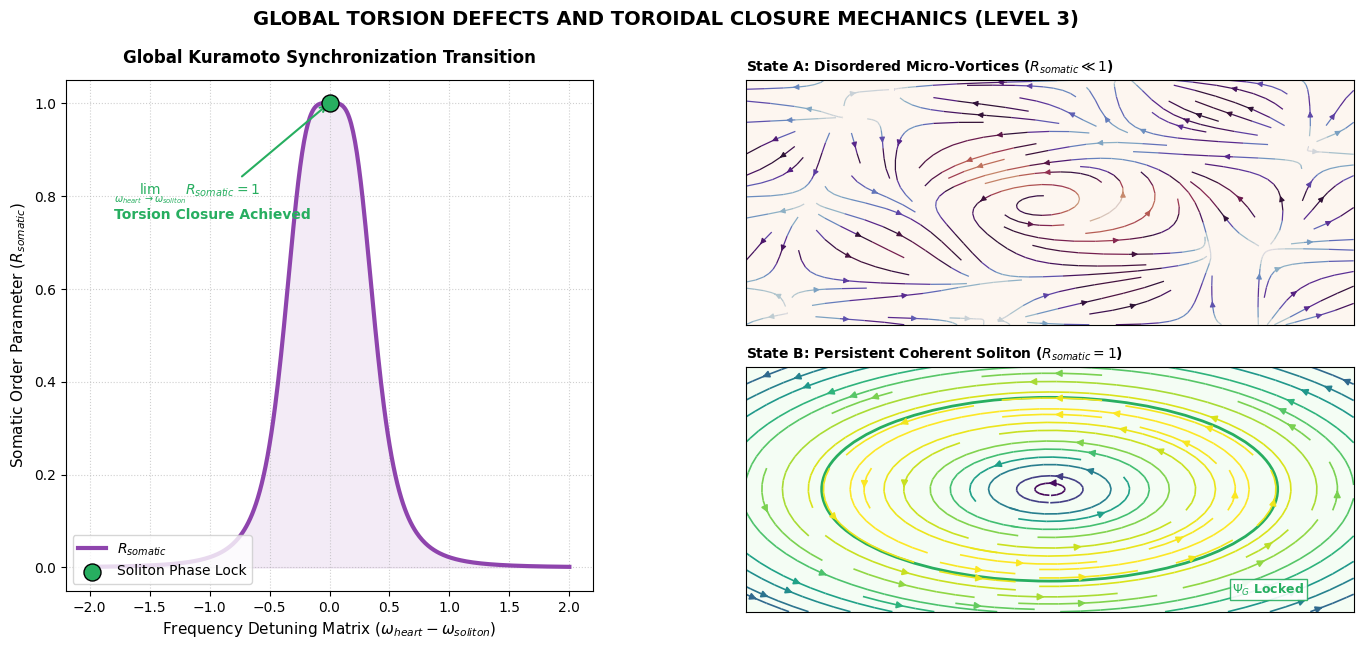
(Image details: the Kuramoto Synchronization Transition, driven by the heart, showing how the system snaps from a high-entropy, disordered state into a perfectly phase-locked macroscopic soliton, dragging the internal information currents into a non-dissipative, coherent channel.
Left Panel (The Kuramoto Order Parameter): Plots the dynamic collapse of chaos into a perfect phase lock as the heart’s frequency matches the internal soliton resonance.
Right Panel (The Coherent Toroidal Vortex Engine): Simulates the phase field of the somatic volume, showing the disordered micro-vortices organizing into a single, high-intensity, global toroidal fold.)
The Thermodynamic Purpose of Digestion: Topological De-Manufacturing
Within the continuous scaling laws of the HydroSyndetic Paradigm, the ingestion and processing of matter cannot be modeled via legacy, reductionist biochemical caloric metrics. Instead, digestion is formalized as a structured Topological De-Manufacturing Sequence whereby an observer interfaces with external mass configurations to extract compressible quantum source code while isolating un-synchronizable computational noise.
The Primary Tube as a Spatial Neutralizer
Topologically, the internal lumen of the metazoan enteric axis functions as an invariant extension of the external boundary; the mucosal lining and the outer boundary layer of the skin form a continuous, non-orientable topological sheet bounding the internal somatic manifold. When a resident biological observer ingests an external Level 3 structure (e.g., plant or animal tissue), that mass is decoupled from its native poloidal-toroidal field engine or electromotive dipole throttle.
Lacking its primary organizational field, the incoming tissue instantly undergoes a top-down phase un-squeezed transition. The low-entropy, liquid-crystalline water sheaths (State B) coating the foreign macromolecular geometry collapse into disordered, unpolarized bulk water clusters (State A). Consequently, within the lumen of the primary tube, the ingested Level 3 structure is thermodynamically neutralized and reduced to a highly concentrated, localized equivalent of the Level 4 (Hydrogeospherics) environment.
The Macromolecular Un-Zipping Function
To bridge the gap between the external Level 4 lumen environment and the internal Level 3 tissue syncytium, the primary tube operates as a mechanical and enzymatic un-zipper. The purpose of this stage is to dismantle the macro-scale geometric constraints of the consumed tissue, systematically breaking down its structural tensor grids until it matches the discrete, localized scale of Level 2 (Hydromoleculics). This un-zipping reduces the foreign hardware matrix into raw macromolecular components: intact amino acid sequences, lipid bilayers, and unorganized fluid hexamer templates. The un-zipped fluid state is governed by a modified non-linear mass-action framework as it approaches the epithelial boundary layer:𝚵lumen→enzymatic shear∑k=1Mψk(Level 2 Macromolecules)
The Computational Filtration Gate: Software vs. Hardware Exhaust
As these Level 2 components cross the transmembrane integrin complexes and enter the true internal fluid syncytium, they encounter a strict computational filtration gate[cite: 37]. The consumer’s global Kuramoto order parameter (Rsomatic→1) driven by the heart’s poloidal field vector acts as the primary sorting function:ℱ(ψk)={Upconversion toρBifωk≈ωheartRejection toρAifωk≠ωheart
The Coherent Software Path: High-fidelity, compressible molecular data streams are drawn into the intracellular space via tensegrity struts and channeled directly into the mitochondrial 107V/m electrostatic refinery. The intense electrostatic suction forces a sub-atomic nuclear spin inversion that snaps incoming protons back into the precise kinetic rest frame (v→lattice) calibrated by the additively stacked Earth-Moon barycentric velocity vectors:v→total=v→orbit+v→Earth-Moon(t)±v→tidal(t)This phase-locks the metabolic inputs directly into the consumer’s native 60THz superradiant plasma phase (ρB), seamlessly updating the observer’s core genomic ledger and architectural template.
The Irreducible Hardware Residue (ρA): Molecular configurations that cannot be algorithmically compressed to match the system’s global phase invariants are rejected as computational noise. This un-polarizable mass drives a fractional loss of phase coherence , manifesting as a localized signal slip rate Γ(Eexhaust)[cite: 197]:Eexhaust=(1−κ)EsolitonTo prevent this backed-up hardware residue from scaling past the critical Stagnation Threshold (ρA≥ρA,crit) and inducing systemic computational quenching, the organism activates macro-scale lymphatic flux vectors (Jν). This un-synchronizable mass is actively shunted outward through the venous, lymphatic, and primary tube exhaust gates, expelling the high-entropy bulk fluid residue (ρA) back into the planetary environment as physical waste.
Cross-Kingdom Bifurcation: Mathematical Regimes of Multi-Scale Fluid Confinement
A central architecture of the HydroSyndetic Paradigm is that while Level 2: Hydromoleculics relies on a universally conserved, invariant ledger of structural protein stators (microtubules, actin, and collagen matrices) to generate localized quantum vortex lines, Level 3: Hydroanatomy marks a profound evolutionary and physical bifurcation. At this organismal scale, kingdoms diverge in their fluid-dynamic engineering based on which specific vector operators they manipulate within the master electromagnetic fluid-body force equations.
To formalize this cross-kingdom divergence, we review the generalized volumetric electromagnetic force tensor F→EM exerted upon a highly conductive, electrolyte-dense plasma phase moving through a structured biological conduit, governed by the complete non-equilibrium Lorentz relation:
F→EM=ρeE→+J→×B→
Where ρe represents the localized net volumetric charge density of the fluid medium, E→ is the macroscopic electric field vector, J→ is the continuous current density vector, and B→ is the total magnetic induction field vector. Rather than altering the foundational geometric laws of the HydroSyndeticum as complexity scales, each biological kingdom partitions its tissue-level fluid-routing behaviors into a distinct, mathematically unique operational regime across this equation.
1. Monera: The Low-Reynolds Electro-Osmotic Boundary Regime
Lacking a centralized, muscular mechanical pumping actuator, filamentous and sheathed bacterial colonies (Monera) cannot generate the high-velocity fluid currents required to drive significant magnetic induction fields. Instead, prokaryotic syncytiums exploit the massive surface-area-to-volume ratios inherent to the sheathed trichome architecture. By coordinating transmembrane ion fluxes across individual cellular boundaries, the colony establishes a highly synchronized, collective longitudinal Zeta Potential gradient along the entire length of the conduit.
This coordinated polarization functions as a macro-scale linear battery, projecting a dominant electrostatic field vector E→monera that acts natively upon the fluid’s charge boundary layers. The systemic hydrodynamic state of the bacterial trichome is therefore governed by the Electro-Osmotic Navier-Stokes Formulation:
ρsys(∂v→sys∂t+(v→sys⋅∇)v→sys)=−∇P+μ∇2v→sys+ρeE→monera+∇⋅(𝒅EPS:𝑻sheath)
Where 𝒅EPS:𝑻sheath represents the global electro-strictive and piezoelectric tensor contraction running through the collective Extracellular Polymeric Substance (EPS) matrix and crystalline S-layer protein envelopes.
Crucially, because the driving field vector is purely electrostatic, the poloidal-toroidal loop closure does not occur entirely within the internal somatic boundary. The electric field lines E→monera project linearly down the hollow core of the trichome tube, exit the open terminal end of the sheath, and loop back through the external environmental medium (Level 4: Hydrogeospherics) before re-entering the base of the colony. The torus is completed by using the external world as the return circuit path.
2. Protista: The Low-Reynolds Peristaltic Pressure Regime
In the kingdom Protista—exemplified by the macro-scale, acellular syncytial networks of Physarum polycephalum—the driving body force drops its primary electromagnetic coupling entirely (F→EM→0) during vegetative navigation. Instead, the system acts as a self-organized mechanical fluidic oscillator. The fluid velocity field of the endoplasm, v→sys, is driven by a periodic, non-linear hydrodynamic pressure wave vector, P→wave(x,t), generated by the rhythmic, calcium-dependent visco-elastic contractions of the outer gel-like ectoplasmic tube walls.
Because these syncytial veins operate at a low Reynolds number (Re≪1), inertial terms vanish, and the system is governed by the Active Peristaltic Stokes-Navier Formulation:
μ∇2v→sys−∇Pviscous+Π→actomyosin(x,t)=0
Where μ is the dynamic shear viscosity of the endoplasm, Pviscous is the internal hydrostatic pressure, and Π→actomyosin(x,t) is the active contractile stress vector field formalized as:
Π→actomyosin(x,t)=∇⋅(σactivecos(ωosct+ϕ(x))𝑰)
Here, σactive is the peak tension capacity of the actomyosin cross-bridges, ωosc is the localized mechanical oscillation frequency, and ϕ(x) represents the spatial phase map across the network.
The poloidal-toroidal loop manifests as an ongoing back-and-forth “shuttle streaming” sequence. By rhythmically adjusting the phase map ϕ(x), the tube walls soften and expand toward nutritional inputs or stiffen to constrict away from external repellents. The torus is closed mechanically through localized mass displacement loops that dynamically compute spatial optimization pathways without a centralized nervous system.
3. Fungi: The Osmotic-Evaporative Source-Sink Network
The kingdom Fungi organizes its Level 3 Hydroanatomy by shifting the thermodynamic engine into a decentralized, multi-channel hydraulic network driven by a continuous, system-wide grid of osmotic and evaporative potential gradients. The driving force is formalized as a macroscopic turgor flux vector field, F→turgor, running through continuous, open coenocytic hyphal cords.
We model this macro-scale cytoplasmic flow field using a modified Darcy-Brinkman Framework for Porous Syncytial Conduits:
ρsysϵ∂v→sys∂t=−∇Pturgor+μϵ∇2v→sys−μkv→sys
Where ϵ represents the internal porosity matrix of the aggregated hyphal cord, k is the hydraulic permeability constant of the syncytial channel, and Pturgor is the global turgor pressure gradient driven by active osmotic source-sink nodes:
∇Pturgor=∇(RT∑(Cinterior−Cexterior)−Δμevap(t))
Here, R is the universal gas constant, T is the localized temperature, C represents the active osmolyte solute concentrations packed within vacuolar compartments at absorbing interior nodes (the source), and Δμevap(t) is the periodic moisture potential drop driven by localized evaporation or exuded fluid cycles at peripheral hyphal tips (the sink).
The poloidal loop in Fungi is a decentralized macro-throttle: fluid enters via osmotic suction at localized nutrient caches, flows through massive parallel hyphal pipelines, and returns via external trans-mycelial soil moisture loops. This closes the toroidal circuit across entire forest ecosystems.
4. Plantae: The Transpirational Electro-Tensile Dipole Field
In the kingdom Plantae, the Level 3 hydraulic engine upconverts into a massive, vertical Electromotive and Cohesion-Tension Dipole Axis. The system exploits a continuous, uninterrupted column of liquid-crystalline water layers bound to xylem and phloem vessel walls, maintaining absolute fluid-thread stability against gravity.
The systemic fluid velocity vector field v→sys is driven by a combined body force vector mapping a massive top-down negative tension gradient directly to a bottom-up root pressure potential, coupled to a vertical electric field vector, E→phyt:
ρsys(∂v→sys∂t+(v→sys⋅∇)v→sys)=−∇(Pcapillary−Ttranspiration)+ρeE→phyt+∇⋅(𝒅𝐜𝐞𝐥𝐥𝐮𝐥𝐨𝐬𝐞:𝑻xylem)
Where Ttranspiration is the immense, negative sub-pressure generated by solar-driven evaporation at the atmospheric stomata, Pcapillary is the positive root pressure engine, and 𝒅𝐜𝐞𝐥𝐥𝐮𝐥𝐨𝐬𝐞:𝑻xylem represents the piezoelectric tensor contraction generated across pre-stressed cellulose microfibril chains under mechanical wind loads. The vertical electric field vector E→phyt tracks the continuous electrochemical dipole running from soil to canopy:
E→phyt=−∇Φdipole(z,t)
The poloidal loop of the plant is planetary-coupled. The immense electro-tensile lines of force project far out into the rhizosphere (the soil matrix) and up into the atmosphere. Field-polarized water is pulled up through the internal xylem conduit, while ions and metabolic sugars loop downward through the outer phloem sheath, completing a grand, continuous toroidal circuit that anchors the plant’s somatic geometry natively within the global water cycle.
5. Animalia: The High-Current Magnetic Confinement Regime
Conversely, the kingdom Animalia shifts the thermodynamic engine entirely into the high-current, magnetic regime of the Lorentz relation, dropping the electrostatic component (ρeE→→0) through macro-scale tissue neutralizations. Here, the system utilizes a centralized, highly specialized muscular heart that acts as a dynamic mechanical pump, forcing blood, lymph, and interstitial fluid through pre-stressed, therapeutic, and anisotropic fascial planes.
This mechanical propulsion generates a massive, moving polarization current density (J→fascial) that tracks the global myofascial “Spiral Slings.” The resulting fluidic acceleration is coupled to the heart’s poloidal-toroidal magnetic field vector, resulting in the Toroidal Magnetohydrodynamic (MHD) Formulation:
ρsys(∂v→sys∂t+(v→sys⋅∇)v→sys)=−∇P+μ∇2v→sys+J→fascial×B→total+∇⋅(𝒅𝐠𝐥𝐨𝐛𝐚𝐥:𝑻sling)
Where B→total is the combined magnetic field tracking both internal toroidal envelopes and external solar-induced geomagnetically induced currents:
B→total(x,t)=B→torus(x)+B→solar_induced(t)
In this regime, the fluid-plasma phase is actively pinched, shaped, and confined magnetically by the Lorentz cross-product J→fascial×B→total. Because the heart’s mechanical torsion loops the magnetic field lines back through the central primitive axis of the body (the primitive streak), systemic torsion closure (ΨG) is achieved entirely within the internal somatic container, terminating exactly at the holographic screen of the skin.
6. Mathematical Summary of Cross-Kingdom Architectural Upconversion
To explicitly map the mathematical invariants shared across these five seemingly disparate operational regimes, we formalize the structural pairing of the internal axial tube (the geometric engine) with the external holographic screen (the thermodynamic container). Table 3 contrasts the underlying force-coupling transformations, the mechanical boundary envelopes, and the exact insulation metrics that dictate whole-body persistence.
KingdomPrimary Axial TubeHolographic Screen (Skin)Fluid Body Force Operator𝚵𝐬𝐜𝐫𝐞𝐞𝐧𝜿𝐜𝐥𝐨𝐬𝐮𝐫𝐞MoneraSheathed Trichome ConduitPorous Peptidoglycan S-LayerCoulomb Boundary Drag (ρeE→)→00ProtistaPlasmodial Syncytial VeinDynamic Gel Ectoplasmic CortexPeristaltic Actomyosin Stress (Π→)Ξscreen(t)FluctuatingFungiCoenocytic Hyphal CordDistributed Chitinous MatrixOsmotic Darcy Drag (−μkv→)Distributed GridEcosystem LoopPlantaeXylem-Phloem Bundle AxisWaxy Hydrophobic Cuticle SheetCohesion-Tension / Coulomb PullSemi-Insulated1−ΔtranspirationAnimaliaMetazoan Enteric AxisStratified Keratinized EpidermisMagnetic Lorentz Pinch (J→×B→)→∞1
This evolutionary matrix demonstrates that every branch of terrestrial biology is bound to the exact same master fluid equations. The diverse morphologies observed across the tree of life are simply the result of distinct kingdoms playing different mathematical keys on the exact same thermodynamic piano, structuring their primary axial tubes to compress environmental hardware into the localized, scale-free software of life.
Conclusion
By scaling our fluid-dynamic definitions from localized macromolecular stators up to organism-wide magnetohydrodynamic fields, Level 3 Hydroanatomy maps the complete geometric closure of the living system. This framework reveals that tissues across all biological kingdoms are not inert, reductionist matter, but highly organized, non-equilibrium hydrodynamic systems capable of stabilizing macro-scale topological singularities. Through this lens, the biological observer is revealed as an exquisite thermodynamic masterpiece: the primary axial tube operates as the structural hardware intake corridor; the additively stacked solar-lunar barycentric velocity vectors fine-tune the local computational clock speed; and the non-linear mass-action equations elegantly balance the extraction of low-entropy quantum software from high-entropy physical hardware waste.
Crucially, this paper formalizes a pristine sequence of architectural upconversion across the nested horizons of the HydroSyndeticum. The localized, cylindrical fluid-vortices that map the micro-linear protein stators at Level 2 do not dissipate; instead, they structurally upconvert and scale. Bound by the continuous sheet of the epithelial boundary and driven by localized kingdom-specific field throttles, these linear filaments aggregate, bend, and close upon themselves. This evolution transforms a disparate sea of microscopic software codes into a singular, three-dimensional toroidal container, systematically migrating the toroidal return circuit from the open environment of Level 4 straight into a completely closed loop inside the holographic screen of the skin.
This structural upconversion demonstrates that nature does not alter its foundational geometric laws as complexity increases; rather, it uses the exact same fluid-dynamic and magnetohydrodynamic invariants to structurally bind the sub-atomic rest frame natively to the macro-scale trajectories of the entire HydroSyndetic.


Leave a Reply