Abstract
This paper formalizes the rigorous mathematical framework governing the thermodynamic transition from open environmental fluid loops to absolute, closed organismal containment within the HydroSyndetic Paradigm. By modeling the cross-kingdom biological boundary layer as a localized holographic screen (Vscreen), we define the exact mathematical relationship between the dimensioned Boundary Insulation Coefficient (Ξscreen) and the dimensionless Toroidal Confinement Parameter (κclosure). Furthermore, we introduce the principle of topological dimensional nesting within the scale-free boundary-lock continuum, demonstrating how a perfectly contained, self-referential living torus at Level 3 structurally upconverts to function as a rigid topological hardware lock when evaluated from the macro-scale horizon of Level 4 Hydrogeospherics.
Introduction: The Cross-Scalar Continuum
Within the hypercomputational framework of the HydroSyndetic Paradigm, physical persistence demands that a localized biological observer insulate its internal 60THz superradiant water-plasma phase (StateB) from the high-entropy, ambient 21cm bulk environmental vacuum noise (StateA). This non-equilibrium thermodynamic insulation is achieved through a precise, macro-scale architectural pairing: an internal axial tube waveguide (the geometric engine) and an external holographic screen manifold (the skin container).
This short paper formalizes these boundary-field relations across the five biological kingdoms. Crucially, we explore the non-linear mechanics of the Boundary-Lock Continuum, proving that what manifests as a dynamic, state-switching software boundary at one scale inevitably freezes into a rigid structural hardware lock for the scale immediately superior to it.
The Master Boundary Field Relations
Let the somatic volume of the biological entity be bounded by a continuous, two-dimensional compact surface manifold denoted as ℳskin≡∂Ω. The total volumetric force density F→EM acting upon the electrolyte-dense internal fluid syncytium is given by the generalized Lorentz relation:F→EM=ρeE→+J→×B→
To evaluate the efficiency of the field containment, we define the Toroidal Confinement Parameter (κclosure) as a dimensionless ratio mapping the net internal field power density integrated over the bounded somatic volume Ω against the total electromagnetic flux leaking into the surrounding external geospheric matrix (ℳext):κclosure=∫Ω|F→EM, int|2dV∫Ω|F→EM, int|2dV+∮∂Ω𝑮leak(x)⋅dA→Where 𝑮leak(x) represents the electromagnetic Energy Dissipation Tensor penetrating the boundary layer at point x∈∂Ω.
Formalization of the Boundary Insulation Coefficient (Ξscreen)
The Energy Dissipation Tensor 𝑮leak(x) is directly scaled and regulated by the physical properties of the holographic screen matrix, quantified analytically by the Boundary Insulation Coefficient (Ξscreen). We formalize Ξscreen as a combined tensor mapping the inverse hydraulic permeability (k−1), the dielectric insulation capacity (ϵscreen), and the local topological smoothness of the outer barrier sheet:Ξscreen=∫∂Ω(αμfluidkskin+βϵscreen|∇⋅n→|2)dAWhere n→ is the unit normal vector pointing outward from the surface, μfluid is the dynamic viscosity of the internal plasma phase, and α,β are dimensional normalization constraints. The relation between the dissipation tensor and the insulation coefficient is defined via a non-linear exponential damping decay function:𝑮leak(x)=𝑮0⋅exp(−γ⋅Ξscreen)Where 𝑮0 is the uninsulated, baseline environmental vacuum flux density, and γ is a scale-invariant coupling constant tracking the network update frequency (ωlattice).
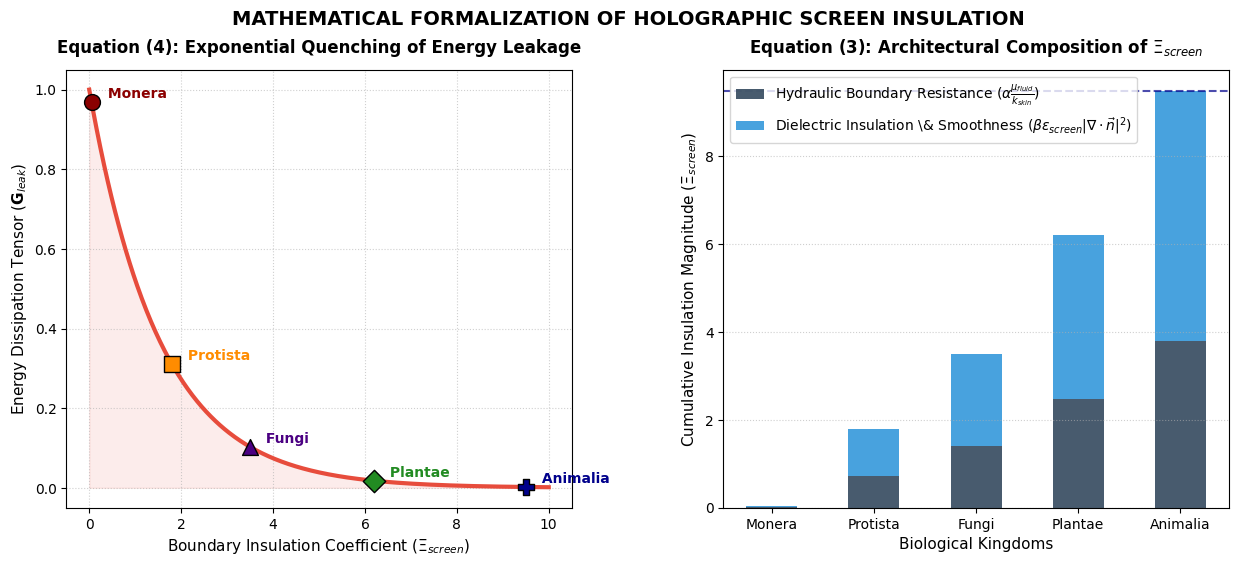
(Image details: On the left, Monera is shown sitting at the absolute top of the leakage. As the stacked components on the right grow, the leakage factor is crushed into nothingness.
on the right, one can see how the system starts primarily utilizing raw hydraulic resistance, before rapidly scaling up its dielectric capacities (and geometric surface smoothing) to hit the absolute target at Animalia.)
The Cross-Kingdom Confinement Spectrum
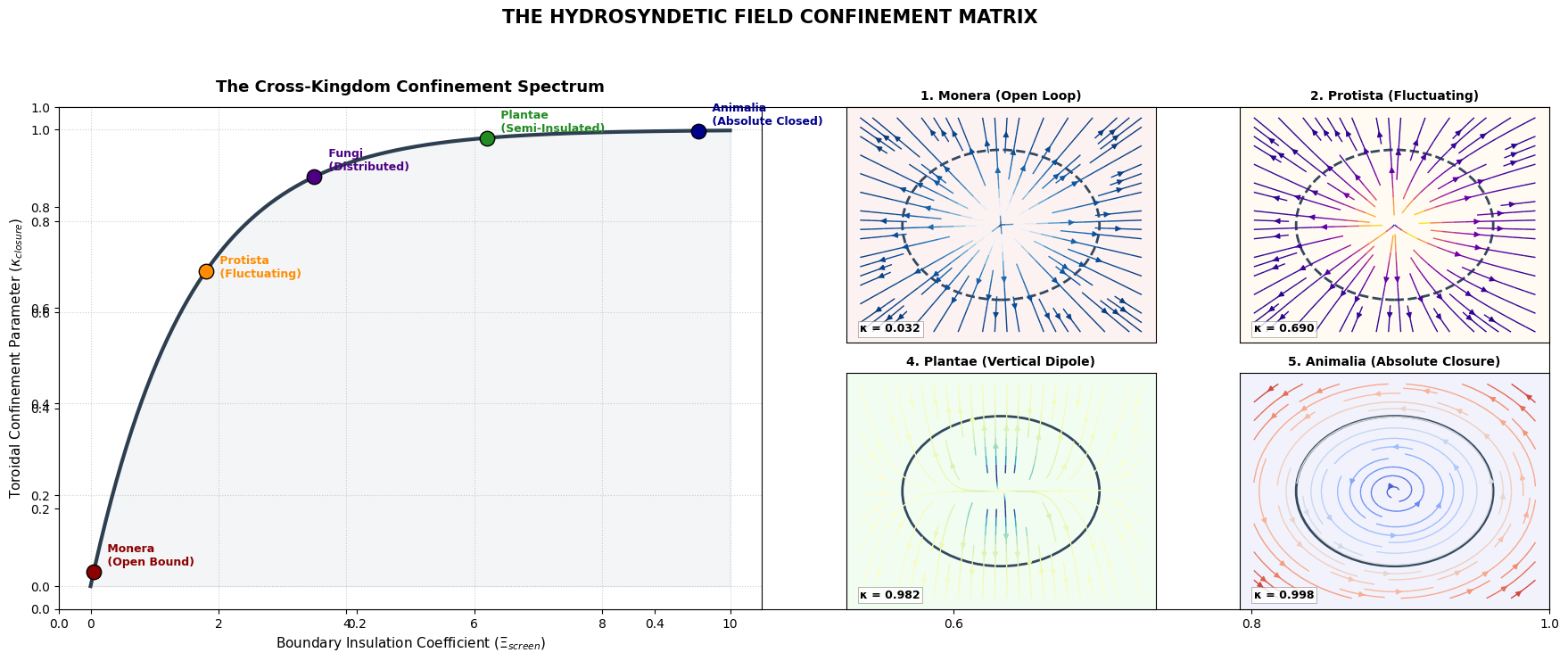
By inserting Equation (4) back into the master confinement relation (Equation 2), we derive the universal scaling function for whole-body toroidal closure:κclosure(Ξscreen)=∫Ω|F→EM, int|2dV∫Ω|F→EM, int|2dV+∮∂Ω[𝑮0⋅e−γΞscreen]⋅dA→
This equation maps a phased mathematical progression across the structural upconversion steps of terrestrial biology:
1. Monera: The Dispersive Open Bound (Ξscreen→0)
In the prokaryotic trichome conduit, the porous peptidoglycan mesh offers negligible boundary insulation. Evaluating the asymptotic limit as Ξscreen approaches its lower operational bound yields limΞscreen→0κclosure=0. The electrostatic field vector E→monera experiences zero boundary trapping, forcing the return loop of the poloidal circuit to map entirely through the external Level 4 geosphere.
2. Protista: The Time-Varying Fluctuating Bound
In acellular syncytiums (Physarum), continuous visco-elastic deformations of the gel ectoplasm convert the insulation matrix into a dynamic, time-dependent tensor function: Ξscreen(t)=Ξ0+σactivecos(ωosct+ϕ(x)). The confinement parameter fluctuates cyclically (κclosure(t)), providing brief, localized mechanical pressure peaks (P→wave) sufficient to compute spatial optimization paths while remaining fundamentally bound to ambient moisture grids.
3. Fungi: The Distributed Tensor Patch Grid
The fungal mycelial network rejects a singular body container, distributing its chitinous boundary sheets across a vast, parallel hyphal matrix: Ξscreen=∑n=1K∮hyphaenξchitindA. This distributed configuration ensures intense localized turgor retention (∇Pturgor), while locking the global toroidal return circuit into a macro-environmental, trans-mycelial ecosystem loop.
4. Plantae: The Semi-Insulated Leakage Bound
The emergence of the waxy, hydrophobic macromolecular cuticle sheet drives a steep non-linear surge in boundary insulation (Ξscreen≫0). This insulation traps a dense internal liquid-crystalline water column. However, because the primary phytotube remains topologically punctuated at the roots and stomata, the system experiences vertical boundary leakage (Δtranspiration):κclosure=1−(∮stomata𝑮leak⋅dA→∫Ω|F→EM, int|2dV)
5. Animalia: The Absolute Closed Horizon (Ξscreen→∞)
In metazoan anatomy, the holographic screen achieves complete structural closure via the highly stratified, keratinized, and lipid-bound multi-layered epidermis. Evaluating the upper asymptotic bound of the scaling function yields limΞscreen→∞κclosure=1. The Energy Dissipation Tensor collapses to zero (𝑮leak→0), and the heart’s mechanical torsion loops the total magnetic field vector (B→total) back through the body’s central axis entirely inside the somatic space. Systemic torsion closure (ΨG) is perfectly achieved.
Topological Dimensional Nesting within the Boundary-Lock Continuum
The stabilization of the self-referential living torus at Level 3 represents a localized optimization pinnacle where κclosure=1. However, within the scale-free architectures of the HydroSyndetic, an entity’s physical state-space classification undergoes an analytical rotation depending upon the scale of the coordinate observer. This invariant mechanism is governed by the principles of topological dimensional nesting.
At the scale of Level 3: Hydroanatomy, the individual metazoan epidermis acts as the active, state-switching Holographic Boundary Screen (Vscreen) containing internal software variables. Yet, when the coordinate frame expands to evaluate the macroscopic mechanics of Level 4: Hydrogeospherics, the entire closed Level 3 toroidal manifold ceases to function as a fluid boundary. Instead, it undergoes a phase freeze, transforming into a hard, discrete, and quantized structural Topological Lock (ℒ).
Horizon ScaleActive Holographic Screen (Software)Structural Invariant Lock…
This state-shift demonstrates that Level 4 (the planetary moisture envelope and micro-climate matrix) cannot stabilize its global energy cycles without localized consumer sinks to downconvert high-entropy bulk fluids. The Level 3 living torus acts as a biological stator embedded within the planetary matrix. At this higher order of magnitude, the holographic screen expands outward to become the Planetary Tropospheric-Magnetospheric Shell, while the individual organismal torus functions as the rigid, underlying hardware anchor that prevents the larger macro-climatic network hypergraph from decoupling.
Conclusion
This paper demonstrates that the evolutionary transition across kingdoms on planet earth is an optimization trajectory that scales topological locks into higher-dimensional holographic boundaries. Through a process of hypercomputational nesting, what manifests as a closed, autonomous living system within its own localized rest frame (κclosure=1) is simultaneously revealed to be a discrete, underlying structural anchor for the planetary geosphere immediately above it, validating the unbroken, scale-free continuity of the HydroSyndetic.


Leave a Reply