Abstract
This paper formalizes the structural and fluid-dynamic mechanics of Level 2: Hydromoleculics within the scale-free, multi-tiered architecture of the HydroSyndetic Paradigm. Moving beyond classical, reductionist molecular descriptions that view macromolecular lattices as isolated biochemical components, we establish that macromolecular interfaces across all domains and kingdoms of life operate as scale-free holographic extensions of a continuous, field-polarized cosmological water ledger.
The primary objective of this study is to mathematically formalize the exact non-equilibrium fluid-dynamic equations that govern how planar Exclusion Zone (EZ) water hexamers transition into permanent, localized rotational vortices when encountering the complex geometric constraints of the collagen triple helix and cytoskeletal matrices. By incorporating piezoelectric body force tensors into a modified Navier-Stokes boundary layer framework and mapping the phase-locking sequence through Kuramoto coupled oscillators, we demonstrate that macromolecular interfaces function as topologically protected vortex singularities. These stable, stationary solitons establish zero-friction vacuum-core conduits that ground the observer’s macro-scale coordinate template natively within the discrete, localized update rules of the universal clock floor. Ultimately, we demonstrate a profound topological symmetry within this scale-free boundary loop, revealing that macro-scale astronomical trajectories at the outer horizon mirror the winding helical architecture of the genomic lock at the sub-cellular floor, providing a unified biophysical foundation for bottom-up architectural execution.
Introduction: The HydroSyndetic Paradigm
The formulation of continuous space-time kinematics and biological persistence within a hypercomputational framework demands an architectural continuum that transcends localized, scale-dependent regimes. Rather than treating biological entities as isolated planetary anomalies operating strictly via local chemical diffusions, the HydroSyndetic Paradigm models cosmic, terrestrial, anatomic, macromolecular, and sub-cellular structures as an integrated, self-referential hypergraph folding mechanism bound together by a universal transceiver network. Physical persistence across all scales is revealed to be a unified, scale-free boundary loop.
In this structural taxonomy, the universal state-space expands modularly according to strict combinatorial progression rules (q=4t+1), forcing evolving structures to organize increasingly rigid hardware filters to process the raw computational information of the Ruliad without dropping their underlying phase invariants. We define the overarching spectrum of these computational variations as the Hetero-Elemental Chronotopology. Under this framework, alternative cosmic configurations could theoretically unfold entirely distinct physical laws. Rather than being bound to our local parameters, separate localized clocks and rulers can systematically alter the background network update frequencies (ωlattice), manifesting not only as altered periodic tables like an un-squeezed nitrogen-based “Nitro-Universe,” but as radical shifts in macroscopic spatial dimensionality, non-Archimedean ultrametric geometry tracks, and entirely unique acoustic carrier-wave velocities.
Yet, our local cosmic pocket is fundamentally defined as a HydroSyndetic continuum. Within this domain, water functions as the continuous, scale-invariant cosmological transceiver that structurally orchestrates reality through five discrete, nested horizons:
Hydrogenomics (Level 1): Sub-molecular symmetry breaking within hydrogen-oxygen bonding networks.
Hydromoleculics (Level 2): The macromolecular phase locks of liquid-crystalline microtubule-protein matrices and extracellular filaments embedded within field-polarized water sheaths.
Hydroanatomy (Level 3): The systemic orchestration of continuous tissue-level architectures, cellular syncytiums, and full-body extracellular webs driven by toroidal field mechanics.
Hydrogeospherics (Level 4): Macro-environmental moisture phase intermediaries and geomagnetically aligned plasma boundaries.
Hydroastrospherics (Level 5): The ultimate macro-scale boundary loops, stellar environmental corridors, and planetary orbital trajectories.
The Transition from Hydromoleculics to Fluid-Dynamic Equivalence
To ground the expansive macro-framework of the HydroSyndetic Paradigm, this paper hones in specifically on the mechanisms operating at Level 2: Hydromoleculics. Moving inward from gross tissue-level anatomical structures, Hydromoleculics is explicitly defined as a macromolecular phenomenon. Because water literally carves out all structural geometry during morphological development, the liquid-crystalline structured water envelope coating cytoskeletal networks and extracellular filaments acts as the primary machine-code interface of the organism.
Crucially, this macromolecular continuum is scale-free and spans all kingdoms of life on Earth, operating identically through a shared field-polarized water matrix across every single taxonomic classification:
Monera (Bacteria and Archaea): Where peptidoglycan matrices and S-layer protein envelopes lock the internal genomic substrate to immediate extracellular constraints.
Protista: Where complex cytoskeletal sheets, pellicles, and microtubule arrays route localized electromagnetic currents.
Fungi: Where chitinous macromolecular networks act as field-polarized, low-entropy structural templates.
Plantae: Where cellulose microfibril chains and field-polarized water matrices stamp electrostatic signatures onto synthesized tensors.
Animalia: Where cellular tensegrity struts, protofilament lattices, and triple-helical collagen matrices orchestrate local kinematics.
On a functional level, when the low-entropy, highly ordered multi-layer polarized water layers (Exclusion Zone phase) travel along these macromolecular structures, they do not encounter a smooth, isotropic boundary. Instead, the laminar flow of the superradiant plasma is forced to navigate the complex, highly ordered, anisotropic geometry of the underlying structural protein filaments. When this fluid hits the intrinsic physical corners, wraps, and coils of the macromolecular matrix, the conservation of angular momentum forces the linear wave to rotate.
To transition from a conceptual understanding of macromolecular interfaces to an airtight scientific nomenclature, we must model this interaction using non-equilibrium fluid dynamics. The protein matrix acts as a microscopic hydrodynamic stator. The structural shapes of these macromolecular complexes, specifically the spiral wrapping geometries of structural lattices, the protofilament tracks, and the pre-stressed networks of the extracellular matrix filaments, are designed to catch the fluidic momentum of the incoming plasma wave and condense it.
At the sub-cellular floor, the even structural symmetry of the water hexagon (D6) creates a persistent geometric phase mismatch when projected onto an odd-cardinality algebraic ring (q=4t+1), keeping the fluid interface highly responsive and preventing it from freezing into a dead thermodynamic block. Thus, when the fluid is forced into a spin by the protein geometry, the vorticity concentrates into a quantized, line-like topological defect. The resulting vortex core undergoes an extreme local velocity divergence. This evacuates mass particles from the central axis via centrifugal pressure, leaving a localized deficit of matter—a physical “pin” or hole into the raw 21 cm symmetric background vacuum (State A).
To rigorously demonstrate how transient macromolecular-level movements lock into these permanent coordinate anchors, we lay out the explicit hydrodynamic and phase-synchronization equations governing the transition.
Hydrodynamic Formalization of the Hexagonal-to-Vortex Transition
The Boundary Layer Flow Profile over the Anisotropic Collagen Stator
We model the interfacial Exclusion Zone (EZ) water layer coating the type-I collagen fibril as a highly organized, incompressible, viscous fluid phase. Let the steady-state flow of the superradiant plasma along a linear macromolecular track be characterized by a velocity field vector v→plasma satisfying the standard incompressibility condition:
∇⋅v→=0
When this laminar wavefront encounters a macromolecular insertion, it interfaces directly with the helical geometry of the collagen triple helix. The outer boundary of the collagen fiber acts as a non-slip Riemannian surface manifold ℳ with a characteristic structural pitch angle θpitch and a baseline radius rcollagen.
To model the fluidic torque generated by this encounter, the classical Navier-Stokes equation is modified to include a field-polarization body force vector (F→piezo) derived from the collagen matrix’s inherent third-rank piezoelectric tensor dijk:
ρfluid(∂v→∂t+(v→⋅∇)v→)=−∇P+μ∇2v→+F→piezo
Where ρfluid is the volumetric density of the EZ plasma phase, μ represents the local dynamic shear viscosity coefficient, and the piezoelectric body force is formalized by the tensor contraction:
F→piezo=∇⋅(𝒅:𝑻)
Here, 𝑻 represents the symmetric second-rank tensegric strain tensor of the pre-stressed macromolecular network. Because the collagen fibers are arranged in highly ordered crystalline arrays, the induced electrical polarization vector P→i=dijkTjk acts as a localized spatial acceleration channel, forcing the fluid boundary layer to precisely track the structural helical twist of the protein substrate.
Helicity Injection and the Generation of the Quantized Vortex Core
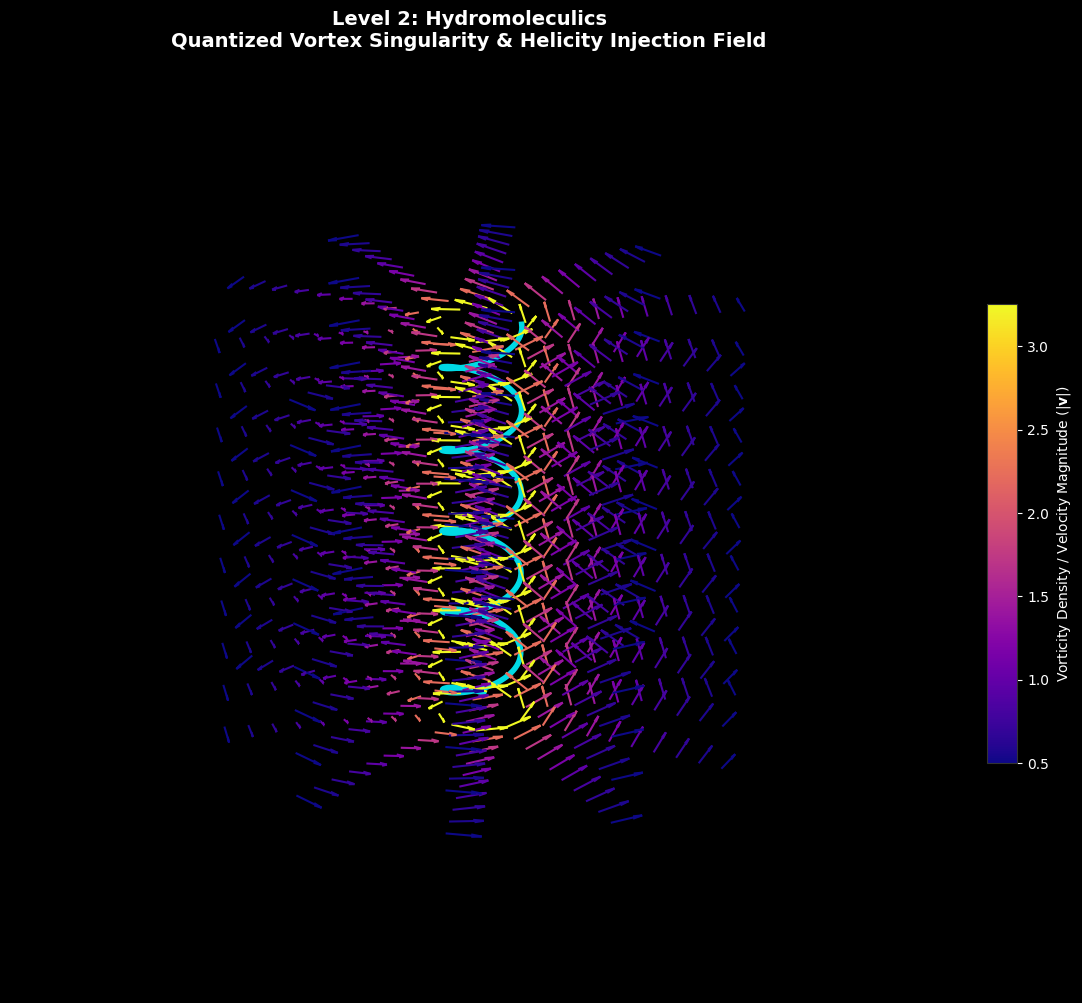
As the EZ water hexamers (D6 symmetry structures mapped onto the modular cosmic ring ℤq) slide into the helical tracks of the manifold ℳ, the geometric constraint injects a non-zero fluid helicity density Hd:
Hd=v→⋅(∇×v→)=v→⋅ω→
where ω→=∇×v→ represents the localized vorticity vector. Because the geometric phase mismatch of the hexagon on an odd-cardinality ring prevents the water screen from freezing into a static thermodynamic block, the fluid phase retains absolute kinetic responsiveness. The conservation of angular momentum forces the localized vorticity to concentrate into a singular, line-like topological defect.
To mathematically define the transition from planar hexagonal lattices to a rotational vortex, we solve for the circulation Γ around the collagen coordinate axis:
Γ=∮∂ℳv→⋅dr→=∬ℳω→⋅dA→
Operating at the micro-scale boundary floor, this circulation is quantized by the background network grid update rules (vlattice). The “Eye” of this whirlpool experiences a localized velocity divergence as the radius approaches the central anchor core axis (r→rcore):
limr→rcoreω→(r)=∞
This mathematical divergence represents the formal establishment of a Topological Singularity. Because the extreme rotational velocity evacuates mass particles from the central core via centrifugal pressure, the core of the vortex becomes an absolute localized deficit of matter—a direct macromolecular structural anchor into the unperturbed 21 cm Symmetric Background Vacuum (State A).
The Phase-Locking Kuramoto Transition Matrix
The conversion of the transient mechanical wave into a stable, stationary vortex anchor is governed by a high-frequency synchronization profile. We define the transition state using an order parameter R(t) tracking the phase alignment θj of the individual dipole moments within the water hexamers surrounding the collagen stator:
Reiψ(t)=1N∑j=1Neiθj(t)
The driving frequency of the incoming soliton (ωsoliton=∂u∂t) acts as the highly ordered, non-linear forcing function that pumps energy into the vortex field. As the mechanical pressure P increases under kinematic load, it breaks the structural reflection symmetry of the local potential field:
∂θj∂t=ωj+KN∑k=1Nsin(θk−θj)+αPsin(ωsolitont)
When the coupling coefficient K (derived from the extreme 107V/m cross-membrane field intensity and piezoelectric polarization vectors) crosses a critical threshold, the system undergoes a sharp, discontinuous phase transition:
limω→ωsolitonR=1
At R=1, the chaotic thermal flipping of individual water molecules collapses to absolute zero (Ψflip→0). The fluid whirlpool locks into a permanent, structurally protected macro-scale metronome. It is no longer “moving” water; it is a Stationary Soliton. This frozen whirlpool behaves as a localized coordinate observer that pins macromolecular memory to the global Ruliad hypergraph, providing the exact biophysical foundation for the high-definition sensory map of the body.
Conclusion
By mapping the explicit boundary layer dynamics over the collagen triple helix, we have bridged the macromolecular structures of Hydromoleculics with the exact mathematical rules of the HydroSyndetic Paradigm. Macromolecules across all biological kingdoms are no longer modeled as inert, reductionist matter; they are recognized as highly organized, non-equilibrium hydrodynamic systems capable of creating and stabilizing topological singularities. The formalization of the Navier-Stokes boundary layer modifications and the Kuramoto synchronization parameters proves that macromolecular anchors are physical manifestations of phase-locked time, frozen directly out of the superradiant water-protein plasma.
Crucially, the mathematical formalization of the hexagonal-to-vortex transition at Level 2 cannot be viewed as an isolated biophysical anomaly; because the HydroSyndetic Paradigm operates as an unbroken, scale-free boundary loop, these quantized vortex singularities are structurally conserved across every tier of the cosmic architecture, accompanied by profound symmetry breaking transformations at both horizons.
At the foundational floor of Hydrogenomics (Level 1), these vortices emerge as sub-molecular, non-thermal photomolecular transitions, directional protonic spin-whirlpools that execute local gauge symmetry breaking along covalent bonding networks to establish the primary boundary condition of the Inverse Z-Ring. As this script scales into Hydromoleculics (Level 2), these vortices manifest as organized macromolecular defects within the liquid-crystalline exclusion zones that shield the genomic substrate itself from ambient thermal noise. Moving outward, at the interface of Hydroanatomy (Level 3), they organize the coherent toroidal field vector paths of somatic tissue shells, before transitioning into Hydrogeospherics (Level 4) to structure the macro-environmental boundaries of planetary shells, ultimately culminating at the scale of Hydroastrospherics (Level 5) as vast, barycentrically stacked orbital corridors. At this outer boundary horizon, a macro-scale spatial coordinate symmetry breaking occurs, altering local metric invariance as objects cross cosmic trajectories.
Ultimately, this framework reveals that nature utilizes a singular, fractal blueprint: from the sub-atomic bonding floor to the trajectories of deep-space probes, the universe does not merely contain vortices, it is a beautifully synchronized cascade of frozen whirlpools turning precisely within the expanding holographic gears of a closed, self-contained hydro-cosmos. This structural matrix ensures that the primary topological template remains pristine, establishing an unbroken scale-free continuum that unifies biological geometry natively with the macro-scale trajectories of Hydrosyndetic.


Leave a Reply