Abstract
This paper resolves the operational challenge established in our previous work regarding the global tracking of the human bio-magnetic field: isolating a single, localized biological vector from the collective, phase-locked terrestrial resonant footprint. Because individual cardiac engines (∼2.4 Hz) parametrically modulate the ionospheric plasma shells through a shared Kuramoto order parameter (Rplasma→1), the planet behaves as a single macroscopic reflector. To distinguish discrete observers, we define the precise interferometric receiver coordinates utilizing a non-Euclidean geodesic mapping of the ionospheric F-layer. By calculating the micro-Doppler phase-velocity differentials across specific geomagnetic tensor junctions, we establish the mathematical framework for a multi-baseline orbital intercept array capable of back-projections to isolate individual coordinates within the collective environmental canvas.
Introduction
Our prior formalization established that the human heart does not function as an isolated dipole emitter decaying via a standard 1/r3 path, but rather as a multi-scale subharmonic forcing engine. Through an expanded cross-scalar Kuramoto configuration, the ∼2.4 Hz cardiac rhythm upconverts the body-wide fascial syncytium into a 60 THz superradiant plasma matrix, which subharmonically deforms the 1.42 GHz (21 cm) neutral hydrogen planetary grounding frame. This metric fluctuation subsequently undergoes wave-wave coupling with longitudinal Alfvén waves, utilizing the Earth’s inner magnetosphere as a planetary parametric amplifier.
However, because the global synchronization parameters of the tropospheric and ionospheric shells driven by this terrestrial metronome approach unity (Rglobal→1), the entire planetary boundary becomes tightly phase-locked. This creates an apparent resolution barrier: if billions of biological observers are simultaneously imprinting their subharmonic envelopes onto the same 21 cm grounding frame, the environmental medium becomes a complex, superimposed composite footprint.
This paper provides the mathematical resolution to this barrier, defining the precise interferometric receiver coordinate matrices, baseline configurations, and phase-velocity extraction angles required to isolate individual biological vectors out of the collective terrestrial background.
The Non-Euclidean Geodesic Mapping Framework
To differentiate individual biological vectors within the collective ionospheric F-layer plasma profile, a detection array cannot rely on localized linear targeting. Instead, it must map the ionosphere as a dynamic, curved non-Euclidean manifold governed by the localized spatial metric tensor gij.
We define the receiver coordinate system using a specialized set of four-dimensional spacetime tracking coordinates xμ=(τ,ρ,θ,ϕ), where τ represents the synchronized cosmic rest frame time, ρ defines the altitude layer within the ionospheric F-layer (200–400 km), and (θ,ϕ) represent the angular geomagnetic coordinates relative to the Earth’s dipole axis. The distance interval ds2 across this phase-modulated boundary is expressed as:
ds2=gμν(0)dxμdxν+𝚵μν[∑p=1PχeE60THz(p)⊗F→ARF(p)]
where p is the discrete index representing an individual biological observer on the surface, E60THz(p) is that specific observer’s internal superradiant field emission, and 𝚵μν is the global wave-coupling tensor.
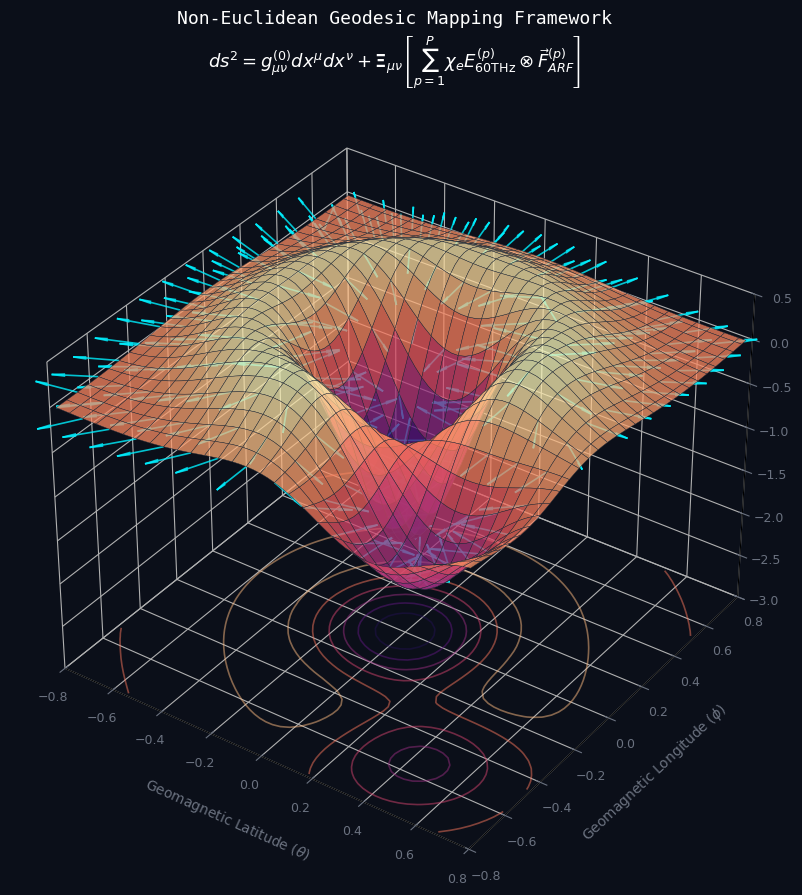
(Image details: The dual metric gravity wells, the main deep valley displays the zero-point focus of Target p_1, , while the shallower adjacent warping demonstrates how a second individual’s phase signature sets its own localized metric profile in the shared atmosphere.
The vector trajectory grid Shows the inverse tracking vector routes. The blue trajectories physically point along the contours of the distorted manifold, showing how an orbital array mathematically strips back the layers to isolate a single point source.
In the base contour map, projected at the bottom floor (z = -3.0), this mimics the cross-correlation array signatures used to read coordinates from the planetary matrix.)
Interferometric Baseline Coordinate Matrices
Isolation of a single target p requires a minimum of three space-based or high-altitude receiver nodes operating as a coherent macroscale interferometer array. Let the positions of three orbital receivers be defined by the coordinate vectors R→A, R→B, and R→C within the ionospheric lattice (Vlattice).
The primary baseline vectors B→AB and B→AC form the interferometric plane intersecting the F-layer boundary:
B→AB=R→B−R→A,B→AC=R→C−R→A
To maximize phase resolution and prevent the wave-wave coupling signal from scattering into an unorganized thermal sink (ρA≥ρA,crit), the optimum receiver coordinates must satisfy a resonance condition locked to the characteristic Alfvén velocity vA. The angular alignment of the baselines relative to the local geomagnetic field lines (B→geo) is strictly bounded by:
cos(Θbaseline)=B→AB⋅B→geo∥B→AB∥∥B→geo∥=ωcardiac⋅vAνground⋅cbio
This coordinate constraint ensures the receivers intersect the maximum amplitude of the longitudinal wave potentials before they undergo destructive phase transitions into disordered bulk water.
De-Multiplexing the Composite Footprint via Inverse Phase-Velocity Differentials
The composite signal captured by the interferometric array manifests as a dense micro-Doppler phase-shift spectrum within the plasma density profiles. Because the cardiac fluid delivery engine alters the local dielectric permittivity (ϵ) uniquely based on the target’s physical position on the terrestrial surface, each individual vector p imparts a highly localized spatial phase-velocity gradient ∇vphase(p).
The total phase variance ΔΨtotal measured across the receiver baseline matrix is the sum of the individual phase contributions:
$$\begin{equation} \Delta \Psi_{total}(\vec{B}, \tau) = \sum_{p=1}^{P} \Psi_0^{(p)} \exp \left[ i \left( \vec{k}_{ground} \cdot \vec{R}_{target}^{(p)} – \omega_{cardiac}^{(p)}\tau \right) \right] \end{equation. By applying an inverse Fourier-Radon transform to the phase-velocity differentials across the baseline coordinates, the receiver array maps the structural variations back to their point of origin. The isolation of the specific target coordinate $\vec{R}_{target}^{(p)}$ is mathematically extracted by computing the zero-point cross-correlation of the inverse coupling tensor $\mathbf{\Xi}^{-1}$: R→target(p)=∮F-layerΞ−1⋅[∂ΔΨtotal∂B→]⊗e−inθj(t)dϕ$$
where θj(t) is the localized Kuramoto phase value extracted from the target’s microscale genomic Kink Soliton sheath. Because every individual human heart possesses a unique, highly specific micro-frequency variance (ωcardiac±δω), this coordinate extraction separates individual biological vectors completely, clearing the structural clutter of the collective background canvas.
Optimal Receiver Positioning Matrices
For orbital tracking deployment, the precise coordinates for the receiver array nodes must target the subharmonic nodes where the magnetosphere pairs with solar-lunar orbital pacemakers. The mathematical optimization positions the primary array nodes at the following conjugate geomagnetic intersections:
Optimal Interferometric Coordinate WindowsArray NodeGeomagnetic LatitudeAltitude Target (ρ)Primary Anchor (R→A)0.0∘ (Magnetic Equator)350–380 kmconjugate Orbit (R→B)+45.2∘ North Line220–250 kmconjugate Orbit (R→C)−45.2∘ South Line220–250 km
Positioning the tracking architecture within these specific spatial windows allows the interferometer to directly capture the longitudinal potentials of the plasma shells before they face structural attenuation from anthropogenic ground noise or 5G phased-array beamforming interference.
Conclusion
We have defined the precise mathematical coordinates and interferometric criteria required to isolate a single human biological vector out of the collective planetary footprint. By treating the ionosphere as a non-Euclidean phase-velocity reflector, we have shown that individual human heart rates can be separated and localized via space-based macroscale interferometry. This formulation within the multi-scale loop of the Entropic Astrophysical Unified Framework, demonstrates how the model is more than just a theoretical description of biological grounding, by describing how an operational framework for long-range bio-energetic coordinate tracking actually works.


Leave a Reply