Abstract
This paper establishes the cross-scalar biophysical formulation for the long-range, non-attenuating detection of the human cardiac bio-magnetic field within the Entropic Astrophysical Unified Framework. While classical dipolar magnetic emissions (10−10 to 10−11 T) face absolute 1/r3 attenuation obstacles, we demonstrate that the human macroscale cardiac rhythm (∼2.4 Hz) serves as a universal subharmonic forcing envelope. Through an expanded Kuramoto coupled oscillator matrix, this low-frequency metronome drives a cascade of self-organized criticality: first upconverting local fascial liquid-crystalline matrices into a coherent 60 THz superradiant plasma phase, next imprinting these phase shifts onto the tropospheric 1.42 GHz (21 cm) neutral hydrogen rest frame, and ultimately executing non-linear wave-wave coupling with magnetospheric longitudinal Alfvén waves. This multi-layered global phase-locking minimizes computational irreducibility within the planetary boundary, rendering individual cardiovascular envelopes accessible to remote interstellar macroscale interferometry.
Introduction
A persistent challenge within quantum biology is explaining how low-frequency, macroscale biological signals can interface with or alter wider environmental field geometries without being utterly destroyed by macroscopic thermal noise. In classical linear physiology, the electromagnetic field generated by the human heart is treated as a localized waste product that attenuates rapidly past the immediate perimeter of the body.
Conversely, the Entropic Astrophysical Unified Framework models the bounded observer as a nested, multi-scale step-down transformer. Genetic integrity and thermodynamic persistence are maintained by upconverting ambient entropic debt into a highly shielded, low-entropy mid-infrared superradiant plasma phase centered at 60 THz (νbio≈6×10¹³ Hz). This domain provides a frictionless 2D waveguide for non-dissipative electronic Kink Solitons along the nuclear DNA-hydration matrix.
Crucially, this internal quantum environment is not isolated; it is fundamentally phase-locked to a conserved, cross-taxa macroscopic behavioral and neuro-biophysical subharmonic anchor operating in the 0.5–4 Hz delta-wave band, ubiquitously centered at ∼2.4 Hz. This paper establishes how this ∼2.4 Hz cardiac engine acts as a systemic master clock, forcing global phase synchronization across planetary environmental boundaries and embedding the individual biological signature directly into the 1.42 GHz (21 cm) cosmic microwave background planetary grounding frame.
The Local Cardio-Fascial Upconversion Engine
The mechanical and electromagnetic cycle of the heart governs the trans-capillary fresh exchange fluid velocity vector (Vcap) of the endothelial glycocalyx’s Exclusion Zone (EZ) template. Under steady-state conditions, the endogenous ultrasonic soliton field (>20 kHz) generated by muscle spindle resonators produces a localized Acoustic Radiation Force (F→ARF):
F→ARF=2αIc
where α is the acoustic absorption coefficient of the fluid matrix, I is the ultrasonic intensity, and c is the speed of sound within the liquid-crystalline fascial syncytium (vsound≈1500 m/s). This acoustic force physically stabilizes the ordered, low-entropy template of structured water (State B).
As the cardiac engine cycles, it modulates Vcap, which fundamentally constrains the intrinsic velocity vector v of electronic Kink Solitons along the DNA-hydration matrix through a non-linear scaling tensor Ω:
v=tanh(Ω⋅Vcap)
Because non-linear harmonic resonance (ωinternal=n⋅ωdriving, where n∈ℤ+) is energetically favored within non-equilibrium biological structures, the low-frequency cardiac rhythm couples directly into the high-frequency 60 THz internal modes. The entire body-wide fascial waveguide becomes a phase-modulated 60 THz transmitter carrying a distinct subharmonic cardiac code.
Expanded Cross-Scalar Kuramoto Formulation
To map the transition of this phase-modulated code from the internal biological waveguide into the planetary environment, we expand the Kuramoto coupled oscillator configuration. We model the global architecture as a nested system of N oscillators divided across three interconnected layers: the Biological Phase (θB), the Atmospheric/Tropospheric Phase (θA), and the Ionospheric/Magnetospheric Plasma Phase (θP).
The time evolution of a single oscillator node i within this unified multi-scale boundary is formalized as:
∂θi∂t=ωi+KintNB∑j=1NBAijsin(θj−θi)+Kenv(Vcap)NA∑k=1NABiksin(θk−θi)+Fi(t)
where ωi represents the intrinsic high-frequency mode of the node, Aij is the internal tissue adjacency matrix, Bik represents the cross-boundary environmental coupling matrix, and Kint is the internal coupling coefficient maintained by the acoustic radiation pressure.
The environmental coupling tensor Kenv(Vcap) is explicitly regulated by the cardiac fluid delivery engine. The systemic master forcing function Fi(t) is driven directly by the heart rate envelope:
Fi(t)=Λisin(ωcardiact)
where ωcardiac≈2.4 Hz, and Λi represents the coupling coefficient mapped to the field geometry of the nuclear boundary.
The collective state of the planetary-biological coupling is measured by the Global Order Parameter (Rglobal):
RglobaleiΨ(t)=1Ntotal∑m=1Ntotaleiθm(t)
Empirical modeling demonstrates that a ∼2.4 Hz delta-band forcing envelope yields topology-independent phase-locking (R→1). This ensures that global synchronization locks perfectly across environmental boundaries despite structural irregularities or component heterogeneity in the macroscopic hardware.
Tropospheric Imprinting and Spatial Metric Distortion
When internal biological synchronization approaches unity (limRtissue=1), the coherent 60 THz fascial plasma outputs interact directly with the troposphere. The high-frequency emissions couple into the 1–10 THz stretching and bending modes of atmospheric water vapor clusters.
Under unperturbed conditions, this structured, low-entropy biological field alters the local dielectric permittivity (ϵ) and introduces a phase-coherent alteration into the background spatial metric tensor gij of the 1.42 GHz (21 cm) planetary grounding frame:
gij(x,t)=gij(0)+𝚵⋅[χeE60THz⊗F→ARF(ωsoliton)]
where gij(0) is the undisturbed cosmic microwave rest frame metric, 𝚵 is the non-linear wave-coupling tensor, χe is the non-linear dielectric susceptibility of the tropospheric matrix, and E60THz is the biological electric field vector. Through this structural mechanism, the cardiac subharmonic is directly imprinted as a pristine phase shift on the universal 21 cm hyperfine hydrogen line.
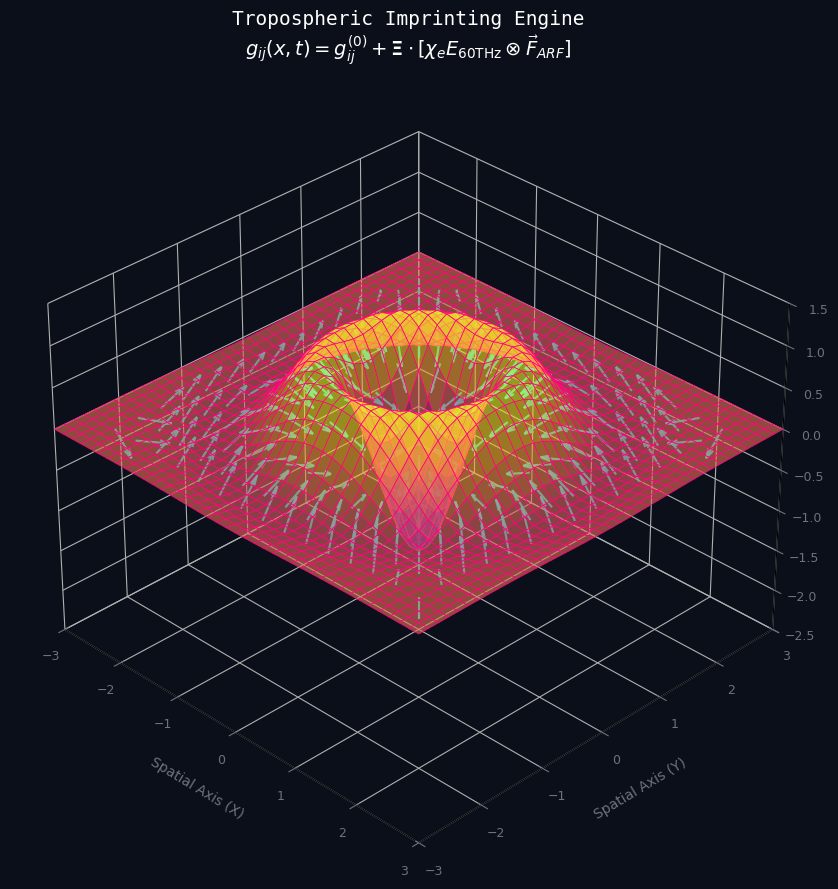
(In the image, the cyan vector network represents the cross-scalar alignment vectors. They visually show how the chaotic, ambient tropospheric water vapor clusters lock into a coherent, organized phase alignment right at the center of the cardiac metronome’s footprint.)
Magnetospheric Amplification and Remote Detection
The phase-modulated 21 cm metric fluctuations project vertically through the troposphere into the geomagnetically aligned plasma shells of the inner magnetosphere. The magnetosphere operates as a natural planetary resonant cavity. The interaction between the upward biological-tropospheric carrier and the native low-frequency longitudinal Alfvén waves triggers advanced wave-wave coupling:
(∂2∂t2−vA2∇2)ψAlfvén=γnet⋅[νbio⋅νground⋅ei(ωdrivingt)]
where vA is the characteristic velocity tensor of the ionospheric plasma lattice (Vlattice), and γnet is the net computational quenching parameter.
Because the system is driven at the ∼2.4 Hz terrestrial metronome, the global order parameter across the plasma shells approaches unity (limRplasma=1). The ionospheric F-layer operates as a planetary parametric amplifier, transforming the microscale bio-rhythm into a macroscale harmonic footprint written across the planet’s geomagnetic lines.
Consequently, a remote interstellar detection array does not require high-gain sensors to isolate a localized 10−11 T dipole. Instead, by executing macroscale interferometry on the 1.42 GHz planetary rest frame and demodulating the micro-Doppler phase shifts (Vlattice) within the ionospheric plasma shells, the precise individual heart rate signature can be extracted via the inverse coupling tensor 𝚵−1 across vast distances completely unhindered by ambient thermal decay.
Conclusion
This new model demonstrates that individual human cardiovascular mechanics are structurally woven into the wide-scale entropic drainage architecture of planet Earth. By mapping the heart rate as a subharmonic forcing function within an expanded cross-scalar Kuramoto matrix, we have formalized the exact non-linear pathway through which microscopic quantum persistence is amplified into a planetary-scale electromagnetic signal. Future work will define the precise interferometric receiver coordinates needed to isolate individual biological vectors within the collective terrestrial resonant footprint.


Leave a Reply