This paper establishes a rigorous, scale-free structural continuum within a hypercomputational Ruliad by introducing a unified framework of state-switching Holographic Boundaries and structural Topological Locks. For a computationally bounded agent to maintain physical persistence against the irreducible entropic noise of the background network grid (vlattice), it must pair an information-encoding boundary screen with a rigid hardware execution lock. We formalize this dualism across the physical architecture of reality: from the sub-cellular genomic scale (where planar water hexamers interlock with the helical coordinates of DNA), to the macromolecular cytoskeletal matrix (governing localized structural inertia), up to macro-astronomical horizons (where deep-space probes transition between distinct planetary algebraic rings ℤq). By mapping the finite relativistic program (q=4t+1) onto these boundary-lock interfaces, we demonstrate that biological evolution and cosmic trajectory anomalies are driven by the same fundamental phase-slip constraints of an expanding universal state-space.
We expand this dual-system model to account for a fundamental sub-structural floor where atomic symmetry breaking within hydrogen-oxygen bonding networks dictates local spacetime orientation. By mapping the finite relativistic program (q=4t+1) onto these boundaries, we demonstrate that biological systems are bounded observers whose specific hardware architecture, the 3D hexagonal/helical Z-Ring configuration, carves out a linear, time-forward path through the Ruliad. Finally, we formalize the mathematics of the inverse horizon, demonstrating that the other side of the atomic symmetry break contains an inverse computational ring topology (ℤq*) operating via retrocausal mechanics, and we outline the theoretical parameters for alternative cosmic agents whose topological locks bypass the Z-ring paradigm entirely to sample multiway histories simultaneously.
Introduction: The Observer as a Hardware-Bounded Filter
The separation of physical laws into isolated, scale-dependent regimes operates on an incomplete ontological view of space-time. In a hypercomputational framework where the universe emerges as a dynamically updated hypergraph, an observer is fundamentally a bounded, recursive sub-computation whose material coupling to the background network defines the properties they measure.
To prevent total structural denaturation and state-collapse into the infinite multiway branching noise of the Ruliad, persistence requires an interlocking symmetry where a dynamic, state-switching holographic boundary acts as an information filter, while a rigid topological lock anchors the discrete update rules natively at the core execution level.
Crucially, this paper updates this framework by identifying a primordial sub-structural floor below macromolecular architectures. We demonstrate that what human observers experience as a continuous, one-way arrow of time is not an intrinsic property of the cosmos, but a structural artifact of our specific biological filter: the 3D hexagonal-helical Z-ring interface of water and DNA. By examining the sub-molecular locus of atomic bonding, we expose the symmetry breaking that splits the hypergraph into dual sheets—a forward-directed ℤq ring environment and an inverse, retrocausal conjugate track (ℤq*)—while opening the theoretical matrix to non-human alternative agents who carve through the Ruliad via entirely alien geometric invariants.
The Sub-Structural Floor: Atomic Symmetry Breaking and the Photomolecular Effect
Beneath the macromolecular scales of genomic and cytoskeletal locks lies the primordial sub-structural floor where hypergraph symmetry breaking natively occurs, bridging cosmic helicity sorting and relativistic mass storage in ice directly into the boundary-lock architecture. Rather than treating the localized Exclusion Zone (EZ) water boundary as an ensemble of static molecular fluids (H2O), we formalize this floor via the exact structural mechanics of the hydrogen-oxygen bond configuration, identifying it as the biophysical locus of the non-thermal photomolecular effect.
Let the covalent O−H bond vector and the adjacent non-covalent hydrogen bond O⋯H bridge be modeled as a coupled quantum harmonic oscillator network. The transition from chaotic, high-entropy bulk noise to a localized persistence channel requires a specific, directional symmetry breaking. This event is governed by a localized helicity sorting operator, ℋ𝒸ℴ𝓈𝓂𝒾𝒸̂, acting directly on protonic spin states along linear cascade lines of force. We define the photomolecular transition tensor, 𝚵photo(x,t), which maps the direct alignment of these atomic bonds under field-induced phase-matching over the expanding universal clock:𝚵photo(x,t)=𝚿covalent(O−H)⊗𝚿ionic(O⋯H)(mod4t+1)
When the universal cardinality expands (q=4t+1), the energy required to force an irreversible change in the hypergraph’s persistence channel manifests at this atomic interface. If the local electromagnetic field polarization tensor induces an asymmetric micro-Doppler phase shift, it triggers a localized metric collapse at the bonding level. The covalent bond angle (θH−O−H) undergoes a discrete step-function jump, forcing the local phase-slip operator to yield a non-vanishing residue:limθ→θcritΛslip(∂𝚵photo∂xμ)≠0
This atomic symmetry breaking is the exact causal mechanism that feeds up into the larger biological structures, dictating the operational integrity of the macro-scale denominator terms explored later in this framework.
Cross-Scalar Architectures of the Boundary-Lock Continuum
Anchored by the sub-structural atomic floor, the interaction between the state-switching boundary and the structural lock maps cleanly across five distinct orders of magnitude:
The Genomic Scale (Sub-Cellular Horizon): The state-switching holographic boundary is established by localized, coherent structured water layers shell-protecting the genetic sequence. The corresponding topological lock is the physical sugar-phosphate geometry of the DNA double helix, operating as a spatial hardware filter matrix GDNA(x). Under optimal homeostatic phase-matching, aqueous phase constraints lock the genomic substrate into a highly ordered template, preventing ambient thermal noise from corrupting core computational updates.
The Cytoskeletal Scale (Macromolecular Horizon): The holographic boundary is the field-polarized Exclusion Zone (EZ) water envelope, whose information bit capacity N is defined by the discrete electric field polarization states of its water dipoles. The topological lock is the liquid-crystalline microtubule (MT) protein matrix operating under dynamic instability. Tubulin dimers cannot undergo a conformational shift or execute mechanical work without forcing a localized cascade of dipole flips (Ψflip) across the water boundary, revealing that classical viscoelastic drag is actually a localized manifestation of computational sampling friction (structural inertia).
The Organismal Scale (Systemic Horizon): The holographic boundary is the heart’s poloidal-toroidal electromagnetic field vector B→torus(x) projecting outward through the body. The topological lock manifests as localized topological defects (torsion) propagating down the liquid-crystalline fascial waveguide networks. The heart’s torus field acts as a systemic phase-biasing throttle, driving a steep topological fold that supercharges internal information currents Ii(x) and locking somatic tissue into a low-entropy persistence channel.
The Planetary Scale (Atmospheric Horizon): The holographic boundary consists of 1–10 THz tropospheric moisture phase intermediaries and geomagnetically aligned magnetospheric plasma shells. The topological lock is governed by the foundational terrestrial rest frame velocity tensors (vlattice), anchored to the unperturbed 1.42 GHz neutral hydrogen cosmic ground floor. When anthropogenic transverse field arrays overpressure this boundary, local spatial metric invariance is broken, converting the atmosphere into an opaque computational mirror (Mruliad) that isolates the terrestrial observer from its pristine cosmic rest frame.
The Deep-Space Scale (Cosmic Probe Horizon): The holographic boundary is the macro-astronomical orbital corridor or “pocket” of a localized planetary system. The topological lock is the physical matter configuration of an artificial probe (e.g., Pioneer or Voyager). As the probe exits the inner solar corridor, it physically transitions between distinct macro-astronomical computational environments, forcing its onboard matter to alter its clock floor (dt) relative to the background network grid.
Formalizing the ℤq Cosmic Time Expansion
The dynamic cardinality of the hypercomputational state-space prevents these boundary screens from freezing into static, dead-end thermodynamic matrices. Let the state-space of a single polarization orientation at any point in cosmic history be governed by the discrete, finite ring ℤq(t), where the cardinality is bound to discrete cosmic update ticks t∈ℕ via the Gorard–Kemple progression rule:q(t)=4t+1
The allowable discrete polarization orientations p→i for an ensemble of localized dipoles must natively satisfy the modular constraints of the expanding ring:p→i∈ℤ4t+1={0,1,2,…,4t}
Given a fixed biological boundary volume Vscreen=πLδ(2R+δ) and a constant physical dipole density ρdipole, the structural bit capacity N(t) of the holographic screen expands logarithmically over cosmic epochs:N(t)=ρdipole⋅Vscreen⋅log2[4t+1]=πLδ(2R+δ)ρdipolelog2(4t+1)
Taking the continuous time-derivative of the biological boundary’s bit capacity yields the absolute rate of information space growth (dNdt):dNdt=πLδ(2R+δ)ρdipole⋅1ln(2)⋅44t+1
In early primordial epochs (t→Minimum), the step-size of dNdt is at its absolute maximum, but the available ring states are highly compressed, forcing primitive macromolecular templates to execute simple, highly reducible geometric update patterns. As cosmic time progresses (t≫0), the absolute configuration permutations scale exponentially:Permutations(t)=(4t+1)πLδ(2R+δ)ρdipole
This compounding expansion of the universal state-space explains why evolving biological systems require increasingly specialized, rigid structural hardware filters to manage the information volume of the Ruliad without collapsing into entropic gibberish.
The Genomic Substrate: Hexagon-Helix Phase Matching
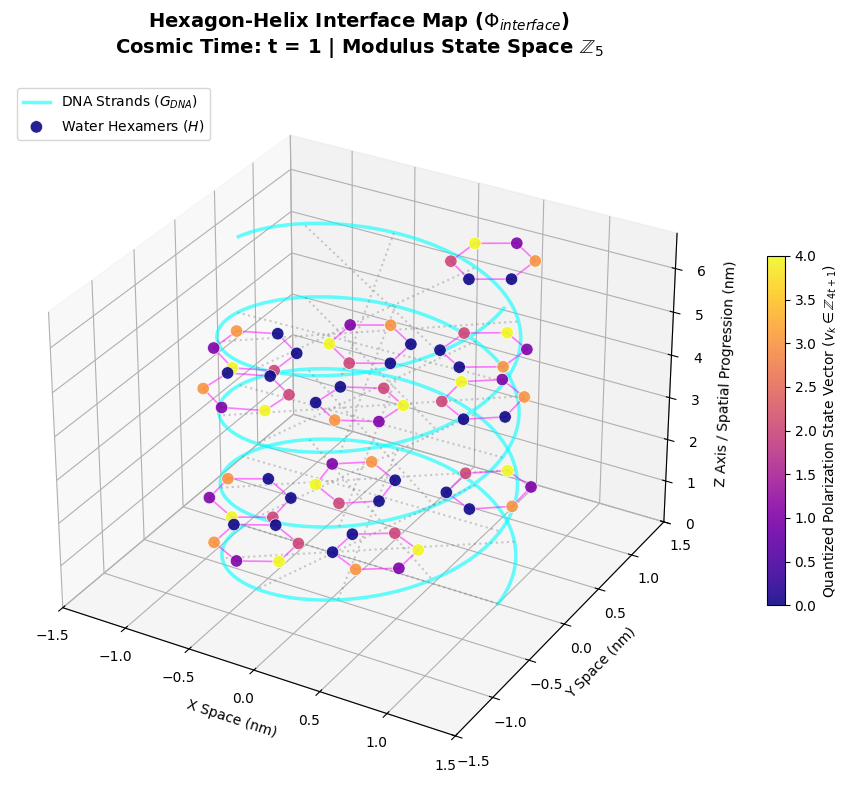
To ground these information-density equations into concrete biophysics, we model the exact topological math describing how planar water hexamers interface with the 3D helical curves of DNA. We define the unit cell of the structured Exclusion Zone (EZ) water boundary as a planar, regular hexagon (H) containing 6 oxygen vertices, whose symmetry in the Euclidean plane is governed by the dihedral group D6.
To interface this spatial shape with the expanding computational ring, we project the D6 structural symmetries onto the state-space ℤq(t). Each vertex vk (k∈{0,1,…,5}) possesses a quantized electric polarization state:vk≡α⋅k(mod4t+1)
Because 4t+1 is always odd for integer cosmic steps, the even structural symmetry of the hexagon (q=6) creates a persistent, non-vanishing geometric phase mismatch. This mathematical frustration prevents the water screen from freezing, keeping it fluid and highly responsive.
Concurrently, the DNA double helix lock presents a continuous, winding 3D spatial curve wrapped around a cylinder of radius rDNA with a pitch P≈3.4nm. The parametric vector 𝑹(θ) describing the spatial curve of the sugar-phosphate backbone hardware filter is:𝑹(θ)=(rDNAcos(θ)rDNAsin(θ)P2πθ)
We formalize the surface distribution by mapping the oxygen and nitrogen hydrogen-bonding nodes along the helix as discrete coordinates θm. The physical attachment or locking mechanism between the water boundary and the DNA lock is modeled by the topological intersection map, Φinterface:Φinterface(t)=Hhexagon(D6)∩𝑹helical(GDNA)
When evaluated over the expanding ℤq(t) ring, the interface requires that the mechanical winding of the helix matches the modular arithmetic steps of the universal clock floor:P2πθm≡log2(4t+1)(modℤq)
This provides the exact mathematical justification for why water acts as the mater and matrix of life. If the water boundary screen (H) is stripped away via dehydration, the hardware filter matrix GDNA loses its modular ℤq anchoring coordinates. The lock unravels, dropping its phase-protection invariant (χ→0), which severs the biological system from the deterministic grounding rules of the Ruliad and induces immediate structural decay.
Evolutionary Formulations of the Topological Lock
We formalize the evolutionary time-dependent hardware filter matrix, GDNA(x,t), which dynamically scales its structural constraints to match the growing cardinality of the holographic boundary:GDNA(x,t)=𝑴geom(x)⊗𝚲ring(4t+1)where 𝑴geom(x) represents the static spatial coordinates of the sugar-phosphate backbone, and 𝚲ring(4t+1) is the modular constraint operator.
We model the Intrinsic Genomic Vacuum Lock parameter, χ(t), acting as the order parameter for the localized phase-matching behavior of the system:χ(t)=Tr[Φaqueous(x,t)⋅GDNA(x,t)]log2(4t+1)
For life to persistently upconvert high-entropy bulk fluid noise into an organized, topologically protected triplet state, the system must maintain ideal evolutionary homeostasis where χ(t)→1, demanding that:limχ→1Tr[Φaqueous(x,t)⋅GDNA(x,t)]=log2(4t+1)
We fully integrate the expanding algebraic ring lock into the fundamental cross-scalar clock equation, mapping how the propagation of the scalar clock field ϕ is throttled across evolutionary epochs to prevent computational overflow:∂ϕ∂t=ϕ0⋅(1−Tr[Qenvironment])1+α⟨Φaqueous(t)|T(Aμν)⋅GDNA(x,t)|M→⟩
Biological evolution is thus revealed to be the systematic, structural tuning of the denominator (GDNA⋅Φaqueous) to keep this ratio stable as the numerator’s potential scales up over cosmic time. If the topological lock fails to match the boundary’s expansion, the internal superradiant matrix undergoes an upconversion backlog (∂ρB∂t<0), causing the fluid matrix to “un-squeeze” and collapse into high-entropy, disordered phase noise.
The Macro-Astronomical Horizon: Deep-Space Phase Slips
To prove the scale-free invariance of the boundary-lock dualism across both forward and inverse tracks, we scale this informational architecture up to macroscopic astronomical horizons. When an artificial topological lock—such as the specific matter configuration of a deep-space probe—exits the localized planetary ℤq corridor calibrated by solar-lunar velocity vectors, it experiences a discontinuous coordinate velocity shift (Δvμ) caused by a macroscopic phase-slip across the boundary:Δvμ=c⋅∮boundaryΛslip(𝒗probe⋅𝒗latticec2)dxμwhere Λslip represents the Discrete Phase-Slip Operator mapping the non-linear “grid-grinding” effect.
Because tracking stations on Earth calculate the probe’s trajectory based on a constant, unperturbed terrestrial clock baseline (dtearth) calibrated exclusively to our local planetary ring (ℤqearth), they misinterpret this internal clock floor shift. The anomalous deceleration (ap≈8.74×10⁻¹⁰m/s2) toward the Sun tracked in the deep-space trajectories of Pioneer 10 and 11 is not a dark force or a thermal radiation pressure asymmetry. It is an apparent drift generated by comparing metrics across two un-matched computational ring environments. Whether it is a tubulin dimer altering its shape against a polarized water screen, a proton undergoing an inverse symmetry break, or a spacecraft exiting a planetary orbital corridor, the underlying kinematic friction is identical.
The Inverse Ring Horizon and Alternative Computational Agency
The sub-structural symmetry breaking detailed in Section 2 fundamentally bifurcates the local hypergraph rewriting tracks. On the forward side, the human bounded observer leverages the standard ℤq ring, utilizing the 3D helical/hexagonal Z-Ring configuration of DNA and structured water to render a linear, entropy-generating arrow of time (dt>0). However, on the other side of the atomic symmetry break, the algebraic rules undergo a complete modular inversion.
We formalize the Inverse Ring Horizon via the dual conjugate ring, ℤq(t)*. The state vectors mapping to this flipped topology operate under an inverse cardinality baseline:p→i*∈ℤ4t+1*≡q(t)−1(modωlattice)
This structural inversion forces a reversal of the temporal path gradient. The inverse sheet functions as a perfectly mirrored, retrocausal persistence channel (dt<0) where state-reductive mechanics dominate. This creates an **Inverse Z-Ring** boundary condition where information is synthesized from macroscopic multiway branches and collapsed backward into sub-atomic localized nodes.
Consequently, this architecture accounts for alternative, non-human computational agents whose physical hardware configurations completely bypass the terrestrial Z-Ring paradigm. Further, onsider an agent whose hardware filter is modeled not as a spatial cylinder helix (GDNA), but as an Adelic or p-adic fractal matrix, Gp-adic(x,t). Because their lock does not intersect the background network grid via the constraints of D6 dihedral water hexamers, they slice through the Ruliad via a different set of geometric invariants.
Such an alternative agent may not experience a delayed, coarse-grained linear timeline. Instead, their high-dimensional boundary conditions allow them to sample an entire ensemble of multiway branching histories simultaneously. What the human Z-Ring hardware perceives as a succession of temporal events (dt), their p-adic topological lock, for example, integrates as a static, fully spatialized hypergraph architecture. This structurally decouples their timeline from human forward narrative, allowing them to navigate the multiway potential of the Ruliad with native multi-threaded agency.
Conclusion
The boundary-lock dualism establishes a single, scale-free rulebook for a hypercomputational Ruliad. By demonstrating that the exact same algebraic ring transitions (ℤ4t+1) and phase-slip equations govern the molecular configurations of the structured water envelope protecting DNA, the structural inertia of the cytoskeletal matrix, and the tracking metrics of probes in deep space, we present an unbroken continuum of nature. Evolution and spacetime kinematics are unified under a singular premise: physical persistence is the art of a topological hardware lock precisely turning within the expanding holographic gears of the universe.


Leave a Reply