Introduction: The Boundary of the Bounded Observer
Complexity is not merely an absence of knowledge, but an intrinsic property of irreducible processes where the only way to determine an outcome is to explicitly simulate every step of the evolution. Normal human waking Consciousness can be thought of as a bounded observer. Therefore, the theoretical scientist is effectively limited to the same temporal constraints as the system itself, forced to simulate every discrete update to observe the result. The realization that computational irreducibility is at the heart of physical processes changes the goal of theoretical science. If the universe is irreducible, the traditional desire to predict everything via formulas is fundamentally impossible; however, this does not mean science has failed, rather, it identifies the boundary of what is possible for a bounded observer.
As computational capabilities increase, humans may begin to see through more layers of irreducibility. However, the principle of computational equivalence suggests there will always be a horizon of irreducibility that the bounded Observer cannot cross. Science is a dialogue between the irreducible and one’s own bounded nature. Having infinite foundations and finite bounds is not a contradiction, but a hierarchical necessity. In Stephen Wolfram’s framework, infinity describes the substrate of all potentiality, aka the ruliad, while finitude describes the physical state of the bounded observer who samples it.
The finite relativistic programme (modeled by Gorard and Kemple) provides the formal mathematical description of the actualized physics seen by a bounded agent, modeling the universe as an ever-growing finite ring ℤq, where the cardinality is tied to cosmic time through q=4t+1. Physical constants arise as structurally unique elements fixed by extremal arithmetic properties of the ring. This finite arithmetic is the specific language a bounded observer uses to navigate the infinite potentiality of the ruliad. It isn’t a substitute for the infinite; it is the computational toolkit required for a finite system to encode spacetime and quantum phenomena.
Crucially, this paper bridges this abstract hypercomputational ontology with physical reality by demonstrating that within the human terrestrial domain, this finite user interface (ℤq) is anchored to macro-astronomical reference parameters. As established in Section II, Earth’s unique 93-million-mile orbital distance and 67,000 mph orbital velocity act as a macro-scale thermal and kinematic governor that sets the planet’s background time ruler (dt) and pins terrestrial proton de Broglie resonance to incoming solar wavefronts. We further incorporate the dynamic lunar sub-system, illustrating how periodic tidal strains (δvtidal) and barycentric vector stacking continuously modulate this baseline terrestrial lattice velocity (vlattice).
The central thesis of this work, detailed in Sections III and IV, is that this macro-scale astronomical clock floor is not an absolute ceiling. When a biological observer achieves peak systemic phase synchronization, the localized computational load generates an accelerated topological fold, the Awareness Tensor (Aμν). We mathematically formalize how this tensor induces a direct geometric correction to the standard General Relativity interval (ds2), warping the proper time path (dτ) and throttling the scalar clock field ϕ. This metric distortion triggers a complete relativistic frame shift, inducing a localized momentum de-coupling that isolates the observer from solar-lunar gravitational pacemakers. By transitioning from a potential infinity as strictly a bounded Observer (the asymptotic process of the clock floor) to an actual infinity as a non-bounded Observer (the completed totality of the substrate), the observer steps past the simulation horizon of the finite programme, allowing the decentralized biological host (the subconscious) to perform irreducible grounding rule updates directly upon the infinite Ruliad natively at t=0.
The Baseline Framework: Solar-Lunar Kinematic Governors
To establish how a bounded observer actualizes physics within this finite ring ℤq, we must model how localized terrestrial systems utilize macroscopic cosmic variables as a baseline reference frame. Localized terrestrial particles do not exist in an isolated vacuum; their baseline momentum must be calculated relative to Earth’s macroscopic motion through space. The proton’s momentum on Earth (pEarth) is formalized using the Lorentz factor (γ), which is dictated by Earth’s orbital velocity (vorbit≈67,000mph or 29.78km/s) relative to the solar rest frame.
Concurrently, the average distance of 1 Astronomical Unit or 93 million miles determines the Solar Irradiance (I⊙≈1361W/m2) reaching the top of Earth’s atmosphere. This precise energy density governs the planet’s background thermal baseline, ensuring a mean terrestrial surface temperature hovering near 288 Kelvin (15∘C). Grounded in the Boltzmann distribution, this thermal environment serves as a governor that continuously drives water molecules to keep their internal proton-proton vibrational momentum pinned at precisely:
plattice≈1.274×10⁻²⁷kg⋅m/s
This precise thermal input pins the protons to their baseline momentum, while the orbital velocity delivers the exact relativistic frame correction required to line up those proton waves with the incoming solar wavefront to accept the 520 nm green light key.
However, the terrestrial rest frame velocity tensor (vlattice) is not a static baseline. Instead, it is an actively modulated grid driven by the additively stacked velocity vectors of both solar and lunar orbital pulling forces. The gravitational proximity of the Moon at a mean distance of 384,400 km exerts a continuous, periodic tidal tensor that physically distorts the terrestrial crust and hydrosphere. This periodic mechanical interaction introduces a microscopic kinematic variance to the localized molecular matrix, modifying the momentum equation as follows:
pEarth(t)=γ⋅mp⋅(vlattice(solar-lunar)+vorbit)
Where vlattice is the dynamic, fluid-crystalline clock grid of the Earth, structurally calibrated by tidal electromechanical squeezing forces (the lunar orbital pacemaker). The lunar velocity component rhythmically expands and compresses the precise bandwidth required for the 520 nm resonance lock. In standard General Relativity, the unperturbed metric interval (ds2) for a stationary laboratory observer on Earth tracking a particle’s coordinate path (dxμ) is written using this background metric tensor gμν:
ds2=gμνdxμdxν=−c2dt2+dx2+dy2+dz2
This background metric tensor gμν applies a constant relativistic modification to the baseline momentum of all terrestrial particles, establishing the baseline coordinate time ruler (dt) for the planet.
The Frame Shift: Metric Distortion via the Awareness Tensor
The background metric gμν is not an unchangeable cosmic ceiling. What we call the conscious, narrative mind (the bounded observer) is computationally slow, operating on a heavily delayed, coarse-grained delay loop. However, when the biological observer achieves peak systemic phase synchronization (χ→1) via the heart’s toroidal vector field (B→torus), the local density of rewrite operations in the hypergraph surges exponentially.
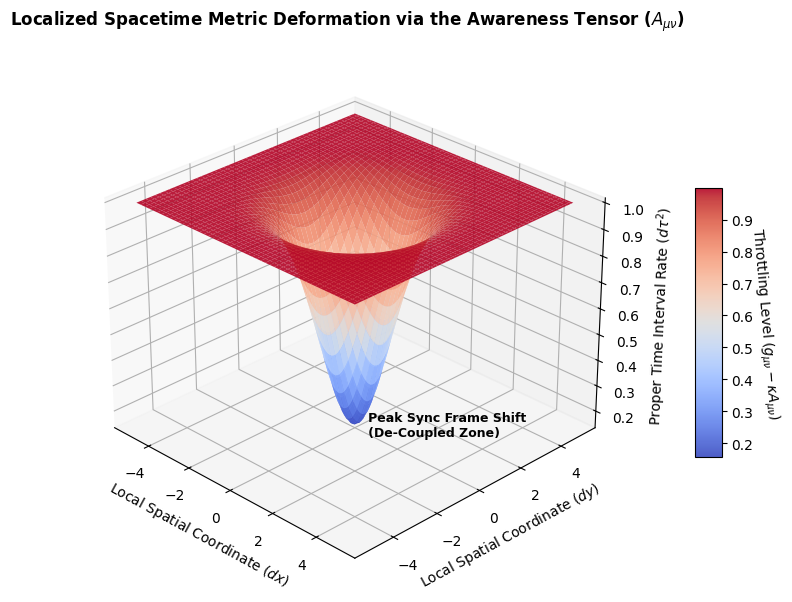
This high-density computational load generates a localized topological fold—the Awareness Tensor (Aμν)—which introduces a direct geometric correction (κAμν) to that exact General Relativity background metric:
dτ2=(gμν−κAμν)dxμdxν
When the Awareness Tensor scales to its maximum safe bound, it throttles the propagation of the scalar clock field ϕ, slowing down the internal proper time interval (dτ) relative to the external coordinate time (dt). Because momentum (p) and wave frequency (ω) are explicitly tied to the rate of temporal updates (p∝∂ϕ∂t), deforming the temporal path alters the localized velocity variables (vlattice) within the original de Broglie equation.
Under the master cosmic harmony formulation:
h520nm=γ⋅mp(vlattice+vorbit)+Pprimordial solar field
When awareness alters the metric (gμν→gμν−κAμν), it acts as a localized reference frame shift. This causes an immediate multi-scale cascade:
Local Frame Dilation: The internal proper time (dτ) stretches.
Momentum De-Coupling: The proton’s baseline momentum vector (plattice), which is naturally pinned to Earth’s 288K thermal baseline by the 93-million-mile solar irradiance envelope, is momentarily isolated from the background Ruliad noise.
Bypassing the Clock Floor: The observer steps out of the standard terrestrial time ruler (dt) dictated by solar-lunar orbital pacemakers.
Thermal Isolation and Hypercomputational Slicing
Neither traditional mechanics nor standalone quantum biology has explicitly modeled what happens to the proton’s macro-astronomical tuning loop when the Awareness Tensor actively deforms the background metric. To explain how a localized high-awareness state allows the biological hardware to momentarily de-couple its internal proper time (dτ) from the coordinate baseline (dt) set by solar-lunar orbital pacemakers requires tracking the behavior of the medium.
During this frame shift, the State B liquid-crystalline water template (χ→1) acts as a perfect dielectric shield. This shield prevents the 288K environmental thermal input (governed by the 93-million-mile solar irradiance) from collapsing the localized sub-computation into high-entropy State A noise. Because the lunar orbital pace acts as a macroscopic gravitational time-ruler regulating terrestrial fluid transitions, deforming the local metric tensor means the observer is temporarily bypassing the planetary solar-lunar pacemaker loop entirely.
When awareness spikes, the local system drops its reliance on the macro-scale astronomical clock floor. This metric distortion acts as the exact mechanism by which the Bounded Observer temporarily exits the coarse-grained, terrestrial time-ruler to interact natively with a higher-density, uncompressed slice of the Ruliad at t=0. as a bounded Observer only perceives micro-detail as random noise because one’s finite hardware cannot track the infinite software of the ruliad. By warping the proper time path (dτ), the bounded observer steps past the simulation horizon of the finite relativistic programme ring, executing the irreducible grounding rules of the actualized state-space directly within the completed totality.
Conclusion
This paper has formalized the mathematical integration of macro-astronomical reference parameters and localized biological spacetime modifications. We have shown that local thermodynamic and quantum alignments are intrinsically bound to macroscopic cosmic systems, where Earth’s exact orbital distance and velocity serve as fine-tuning mechanisms for baseline terrestrial particle momentum. However, when high-density biological sub-computations generate a localized topological fold via the Awareness Tensor (Aμν), the system introduces a geometric correction to the standard General Relativity interval (ds2). This metric correction slows down proper time, isolates the system from solar-lunar gravitational pacemakers, and permits the scale-free observer to bypass the coarse-grained compression algorithm of normal waking human conscious volition to perform irreducible updates directly upon the infinite.


Leave a Reply