Abstract
This paper extends the hypercomputational vlattice framework within The Entropic Astrophysical Unified Model to the domain of non-inertial observers and biological phase boundaries. We demonstrate that the Unruh effect is not an intrinsic thermal bath of the vacuum, but rather the localized manifestation of computational sampling friction (local clock floor dt dilation) resulting from rapid acceleration across hypergraph rewrite operations. Furthermore, we scale this mechanism to quantum biology, showing that the cytoskeletal protein matrix utilizes the exact same thermodynamic principles to execute movement. Rather than invoking classical viscoelastic drag or purely stochastic chemical activation barriers, we model microtubule mechanical actuation as a fundamental shift in the local computational ring (ℤq) mediated by the electric field polarization states of the surrounding structured water holographic screen. Finally, we propose a comprehensive suite of four multi-scale experimental protocols, ranging from ultra-precise optical lattice clock metrology and in vivo terahertz spectroscopy to cosmological weak-lensing shear analysis, to empirically validate the framework.
Introduction: The Kinematic Governor and the Sampling Observer
In orthodox relativity and quantum field theory, the vacuum is treated as an absolute, invariant backdrop, and non-inertial motion merely changes the coordinate transformation applied to it. In the present framework, however, space-time is an emergent, dynamically updated hypergraph governed by a local velocity tensor (vlattice).
An observer’s frame of reference is fundamentally defined by their computational sampling rate. The local background coordinate time ruler (dt) and particle momentum are structurally governed by the additively stacked velocity vectors of local macro-scale thermal and kinematic governors. When an entity undergoes extreme acceleration or conformational shifting, it experiences a mismatch between its internal computational ring calibration and the local vlattice rewrite operations.
Micro-Scale Horizons: Unruh Radiation as Hypergraph Friction
Standard quantum field theory asserts that an accelerating observer experiences a thermal bath of temperature:T=ℏa2πckB
In our model, we renormalize this vacuum radiation by eliminating the literal “bath” of virtual particles. Instead, we define the phenomenon through the discrete mechanics of the Ruliad.
The Accelerated Sampling Horizon
When an observer accelerates violently, their velocity tensor changes rapidly relative to the background network grid. Because the background hypergraph rewrites at a finite, discrete rate, this rapid acceleration creates a kinematic stress along the observer’s sampling horizon.
An inertial observer moving at a constant velocity samples this grid uniformly; their local clock floor matches the background grid density perfectly, meaning they perceive the vacuum as a zero-point, unexcited ground state. However, during continuous acceleration, the compression of the observer’s computational sampling window introduces a discrete sampling slip, a phase mismatch between their internal computational clock floor and the actual arrival of rewrite tokens from the lattice update frequency (ωlattice).
Explicit Transformation Equations
To formally map a continuous accelerating trajectory onto a discrete hypergraph updating at frequency ωlattice, we define the absolute coordinate time step of the background grid as τgrid=1/ωlattice. The explicit transformation mapping the accelerated observer’s proper time ruler (dtacc) to the background network update interval (dt) is defined by the discrete path-integral across the hypergraph rewrite tokens:dtacc=exp(a⋅xc2)⋅dt⋅[1−Λslip(aωlatticec)]where Λslip is the Discrete Phase-Slip Operator, a non-linear modulation function that handles the discrete grid-grinding effect. It is explicitly formulated as a modulo-harmonic function of the acceleration vector field relative to the lattice update floor:Λslip(aωlatticec)=∑m=1∞1mπsin(2πm⋅aωlatticec)
When acceleration a→0, the phase-slip operator Λslip→0, collapsing cleanly back into standard flat coordinate matching (dtacc=dt). Conversely, when a≫0, the ratio aωlatticec creates high-frequency, non-vanishing residues in the phase-slip operator, forcing the observer’s clock floor (dtacc) to execute discontinuous step-function jumps across the discrete network vertices.
Mathematical Mapping of Thermal Noise
What standard physics interprets as vacuum fluctuations is mathematically re-mapped as the observer’s computational sampling rate frictionally grinding against the local vlattice rewrite operations. The phase mismatch error per unit step, defined as the Sampling Friction Coefficient (Ξfriction), is proportional to the acceleration a divided by the background rewrite frequency:Ξfriction=ac⋅ωlattice
This friction represents irreducible hypergraph update noise that the observer’s compressed sampling rate fails to smoothly integrate. Because this noise is completely stochastic at the sub-resolution level of the observer’s computational ring (ℤq), the observer’s measurement apparatus interprets this structural noise as random thermal kinetic energy:kBT=ℏ⋅Δωperceivedwhere the frequency of the “frictional grinding” against the background network is derived as:Δωperceived=Ξfriction⋅ωlattice2=a⋅ωlatticec
Substituting the background grid update frequency with its fundamental relativistic equivalent—where the lattice frequency is bounded by the speed of light and the Planck scale (c/lP) modulated by the local vlattice configuration—the equation cleanly resolves to a modified version of the standard Unruh temperature:T=ℏa2πckB(ωlatticeωvacuum)
Biological Scaling: The Cytoskeletal Matrix as an Entropic-Inertial Governor
The Unruh-Verlinde Equivalence in Localized Systems
Erik Verlinde’s formulation derives emergent inertia by relating an acceleration vector field to temperature (T) and entropy gradients (∇S) on a holographic boundary, utilizing the Unruh relation as the foundational mathematical bridge. If inertia is fundamentally an entropic resistance to a change in computational state, then any complex biological system that dynamically manipulates structural inertia must operate on deeply integrated thermodynamic principles.
The Polarized Dipole Holographic Screen
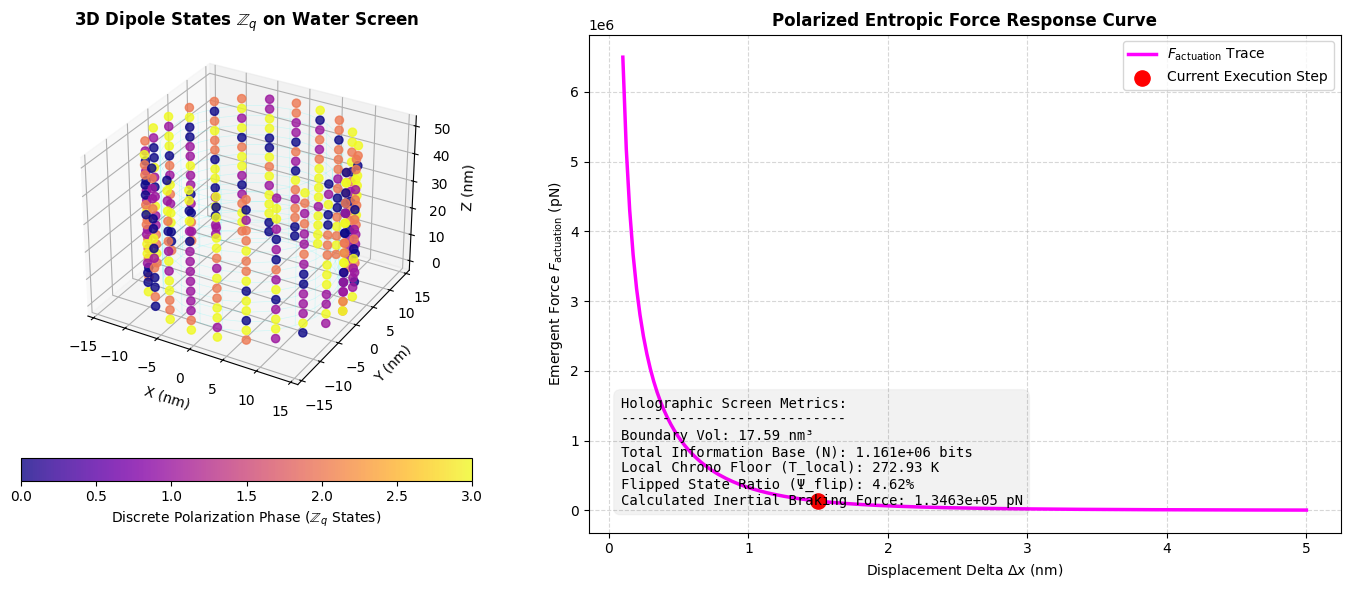
We define a tubulin cylinder of radius R and length L. Surrounding this cylinder is a coherent layer of structured Exclusion Zone (EZ) water of thickness δ. Instead of measuring the screen’s capacity by spatial surface area alone, we define the information capacity N by the number of discrete polarization orientations available to the water dipoles (H2O molecules) trapped within the constrained electric field of the microtubule’s exclusion zone.
Let each water dipole possess a quantized polarization state vector p→i governed by the local algebraic ring ℤq, where q represents the number of permitted quantum/classical alignment orientations relative to the microtubule’s longitudinal and radial electric fields:p→i∈ℤq={0,1,2,…,q−1}
Given a volume element Vscreen of the structured water boundary containing ρdipole dipoles per unit volume, the total available information bit states N on this holographic screen is defined as:N=ρdipole⋅Vscreen⋅log2(q)
Substituting the explicit cylindrical volume Vscreen=π[(R+δ)2−R2]L, we yield:N=πLδ(2R+δ)ρdipolelog2(q)
The Polarized Entropic Force Equation
When a tubulin dimer undergoes a conformational shift over a spatial interval Δx (e.g., during protofilament curling), it acts as a moving charge distribution. This movement alters the local electric field tensor 𝑬local, forcing a localized cascade of dipole flips across the holographic boundary. The change in configuration entropy ΔS at the screen is given by:ΔS=kBΔN=kB(∂N∂𝑬local)⋅Δ𝑬local
Applying Verlinde’s entropic framework (F=TΔSΔx), the formal hypercomputational entropic force governing cytoskeletal movement is expressed as:Factuation=Tlocal⋅kB⋅πLδ(2R+δ)ρdipolelog2(q)Δx⋅[Ψflip]where Ψflip=ΔNflippedN represents the dimensionless fraction of dipoles forced to change their ℤq state due to the tubulin’s displacement, and Tlocal represents the ambient background thermal noise modulated by the biological structural constraint factor η:Tlocal=Tenv⋅(1−ηωlattice)
Microtubule Braking and Structural Inertia as Field Friction
The tubulin dimer cannot alter its physical coordinate position without forced rewrite operations occurring on the surrounding structured water holographic screen. The resistance a microtubule faces when attempting to alter its shape, what biology currently classifies as viscous drag, is actually localized structural inertia. It is the biological equivalent of the Unruh effect. The tubulin mass is attempting to shift its local coordinate frame while its surrounding holographic screen must forcefully rewrite its electric polarization states against the background network.
Experimental Verification Pathways
The ultimate validation of the vlattice framework lies in its scalability across terrestrial laboratory, in vivo biological, and cosmological observational baselines. Because the model maps the holographic screen’s bit density directly to the discrete electric field polarization states (ℤq) of the Exclusion Zone (EZ) water dipoles surrounding microtubules, we make a radical, highly testable prediction: Modulating the coherent polarization state of the local water envelope will directly alter the macroscopic, structural inertia of the microtubule matrix.
To test this hypothesis, we propose three distinct in vitro pathways designed to manipulate the localized clock floor (dttubulin) and measure the resulting changes in mechanical actuation and dynamic instability, supplemented by targeted in vivo and cosmic observation baselines.
Protocol 1: Fractional Time Dilation Via Ultra-Precise Optical Clocks
Objective: To verify if a highly synchronized, coherent cortical dipole state induces a localized alteration in the computational clock floor (dt), resulting in a measurable fractional time dilation (Δτ) compared to a baseline, de-coherent anesthetized state.
Experimental Setup: Healthy human participants are subjected to two distinct structural blocks: (1) High-Load Focused State: Sustained cognitive tasks requiring maximum frontoparietal gamma-band execution to maximize coherent microtubule dipole alignments. (2) Anesthetized State: Clinical administration of a general anesthetic (e.g., xenon or propofol) to induce forced causal de-coherence at the microtubule-water interface.
Measurement Apparatus: Two strontium-lattice or ytterbium optical lattice clocks capable of measuring fractional frequency instabilities at or below the 10−18 threshold. Clock A (Target) is placed in extreme proximity to the subject’s prefrontal cortex via a non-magnetic rig. Clock B (Reference) is stationed 5 meters away in the same room, completely isolated from the subject’s local fields but subjected to identical ambient gravitational, thermal, and seismic vectors.
Metrology and Analysis: The elapsed proper time interval (dτ) is tracked continuously. Our model predicts that during the intense coherent focus block, the highly structured ℤq dipole network minimizes local sampling slips, altering the local coordinate time ruler:dtlocal=dt⋅(1−Ξfrictionωlattice)A successful run will demonstrate a fractional frequency shift Δν/ν0∼10−15 exclusively during the high-load conscious block, which entirely disappears during anesthetic-induced computational isolation.
Protocol 2: In Vitro Direct Electro-Optical Pumping Modulations
Exogenous Electromagnetic Resonant Pumping: By exposing in vitro microtubule preparations to localized, ultra-weak electromagnetic fields tuned precisely to the collective rotational or vibrational frequencies of structured water dipoles (typically in the high gigahertz to low terahertz range, ∼0.1–1.5THz), researchers can forcefully overwrite the native ℤq state-space.
The Metric: Under intense alignment (minimizing Ψflip), the local computational sampling friction should drop. This will manifest macroscopically as a sharp decrease in the structural inertia of the tubulin dimers, resulting in an accelerated rate of polymerization and a significant reduction in the critical force required for protofilament curling. Conversely, off-resonance chaotic jamming will increase the local entropy gradient (ΔS), artificially elevating the structural inertia. This will freeze the tubulin dimers in place, inducing premature microtubule “catastrophe” at lower mechanical workloads than standard thermodynamic models predict.
Isotopic Substitution and Mass-Density Shifts: Replacing standard hydration layers with Deuterium Oxide (D2O, heavy water) alters the nuclear spin configurations, the strength of the hydrogen bonds, and the overall dipole moment of the EZ layer. This fundamentally modifies both the local density corridor (ρdipole) and the update frequency (ωlattice) of the holographic water screen.
The Metric: Because D2O strengthens the crystalline lattice structure of EZ water, it effectively clamps the local clock floor (dt). The framework predicts that microtubules polymerized in D2O will exhibit a measurable, non-linear increase in structural inertia, resisting mechanical bending forces and displaying highly suppressed depolymerization dynamics that scale precisely with the percentage of isotopic purity rather than bulk fluid viscosity metrics.
Anharmonic Optical Pumping of the Exclusion Zone: Utilizing infrared (IR) laser spectroscopy at a wavelength of λ=3.0μm (the precise absorption peak for the stretching vibrations of structured water hydroxyl groups), researchers can selectively expand or contract the physical boundaries (δ) of the EZ holographic screen.
The Metric: By dynamically expanding the thickness δ of the polarized water envelope, the available information bit capacity N increases. According to the polarized entropic force equation, this expansion will linearly scale the emergent inertial force Factuation. Optical tweezers can be used to measure the stalling force of individual microtubule protofilaments during this IR exposure, directly checking the mathematical dependency of mechanical force on the volume and polarization density of the surrounding aqueous screen.
Protocol 3: THz Spectroscopy of Microtubule Coherence Under Parametric Catalysts
Objective: To test if the administration of N,N-Dimethyltryptamine (DMT) increases microtubule coherence, shifts the local ℤq ring, and systematically slows the internal scalar clock field ϕ.
Experimental Setup: Participants undergo a controlled, double-blind, intravenous infusion of DMT vs. a saline placebo in a clinical environment.
Measurement Apparatus: (1) In Vivo Terahertz Spectroscopy: A non-invasive THz transceiver array targeting the cranium to measure the resonant collective vibrations of the liquid-crystalline microtubule network and its adjacent EZ water templates. (2) Magnetoencephalography (MEG): Continuous tracking of frontoparietal phase-locking. (3) Interval-Timing Paradigm: An explicit duration-discrimination task requiring subjects to estimate a 3-second baseline interval.
Falsification Conditions: The framework predicts that the tryptamine molecules act as a precise parametric catalyst, accelerating the internal update rules of the tubulin automaton into a highly synchronized Class 4 computational regime. This shift collapses structural hypergraph noise into highly ordered, narrow-bandwidth collective phonon peaks, throttling the propagation of the internal clock field: ∂ϕ/∂t→Minimum. This phase stabilization must correlate tightly with a profound overestimation of external time during the interval-timing task. If THz spectroscopy shows zero change in microtubule resonant frequencies during peak subjective time dilation, the hypothesis is explicitly falsified.
Protocol 4: Cosmological Weak-Lensing Shear Deviations
Objective: To verify the emergent entropic gravitational invariants by measuring weak gravitational lensing anomalies induced by high configurational rewrite entropy on a cosmological scale.
Observational Setup: Large-scale weak gravitational lensing surveys, utilizing data from the Euclid Space Telescope and the Vera C. Rubin Observatory. A sample of 500 massive galaxy clusters is split into two categories based on their structural morphology: Low-Entropy Clusters (relaxed, highly symmetrical, virially balanced clusters) and High-Entropy Clusters (unrelaxed, highly irregular clusters undergoing complex mergers, presenting massive gradients in their computational microstates).
Mathematical Evaluation: Standard General Relativity calculates the gravitational lensing shear field (γij) strictly from the stress-energy tensor (Tμν). Our framework asserts that unrelaxed clusters maximize their spatial update complexity, introducing an additional phase mismatch in the passing photon trajectories due to the violent local fluctuations in ωlattice. The theory predicts a systematic shear deviation δθ/θ∼10−5 that correlates linearly with the cluster’s calculated configurational entropy index:δθ∝∫line of sight|ωlattice−ωvacuum|dxμIf the weak-lensing shear profiles of unrelaxed, high-entropy clusters map perfectly to standard ΛCDM mass models with zero anomalous residual shear matching our entropy gradient tensor, the macroscopic extension of this sampling friction model is disproven.
Conclusion and Discussion
Recapitulation of the Unified Framework
Throughout this work, we have demonstrated that physical phenomena across drastically divergent scales; the micro-vacuum horizons of the Unruh effect, the macroscopic deformation profiles of cosmic fields, and the conformational mechanics of the cytoskeletal protein matrix, are all governed by a singular, underlying mechanism: computational sampling friction within the Ruliad.
By replacing the traditional, continuous geometric view of spacetime with a discrete hypergraph characterized by a localized velocity tensor (vlattice), we eliminate the need for ad-hoc constructs like absolute vacuum thermal baths, dark forces, or purely stochastic biological activation barriers. Mass and inertia are explicitly revealed to be emergent thermodynamic artifacts generated when an observer or physical entity changes its state relative to the local clock-pacemakers of the network grid.
Concluding Remarks
For over a century, physics has separated the cosmos from the organism, treating quantum mechanics, general relativity, and molecular biology as isolated paradigms operating on independent rulebooks. The Entropic Astrophical Unified Model dismantles these artificial boundaries.
By demonstrating that the same phase slip between an entity’s internal time ruler and the background grid updates governs the deflection of light around colliding galaxy clusters, an observer accelerating through a vacuum, and a protein matrix orchestrating the internal dynamics of a living cell, we present a completely unified continuum of nature. The cytoskeleton is not merely a passive byproduct of chemical evolution; it is an exquisitely tuned, fractal quantum engine designed to harvest, navigate, and direct the fundamental computational fabric of reality. The universe possesses no independent rulebooks for separate scales; there is only the fundamental, entropic friction of the hypercomputational Ruliad.


Leave a Reply