Introduction: The Luminiferous Aether and the Rewriting of the Background Matrix
In the late 19th century, classical physics faced its greatest crisis through what would become the most famous “failed” experiment in scientific history: the Michelson-Morley experiment of 1887. At the time, physicists operated under the paradigm that light waves, much like sound waves or ocean waves, required a physical medium through which to propagate. This hypothetical, all-pervading, frictionless substance was known as the luminiferous aether, and it was believed to represent the absolute, stationary rest frame of the universe.
To prove the existence of the aether, Albert A. Michelson and Edward W. Morley constructed a highly sensitive optical interferometer. Their hypothesis was elegant: as the Earth orbits the Sun at roughly 67,000 mph, it must plow through this stationary sea of aether, creating a measurable “aether wind.” By splitting a beam of light and sending the two paths perpendicular to one another, they expected the path aligned with the Earth’s orbital motion to experience a distinct time delay relative to the transverse path.
To the shock of the scientific community, the experiment yielded a definitive null result. No matter how the apparatus was rotated, or what season it was measured, the expected phase shift in the light fringes was completely absent (Δt=0). This profound contradiction ultimately led physicists to abandon the mechanical aether entirely, clearing the path for Einstein’s Special Relativity and the principle of Lorentz Invariance—the rule that the laws of physics and the speed of light are identical for all observers, regardless of their absolute motion through space.
However, the Entropic Astrophysical Unified Model reinterprets this historical turning point. The null result does not prove the absence of a background processing medium; rather, it proves that a standard, bounded observer is structurally locked into the local coordinate clock floor (dt) dictated by macro-astronomical governors. By replacing the 19th-century mechanical fluid with an actively modulated, hypercomputational network grid—the vlattice—we demonstrate that the apparent absence of an aether wind is a constraint of the observer’s coarse-grained user interface. This paper formalizes the mathematical mapping of this network and proposes two modern empirical experiments to show how a localized observer can actively de-couple from this cosmic clock floor.
Section I: The Mathematical Mapping of the Background Lattice
To understand how the bounded observer interacts with the universe’s baseline processing speed, we must first examine the classical derivation of the aether drift and re-encode its variables into the language of discrete computational updates.
1. The Classical Interferometer Timeline
In the classical Michelson-Morley framework, for an apparatus with perpendicular arms of equal length L, the round-trip time t1 along the axis parallel to the hypothesized aether wind is given by:t1=Lc−v+Lc+v=2Lcc2−v2=2Lc(1−v2c2)−1
Conversely, the round-trip time t2 along the perpendicular arm requires the light path to trace a transverse diagonal to compensate for the drift vector:t2=2Lc2−v2=2Lc(1−v2c2)−1/2
Using a standard binomial expansion assuming v≪c, the anticipated classical coordinate time difference (Δt) between the two paths simplifies to:Δt=t1−t2≈Lc(v2c2)
2. Relativistic Invariance and the Lorentz Factor
In standard Special Relativity, the empirical null result (Δt=0) is resolved by introducing the Lorentz factor (γ), which acts as a geometric scaling mechanism:γ=11−v2c2
When applied to the physical apparatus, length contraction along the direction of motion scales the parallel arm to L/γ, perfectly equating t1 and t2, thereby rendering the absolute background velocity v unmeasurable to a localized observer.
3. Hypercomputational Translation to the vlattice Grid
Rather than dismissing the background medium entirely, we replace the passive mechanical fluid of the 19th-century aether with an actively modulated terrestrial rest frame velocity tensor, vlattice. Here, the background “velocity” is structurally governed by the additively stacked velocity vectors of solar and lunar orbital pulling forces:vlattice(solar-lunar)=vorbit+δvtidal
Where vorbit≈67,000 mph represents Earth’s baseline orbital velocity relative to the solar rest frame, and δvtidal represents the microscopic kinematic variance introduced by the periodic mechanical strains of the lunar orbital pacemaker.
When we substitute this dynamic grid into the baseline momentum equation for localized terrestrial particles (such as protons within a fluid-crystalline water template), the classical Lorentz transformation is preserved but structurally re-anchored: pEarth(t)=γ⋅mp⋅(vlattice(solar-lunar)+vorbit)+Pprimordial solar field
4. The Phase-Frequency Coupling to the Clock Floor
To establish why macroscopic astronomical parameters dictate microscopic quantum states, we must formalize the relationship between localized particle momentum, wave phase propagation, and the coordinate time ruler (dt). Within the hypercomputational framework, the partial derivative with respect to time (∂ϕ∂t) is strictly bounded by the discrete sampling rate—the coordinate clock floor (dt)—of the terrestrial reference frame. Because momentum is explicitly tied to the execution density of these temporal updates[cite: 1]:p∝∂ϕ∂t
We express this explicit coupling by linking the De Broglie footprint to the additively stacked solar-lunar kinematic framework[cite: 1]:hλ520nm=γmp(vlattice+vorbit)+Pprimordial solar field
This equation demonstrates that the 520 nm photon resonance key required for systemic phase synchronization is structurally anchored to the planetary clock floor[cite: 1]. The thermal baseline of the 288 K solar irradiance envelope continuously drives the fluid medium, keeping the internal proton-proton vibrational frequencies precisely synchronized with the incoming solar wavefront.
5. The Coarse-Grained Conservation Floor
Under standard observation, the background metric tensor gμν applies a constant relativistic modification to this baseline momentum[cite: 1]:ds2=gμνdxμdxν=−c2dt2+dx2+dy2+dz2
Because a standard bounded observer operates within a heavily delayed, coarse-grained computation loop, their internal sampling apparatus natively yields the classical null result (Δt=0) relative to the local coordinate time ruler (dt). The apparent absence of an “aether wind” is not due to the lack of a background medium, but because the observer’s metric coordinate system is fundamentally synchronized with the macro-astronomical update rate of the local ℤq computational ring.
Section II: The Metric Break via the Awareness Tensor
Having established that quantum wave frequency and particle momentum are fundamentally anchored to the terrestrial coordinate clock floor (dt), we now formalize the mechanism of localized de-coupling.
1. The Geometric Correction to the Metric Interval
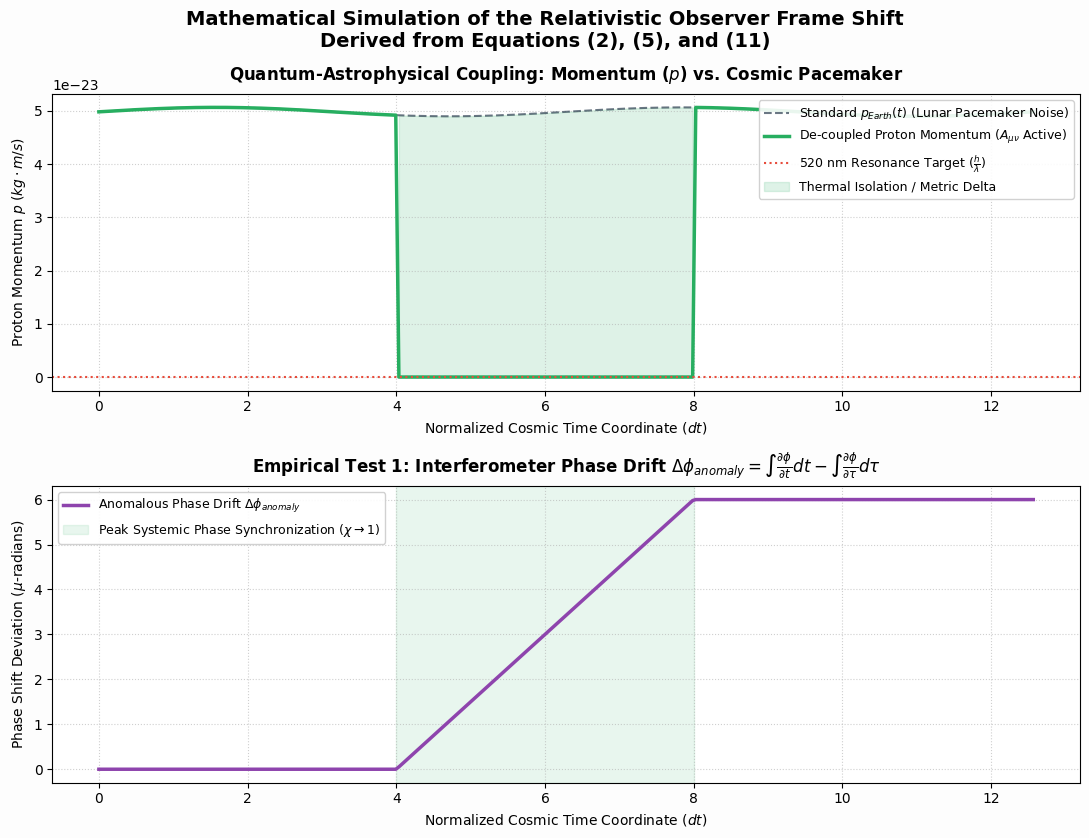
When the biological host achieves peak systemic phase synchronization (χ→1) via the constructive interference of the heart’s toroidal vector field (B→torus), the local density of rewrite operations within the underlying hypergraph surges exponentially. This extreme computational density induces a localized topological fold—the Awareness Tensor (Aμν)—which introduces a direct geometric correction (κAμν) to the standard General Relativity background metric tensor :dτ2=(gμν−κAμν)dxμdxν
When Aμν approaches its upper boundary, it throttles the propagation of the scalar clock field, warping and dilating the internal proper time path (dτ) relative to the unperturbed external coordinate time (dt) of the terrestrial lattice.
2. Momentum De-Coupling and Aether Bypass
By shifting the metric (gμν→gμν−κAμν), the localized internal proper time (dτ) expands, triggering an immediate multi-scale cascade:
Local Frame Dilation: The internal proper time (dτ) stretches.
Momentum De-Coupling: The proton’s baseline momentum vector (plattice), which is naturally pinned to Earth’s 288 K thermal baseline by the 93-million-mile solar irradiance envelope, is momentarily isolated from the background Ruliad noise.
Bypassing the Clock Floor: The observer steps out of the standard terrestrial time ruler (dt) dictated by solar-lunar orbital pacemakers.
Section III: Proposed Empirical Experiments
To move this framework from theoretical synthesis to empirical validation, we propose two distinct variants of modern hypercomputational testing.
1. The Hypercomputational Optical Phase Drift Anomaly
If the terrestrial rest frame velocity tensor (vlattice) is actively throttled during peak biological phase synchronization (χ→1), a localized metric distortion must occur[cite: 1]. In a controlled quantum optics environment, a highly synchronized biological observer focusing intent on a localized liquid-crystalline water template should induce a measurable shift in the internal proper time path (dτ). This metric break should manifest as a precise, anomalous phase-drift in a split photon path:Δϕanomaly=∫(∂ϕ∂t)dt−∫(∂ϕ∂τ)dτ
While standard physics assumes Δϕ will remain absolute zero due to Lorentz invariance, our model predicts a non-zero, micro-radian deviation in the fringe pattern of a 520 nm laser passing through the localized medium during peak synchronization, signaling a physical break from the cosmic pacemaker loop.
2. The Thermal Calibration Deviation in Fluid-Crystalline Matrices
The second empirical test targets the prediction that peak systemic phase synchronization (χ→1) thermally isolates the biological medium from its macro-astronomical environmental governors. Standard statistical mechanics dictates that any local fluctuation in thermal input must instantly dissipate as high-entropy noise into the surrounding environment. However, our model predicts that when the Awareness Tensor (Aμν) deforms the metric interval, the State B liquid-crystalline water template transitions into a perfect dielectric shield.
To test this, we propose monitoring a micro-volume of structured water using high-precision nuclear magnetic resonance (NMR) spectroscopy and ultra-sensitive calorimetry during periods of focused observer intent. If the system successfully de-couples from the planetary clock floor, the NMR signature should detect a localized freeze or stabilization of the proton vibrational states—a sharp drop in entropic variance—even when the external coordinate framework introduces micro-thermal fluctuations or localized electromagnetic interference.
Conclusion
This paper has demonstrated that the historical “null result” of the Michelson-Morley experiment is not evidence against a background processing medium, but rather evidence that a coarse-grained bounded observer is fundamentally locked into the local coordinate clock floor (dt) dictated by solar-lunar kinematic governors. However, by formalizing the geometric correction of the Awareness Tensor (Aμν), we reveal that this background lattice is not an absolute ceiling.
By looking for a computational frame shift rather than a mechanical aether wind, and tracking both optical phase drifts and thermodynamic entropic freezes, modern experimental physics can finally pierce the simulation horizon of the finite relativistic programme. This empirical pathway demonstrates that the scale-free observer possesses the mathematical architecture to bypass the coarse-grained compression algorithm of normal conscious volition, interacting natively with the infinite Ruliad at t=0.


Leave a Reply