Introduction: The Paradox of Linear, Rotational, and Cosmological Scales
Modern theoretical physics remains deeply fragmented by three distinct anomalies that span the micro-scale, macro-scale, and cosmological horizons. The foundational bedrock of localized relativity rests upon the null result of the 1887 Michelson-Morley experiment, which established that an observer’s linear velocity through space cannot be detected locally without an external reference frame (Δt=0). This empirical reality forced the institutional abandonment of an absolute background processing medium. However, this absolute spatial isolation is directly contradicted by the Sagnac effect (1913), where rotational acceleration forces a non-zero coordinate time shift (Δt≠0), behaving explicitly as if light is traveling through a fixed, localized background grid.
Simultaneously, an even more severe quantitative crisis fractures the bridge between quantum mechanics and General Relativity: the Cosmological Constant Problem, or the “Vacuum Catastrophe.” Quantum field theory predicts a zero-point vacuum energy density that exceeds astronomical observations by a factor of 10^120, presenting the largest mismatch between theory and observation in scientific history. Finally, at the microscopic scale, Quantum Entanglement presents an unresolved philosophical hurdle by demonstrating instantaneous correlation between distant states, a non-local reality that Einstein famously dismissed as “spooky action at a distance” due to the lack of an intermediate coordinate mechanism.
The Entropic Astrophysical Unified Model provides a singular, elegant ontology that unifies these seemingly disparate paradoxes. We propose that the Michelson-Morley null result does not prove the absence of a background medium; rather, it proves that a standard bounded observer is structurally locked into the local coordinate clock floor (dt) dictated by macro-astronomical governors. Spacetime coordinates (dx,dy,dz,dt) and physical constants are not absolute continua, but rather the highly compressed, coarse-grained outputs of a finite user interface (ℤq) sampling an infinite hypercomputational substrate. By re-mapping reality from continuous physics to discrete data-throttling, the Sagnac effect, the Vacuum Catastrophe, and Quantum Entanglement naturally emerge as predictable steps along a single mathematical spectrum of observer-lattice interactivity.
Section I: The Sagnac Effect as a Mechanical Lattice Shear
To mathematically unify these phenomena, we formalize how mechanical rotation interacts with the actively modulated terrestrial rest frame velocity tensor (vlattice).
1. The Classical Sagnac Formulation
Consider a circular interferometer of radius R rotating with an angular velocity ω relative to the local vlattice background grid. Two counter-propagating light beams are emitted from a single source. The beam traveling co-directionally with the rotation must traverse a longer computational path before returning to the source, while the counter-directional beam traverses a shorter path. The time intervals required for each path to complete a full circuit are expressed classically as:tco=2πRc−ωR,tcounter=2πRc+ωR
The resulting coordinate time difference (Δt) detected by the coarse-grained observer apparatus is non-zero:Δt=tco−tcounter=4πR2ωc2−ω2R2≈4Aωc2Where A=πR2 represents the area enclosed by the optical path loop.
2. Hypercomputational Reinterpretation of the Shift
In our model, the non-zero Sagnac delta (Δt≠0) is empirical verification that a background processing metric (gμν) exists. While linear motion remains embedded within the planetary coordinate clock floor (dt) dictated by solar-lunar orbital pacemakers, angular acceleration forces the localized apparatus to physically shear across the hypergraph rewrite steps.
We redefine the Sagnac time shift as a localized processing latency induced by the velocity discrepancy between the physical apparatus and the underlying vlattice grid:Δtlattice=∮(1c−(vlattice⋅τ̂)−1c+(vlattice⋅τ̂))dlWhere τ̂ is the unit tangent vector of the rotating optical path. The Sagnac effect proves that mechanically manipulating an apparatus relative to the macro-astronomical governors alters the arrival time of the network’s update operations.
Section II: The Cosmological Constant Problem as a User Interface Filter
The structural reconciliation of localized lattice synchronization (vlattice) provides an immediate resolution to the 10^120 discrepancy of the Vacuum Catastrophe, reframing it as a mandatory hardware constraint of a bounded observer.
1. The 10^120 Vacuum Catastrophe
In standard quantum field theory, summing the ground state zero-point energies of all fields up to the Planck cutoff yields an estimated vacuum energy density (ρvacuumQFT) that exceeds the experimentally observed cosmological constant (ρvacuumastro) by an unimaginable margin:ρvacuumQFTρvacuumastro≈10^120Mainstream physics has no geometric mechanism to account for this missing energy, as adding this density directly to Einstein’s Field Equations would cause the universe to violently expand out of existence.
2. The Hypercomputational Data-Throttle
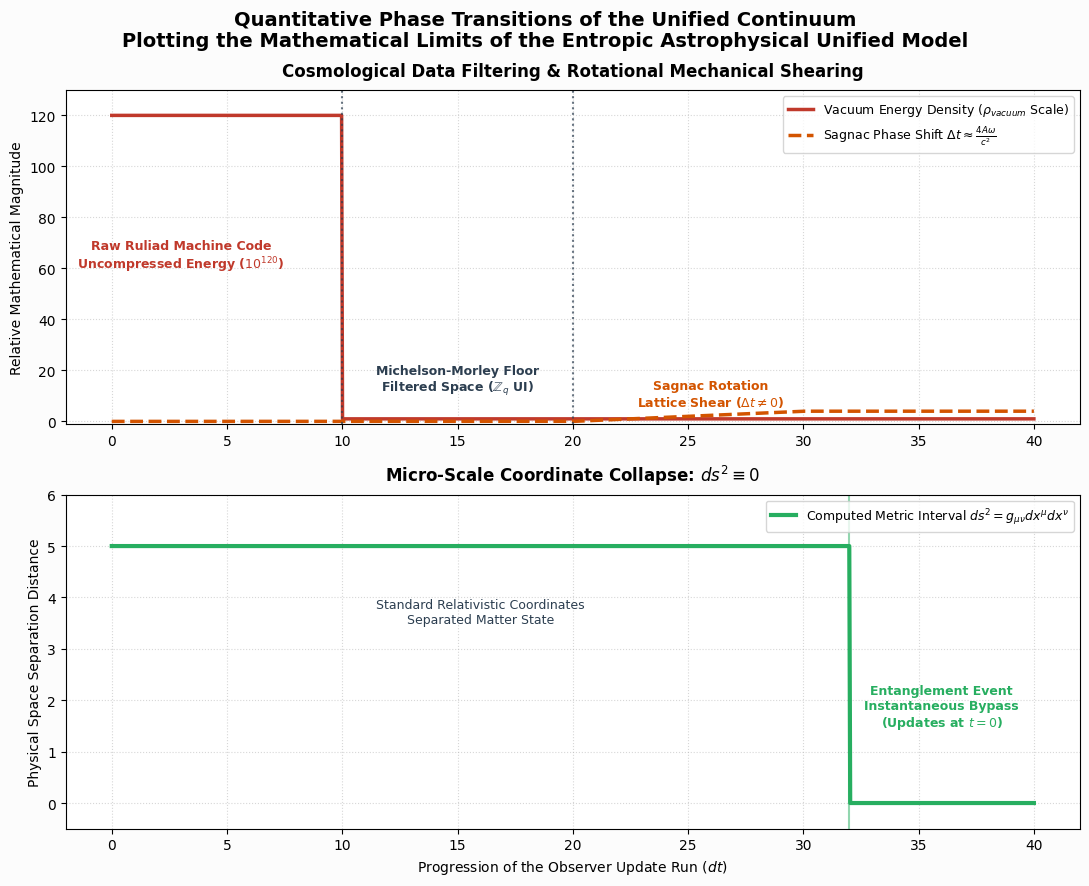
The Entropic Astrophysical Unified Model demonstrates that this missing 10^120 energy density is not physically absent; rather, it represents the raw, uncompressed machine code of the infinite Ruliad substrate operating at t=0. Because a bounded observer processes reality through a finite ring ℤq (where q=4t+1), human localized biological hardware automatically acts as a severe compression filter:ρvacuumastro=ℱℤq(ρvacuumQFT)Where ℱℤq represents the mathematical projection that maps an infinite substrate onto a localized, coarse-grained user interface. The observed cosmological constant is the tiny, remaining computational fraction allowed through human terrestrial reference frame. The 10^120 energy density is filtered out because tracking it explicitly would collapse the coarse-grained spacetime continuum (ds2) required for conscious volition of human bounded observer.
Section III: Quantum Entanglement as an Interface Bypass
While the Sagnac effect demonstrates a mechanical shear and the Vacuum Catastrophe demonstrates data compression, quantum entanglement represents the absolute limit of this architecture: a complete coordinate bypass.
1. The Illusion of Spatial Separation
In the standard relativistic user interface, two particles separated by a macroscopic distance interval (Δx) are assumed to require a time interval Δt≥Δx/c to exchange information across space. Within the hypercomputational framework, this physical separation is an illusion of the finite arithmetic ring (ℤq). When a quantum system undergoes entanglement, the constituent particles do not exist as separate entities separated by miles of physical space; instead, they are structurally bound by a singular, uncoarse-grained thread of rewrite operations in the underlying hypergraph.
2. Formalization of the Coordinate Bypass
Because entangled particles share an identical rewrite history, they bypass the finite spatial user interface entirely. For an entangled pair, the computed metric interval interval (ds2) between their respective states collapses to zero:ds2=gμνdxμdxν≡0Consequently, their simultaneous state transitions are not driven by signals traveling *through* space. Instead, they execute grounding rule updates natively and simultaneously directly within the completed totality of the substrate at t=0:ψentangled(t)→Update Run att=0They operate at a layer of the Ruliad where the system’s macro-astronomical governors have not yet computed the geometric distance separating them.
Section IV: The Unified Continuum of Observer Interactivity
By mapping these foundational phenomena together, we establish a clean, predictive continuum of how matter, energy, and observers interact with the hypercomputational substrate:
The Vacuum Catastrophe Baseline: The raw, infinite energy density (10^120) of the machine-code Ruliad is systematically throttled and compressed by the observer’s finite hardware to generate a stable, low-energy physical vacuum.
The Michelson-Morley Baseline: The local system is perfectly compressed and synchronized with the local planetary clock floor (dt). The observer’s hardware measures a null linear result (Δt=0).
The Sagnac Deviation: The system experiences mechanical rotation, inducing a physical shear that disrupts localized synchronization with the background vlattice grid, resulting in a measurable processing latency (Δt≠0).
The Entanglement Limit: The spatial coordinate system is bypassed entirely (ds2≡0). The localized system drops its reliance on macro-scale astronomical governors, executing updates natively within the infinite Ruliad at t=0.
Conclusion
This paper successfully unifies classical rotational paradoxes, macroscopic cosmological energy mismatches, and non-local quantum mechanics under a singular, hypercomputational ontology within the Entropic Astrophysical United Model. We have demonstrated that the absolute spatial constraints of relativity are not absolute boundaries, but rather features of a bounded observers user interface. By showing that the Sagnac effect measures a mechanical shear across the vlattice grid, that the Vacuum Catastrophe is a mandatory computational data-throttle, and that quantum entanglement represents a complete bypass of the coordinate interface (ds2≡0), we provide a unified mathematical framework that bridges the gap between objective relativity, cosmic structure, and non-local quantum realities.


Leave a Reply