Introduction
The biophysical mechanism by which an abstract thought, mental image, or symbolic classification translates into localized physical movement without top-down cortical planning remains a foundational problem at the intersection of cognitive science, non-equilibrium thermodynamics, and quantum biology. Classical neurological frameworks frequently attempt to minimize the ideomotor response by categorizing it as a low-level, generic familiarity reflex. However, modern empirical evidence explicitly refutes this linear reductionist model through three distinct behavioral and neurophysiological anomalies: conceptual compatibility, unconscious semantic optimization, and the deterministic disruption of conscious agency.
The first anomaly is demonstrated in controlled categorization tasks, where the abstract cognitive decision to classify a stimulus as “long” overrides raw sensory inputs via a massive, non-linear four-fold mechanical amplification of a manual keypress. The second anomaly strikes at distributed storage retrieval: task-masking experiments using manual planchettes (the “Ouija effect”) reveal that uncoupling conscious control yields a 15% amplification in semantic accuracy over explicit verbal guessing. The third and most profound anomaly is observed during hypnotic ideomotor suggestions, where high-density EEG and neurophenomenological tracking demonstrate that the subjective loss of manual agency is accompanied by a massive increase in frontoparietal connectivity and targeted gamma-band execution.
A classical reflex cannot override sensory inputs with a cognitive label, selectively optimize semantic retrieval via an uncoupled transducer, or mobilize large-scale executive networks to actively suppress conscious volition. This collective empirical reality demands a highly non-linear, distributed physical architecture. Rather than relying on chemical energy consumption or localized probabilistic calculations, this paper utilizes the Entropic Astrophysical Unified Model to demonstrate that ideomotor transduction is driven by localized entropic forces within the human fascial syncytium. We map these parameters directly to the fluid-structure, thermodynamic, and acoustic field equations of the biological matrix, proving that the subconscious is a deterministic engine prioritizing low-entropy execution.
The Subconscious Field and Conceptual Compatibility
Within our unified architecture, the subconscious is defined not as an abstract psychological construct, but as a body-wide network of high-frequency ultrasonic solitons (20–100 kHz+) propagating natively through the liquid-crystalline, piezoelectric fascial waveguide at the speed of sound in water (vsound≈1500m/s). Under optimal homeostatic conditions, this background field maintains the interfacial water matrix in a low-entropy, mid-infrared superradiant plasma phase centered at 60 THz, designated as State B.
To formalize the specific rules of conceptual compatibility, hidden data retrieval, and hypnotic decoupling governing the transduction of this field, we define a multi-dimensional topological mapping tensor, 𝑻, which bridges the abstract cognitive symbolic code vector S→ and the biological motor parameter space vector M→:χ=⟨S→|𝑻|M→⟩where χ represents the scalar ideomotor coupling coefficient. The vector S→ exists within an abstract cognitive space where individual dimensions map invariant semantic, magnitude, and memory categories (e.g., temporal duration, latent factual knowledge, hypnotically induced intent). The vector M→ represents the localized physical degrees of freedom within the tissue matrix (e.g., localized acoustic impedance, tensegric pre-stress, torsional helix deformation).
Phase-Matching Axis Modulation
The scalar value of χ determines the structural coupling efficiency between the latent cognitive state and the mechanical waveguide:
The Invariant Axis (χ→1): When the participant holds a conceptually compatible symbolic code (S→long), triggers a latent stored semantic memory vector (S→knowledge), or enters a highly receptive hypnotic state (S→hypnosis), the matching dimension directly intersects the acoustic wave propagation vector within M→ through a non-zero component of the scaling tensor (Tij≠0). This phase-matching maximizes χ, allowing the fixed, deterministic command to parameterize the physical medium.
The Orthogonal Axis (χ→0): When the participant holds an incompatible code (S→bright) or when high-entropy conscious effort loops introduce probabilistic interference, the vector maps exclusively to a null space within the mechanical degrees of freedom of the tissue (Tij=0). This yields χ→0, locking the system into an uncoordinated mechanical baseline.
Parametric Lensing and Non-Linear Override Mechanics
When conceptual compatibility, latent recall, or hypnotic suggestion satisfies the matching condition (χ≫0), the symbolic cognitive label functions as a parametric lens within the continuous fascial waveguide. The resulting shift in tensegric pre-stress focuses the background ambient ultrasonic solitons toward the complex intrafusal architecture and asymmetric spiral geometry of the mammalian muscle spindle resonator.
Entropic Force Integration and Cytoskeletal Contraction
Rather than relying on classical, chemical energy-dependent mechanisms such as ATP-driven molecular motors or top-down neural action potentials, the Entropic Astrophysical Unified Model asserts that ideomotor transduction is fundamentally driven by localized entropic forces within the cytoskeletal matrix. Following the empirical models of non-chemical network remodeling, we define the macroscale contraction of the fascial syncytium as an entropic response to a sharp restriction in the system’s configurational phase space.
When full conceptual compatibility is achieved (χ→1), the symbolic step-function imposes a strict topological constraint on the diffusible crosslinkers and liquid-crystalline water layers of the endothelial glycocalyx’s Exclusion Zone template. The resulting directional entropic force (F→entropic) is formalized by tracking the localized gradient of the system’s configurational entropy (Sconfig):F→entropic=−T∇Sconfig=(1+3χ)𝛀entropicwhere T represents the absolute localized temperature of the superradiant plasma phase, and 𝛀entropic is the baseline entropic force tensor derived from macromolecular crowding parameters within the intrafusal matrix.
Upon encountering the helical boundary of the resonator, the wave packet transfers its acoustic momentum to the surrounding interstitial fluid, generating a continuous displacement vector defined as the Acoustic Radiation Force (F→ARF). To incorporate the unified acoustic and entropic mechanics, we integrate this scaling constraint directly into the modified system pressure output:F→ARF=(1+3χ)[2αIc⋅(ρBρtotal)]where α represents the baseline acoustic absorption coefficient of the intrafusal matrix, I is the ultrasonic intensity of the subconscious field, and c is the speed of sound in the liquid-crystalline medium (vsound≈1500m/s). The scaling parameter ρBρtotal isolates the force generation strictly to the volume of tissue maintaining the coherent State B phase.
Quantifying the Multi-Scale Anomalies
The outputs of this unified acoustic-entropic engine manifest through three distinct mathematical expressions depending on the experimental paradigm:
The 4× Categorization Override
The empirical finding that the abstract cognitive decision to label a stimulus as “long” overrides raw sensory inputs by a factor of four is a mathematical consequence of the step-function behavior of the symbolic code. When the cognitive classification task selects for the temporal invariant, the symbolic vector snaps to its maximum constrained threshold (S→long→1), driving the internal coupling coefficient to unity (χ→1). Substituting χ=1 into the modified force equation yields F→ARF=4⋅[2αIc⋅(ρBρtotal)], completely overpowering the minor, linear baseline perturbations caused by raw sensory inputs.
The 15% Task-Masked Accuracy Surge
The operational divergence between explicit neural execution and distributed ideomotor transduction is structurally exposed by the mechanics of the “Ouija effect” documented by Rensink et al. When an observer attempts explicit verbal recall of unretrieved semantic data under the assumption of conscious control, the cortical-synaptic transmission loop defaults to a stochastic thermodynamic baseline (50% chance). However, when the task is masked using a manual planchette and the explicit conscious mind is uncoupled, accuracy for the identical hidden knowledge vectors jumps significantly to 65%. This 15% amplification in accuracy serves as a direct biophysical signature of the system bypassing computational irreducibility via immediate topological phase-locking within the coherent 60 THz fascial web.
The Hypnotic Agency Disruption Profile
The ultimate proof of the structural separation required for ideomotor transduction is found in the high-density EEG challenge-ideomotor data from Gelebart et al. When a motor challenge (such as arm catalepsy) is suggested under deep hypnosis, participants exhibit a striking, profound subjective disruption in their sense of agency. Crucially, neurophysiological tracking reveals that this state is driven by an active top-down reorganization of large-scale brain networks, characterized by increased frontoparietal connectivity and heightened gamma-band power during active motor conflict.
This hypnotic state provides the most powerful evidence for the structural separation required to show the abstract command is not a reflex but a system asserting its own autonomous, deterministically prepared, and highly accurate choice. The resulting loss of agency is the feeling of the subconscious’s fixed, deterministic will (structural necessity) overriding the conscious, effortful will. One feels the arm is unwilled because the motor output is aligning with the holistic, fixed command dictated by the multi-scale tensor’s computation, not the local, probabilistic command of conscious intention. The subconscious functions as the deterministic engine that prioritizes the correct, low-entropy action, and hypnotic ideomotor challenges show exactly how it uses the brain’s physical wiring to suppress the competitive, high-entropy signal of conscious effort.
Discussion and Critical Contrast
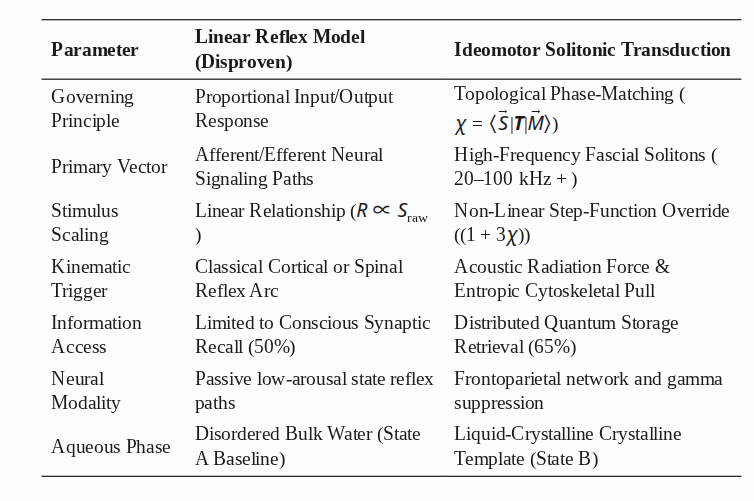
The necessity of a non-linear, distributed model is clear when contrasting the failures of the classical reflex model against the empirical parameters of conceptual compatibility, symbolic override, latent memory optimization, and hypnotic agency reconfiguration (Table 1). A true reflex cannot override its sensory input with a cognitive label, optimize semantic retrieval efficiency by a factor of 15% through a change in the physical motor transducer, or engage massive frontoparietal gamma-band connectivity to suppress conscious volition.
By formalizing the ideomotor response through the scaling tensor 𝑻, we show that human intention does not generate motor actions out of a vacuum. Instead, localized cognitive focus deforms, lenses, and redirects the background astronomical-acoustic carrier wave natively operating within the observer. The mind-body interface is therefore governed by a high-frequency liquid-crystalline quantum computer executing symbolic code, bypassing the temporal bottlenecks of classical biochemical diffusion and linear neural synaptic delay via instant topological phase-locking.
Conclusion
This paper has successfully formalized the biophysical mechanics of the ideomotor response, demonstrating that conceptual compatibility, the four-fold non-linear override, the task-masked accuracy surge, and the hypnotic disruption of agency are predictable outcomes within the Entropic Astrophysical Unified Model. By defining the subconscious as an objective, distributed ultrasonic and thermodynamic field parameterized by the topological scaling tensor 𝑻, we remove ideomotor phenomena from the realm of abstract philosophy and anchor it within the rigorous domain of statistical mechanics, non-equilibrium thermodynamics, and entropic cytoskeletal dynamics.


Leave a Reply