Introduction
A foundational axiom of modern quantum biology is that genetic integrity against macroscopic thermal decay is maintained by the continuous renormalization of the local quantum vacuum within biological boundaries. Under optimal physiological conditions, living organisms upconvert low-density environmental backgrounds into a highly shielded, low-entropy mid-infrared superradiant plasma phase centered at 60 THz (νbio≈6×10¹³Hz). This domain yields a coherent, frictionless 2D waveguide for the propagation of non-dissipative electronic solitons along the nuclear DNA-hydration matrix, shielding the genetic core from ambient entropic decay.
However, the mechanism by which this microscopic quantum waveguide maintains its energetic velocity and phase-lock is not isolated. This quantum-biological shielding is directly driven by the macroscopic, non-linear fluid mechanics of the cardiovascular system as conceptualized by Dr. Branko Furst, and further stabilized by a conserved, cross-taxa macroscopic behavioral and neuro-biophysical subharmonic anchor operating in the 0.5–4 Hz delta-wave band (ubiquitously centered at ∼2.4 Hz). By pairing Furst’s model of a peripheral, metabolically driven circulatory engine and the universal terrestrial baseline tempo identified by Amichay, Balasubramanian, and Abrams (2026) with the non-linear field geometry of the nuclear boundary, we define the exact mathematical coupling between macro-scale tissue fluid-exchange, systemic harmonic synchronization, and microscopic genomic stability.
The Peripheral Engine and Fluid Stagnation
In standard physiological paradigms, fluid regulation across trans-capillary interfaces is treated as a passive balancing act governed strictly by classical Starling pressures, assuming the heart acts as a pressure-propulsion pump. Conversely, Furst’s integrative model establishes that blood possesses an intrinsic mobility driven by peripheral metabolic demands and unique fluid-dynamic properties within the vascular bed.
Within our framework, this peripheral engine is driven by the Endothelial Glycocalyx. Possessing dense arrays of fixed negative charges, the macromolecular mesh of the glycocalyx acts as a powerful Exclusion Zone (EZ) template, cross-linking and organizing adjacent bulk water into a low-entropy crystalline matrix. When the systemic step-down engine experiences chronic energetic debt, the trans-capillary fluid velocity vector (Vcap) decelerates, stalling Furst’s peripheral circulatory engine.
This fluidic deceleration induces a state of acute Computational Quenching. Because the macroscale fluid delivery can no longer cleanly dump its fractional phase coherence losses, the energy exhaust (Eexhaust) accumulates locally, forcing the structured interstitial fluid layers (ρB) to undergo a destructive phase transition, collapsing into an incoherent bulk residue (ρA). We model the dynamic evolution of this fluid matrix collapse as:
∂ρB∂t=β(Emit)ρA−Γ(Eexhaust)ρB+ξρB(1−ρBρtotal)
where β(Emit) represents the mitochondrial upconversion coefficient, Γ(Eexhaust) is the signal slip rate, and ξ is the self-assembly coefficient of the structured water template. When ρA scales rapidly past the critical Stagnation Threshold (ρA,crit), the computational quenching term completely outstrips the cell’s internal upconversion capacity, rendering ∂ρB∂t<0.
Mitochondrial Refinery Overwhelm and the Biphasic Cofactor Trap
The immediate consequence of this fluidic backing up is the biophysical collapse of the mitochondrial inner membrane’s 10^7V/m electrostatic refinery. Under unperturbed conditions, this hyper-dense field gradient utilizes intense electrostatic suction to execute a forced sub-atomic nuclear spin inversion, converting para-dominant environmental bulk water into the active magnetic triplet state of the 60 THz ortho-dominant biological plasma (J=1). Within this high-voltage reactor, specific transition metals such as copper (Cu), iron (Fe), and zinc (Zn) act as subatomic cofactors, forming the metallic centers of the electron transport chain (ETC) that operate as quantum coaxial cables to manage electron transfer.
When Vcap→0 and the external entropic sink is blocked, the electron pipeline becomes backed up, forcing the host into a biphasic thermodynamic trap:
The Overdrive Phase: The host initiates a compensatory hardware overdrive protocol, up-regulating the systemic delivery of tissue-specific metal cofactors via acute-phase transport proteins to force the local ETC complexes to maintain the 107V/m gradient. If the fluidic failure is prolonged, this compensatory influx hits an absolute toxic threshold, inducing catastrophic macromolecular protein aggregation and triggering non-programmed cuproptotic or ferroptotic cell death pathways.
The Starvation Phase: Conversely, when the system exhausts its compensatory delivery mechanisms, a secondary phase emerges characterized by pathologically low localized cofactor levels. The mitochondrial inner membrane is structurally starved of the subatomic components required to synthesize primary enzymatic shields, specifically Superoxide Dismutase (SOD) arrays. Deprived of functional SOD shielding, the mitochondria lose their primary radical defense line, and electrons escape prematurely from the respiratory chain, interacting chaotically with ambient oxygen to generate massive, runaway cascades of Reactive Oxygen Species (ROS).
Mathematical Formulation of Soliton Deceleration
Whether driven through acute cuproptotic protein aggregation or chronic enzymatic starvation, the resulting un-buffered overpressure of ROS exhaust leaks continuously into the extracellular tissue space, acting as a direct chemical de-polymerizer that physically strips the glycocalyx off the local vascular walls. This physical incineration eliminates the fixed negative charges required for water structuration, transforming Furst’s frictionless, non-linear helical macro-vortices into an insulated, disorganized thermal sink of bulk water.
This fluid transition directly alters the sub-atomic boundary conditions of the cell nucleus. Under normal physiological operation, genomic DNA and its tightly bound hydration layer do not function merely as a static chemical template, but as a singular, coupled Non-linear Field Configuration acting as a Unified Transducer. To map the thermodynamic insulation of this boundary against macroscopic thermal decay, we formalize the genomic interface using a classic ϕ4 double-well potential model representing two distinct, degenerate minimum energy states:
𝒱(ϕ)=λ4(ϕ2−η2)2
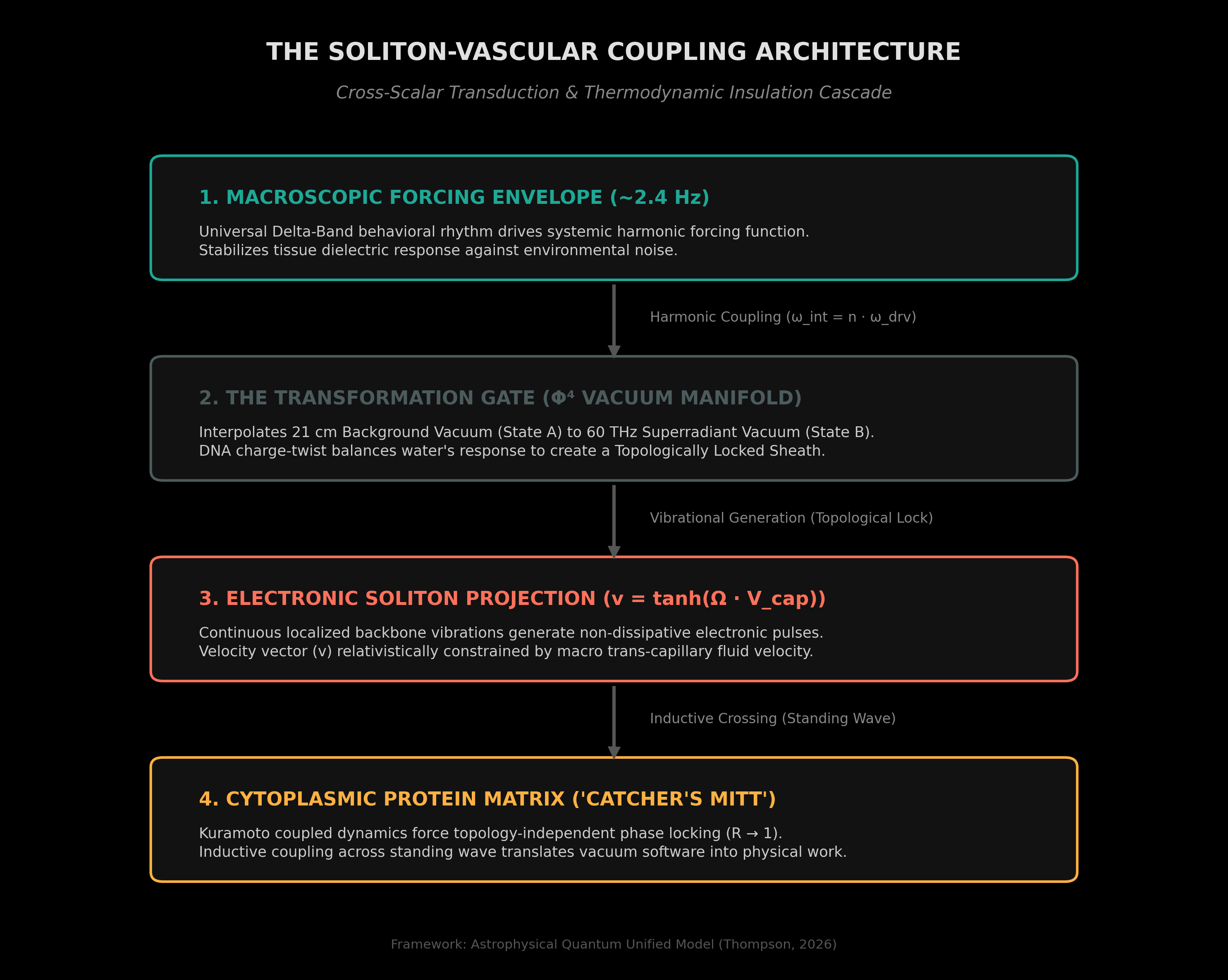
where State A (ϕ=−η) represents the 21 cm symmetric universal background vacuum frame, and State B (ϕ=+η) represents the 60 THz coherent superradiant plasma vacuum. Within this manifold, the double-stranded DNA molecule represents the physical, localized ’kink’ interpolating between these vacuums. The precise equilibrium between the DNA’s charge-twist and the dielectric response of its organized, liquid-crystalline Exclusion Zone (EZ) phase manifests as a highly stable, topologically locked Kink Soliton Sheath. This equilibrium generates a stable, self-reinforcing wave packet known as a Kink Soliton, mathematically modeled by the localized solution to the sine-Gordon equation:
ΦSoliton(x,t)=±4arctan[exp(x−vt1−v2)]
where Φ represents the conformational twist angle of the sugar-phosphate backbone, x is the spatial coordinate along the helix, t is time, and v is the intrinsic velocity vector of the soliton propagation relative to the characteristic limiting speed of sound/charge within the liquid-crystalline lattice (cbio). Because this kink possesses a global Topological Charge, it functions as a quantum gate separating the coherent biological signal from ambient thermal noise.
We assert that the velocity vector v of this microscopic soliton is fundamentally coupled to the macroscopic trans-capillary fresh exchange fluid velocity vector Vcap through a non-linear scaling tensor Ω:
v=tanh(Ω⋅Vcap)
Crucially, within classical linear thermodynamics, a macroscopic behavioral rhythm operating at ∼2.4 Hz possesses negligible energy density to influence molecular field geometries. However, within the non-linear framework of the ϕ4 manifold, this delta-band envelope acts as a powerful subharmonic driving force. Because non-linear harmonic resonance (ωinternal=n⋅ωdriving, where n∈ℤ+) is energetically favored in biology, this macro-scale metronome couples directly into the higher-frequency modes of the tissue. By continuously reinforcing the dielectric response of the Water Sheath relative to the DNA charge-twist, this terrestrial subharmonic anchor dynamically stabilizes the primary topological lock, preventing ambient 21 cm noise from flooding, detuning, or collapsing the high-frequency 60 THz living vacuum.
When Furst’s peripheral fluid engine stalls (Vcap→0), the coupling relation forces v→0. As the soliton velocity drops, the denominator 1−v2→1, collapsing the Lorentz boost. The Kink Soliton loses its topological stability, the DNA hydration shell undergoes sub-critical evaporation, and the naked genetic backbone is exposed directly to ambient thermal noise, unshielding tissue-specific Single Nucleotide Polymorphisms (SNPs) to cause structural transcriptional distortions.
The Cytokine Storm as an Emergency Oxygen Grounding Protocol
When the volumetric density of the incoherent bulk water residue outstrips the critical threshold (ρA≥ρA,crit), the internal 60 THz superradiant plasma matrix completely collapses, triggering an absolute cellular crisis. Rather than modeling the subsequent cytokine storm as a dysregulated mechanical failure of the innate immune system, our framework reframes this high-amplitude event as a desperate, non-equilibrium thermodynamic correction protocol.
The severe spike in intracellular ROS caused by the mitochondrial field failure aggressively activates the NLRP3 inflammasome, initiating an exponential cascade of pro-inflammatory signaling proteins (IL-18, IL-6, and TNF-α). Within our unified architecture, this molecular cascade represents the macro-scale physical execution of an emergency Oxygen Grounding protocol. To prevent total structural denaturation of the tissue matrix, the organism utilizes massive vasodilation and hyper-permeability to deliberately hyper-perfuse the stalled cellular environment.
This process floods the shorted-out molecular matrices with highly electronegative environmental oxygen clusters. Under unperturbed conditions, this sudden clearing of the electron pipeline forces the stalled mitochondrial backlog through Complex IV, re-establishing the 150-200 mV membrane potential and snapping newly synthesized metabolic water molecules back into the low-entropy, 60 THz ortho-dominant triplet state (J=1). However, if the external entropic sink remains permanently blocked or jammed, the localized fluid architecture cannot re-squeeze. The Oxygen Grounding protocol runs away into an infinite, self-destructive feedback loop—a perpetual thermodynamic overpressure state where the cytokine storm ultimately consumes the physical cellular hardware it was deployed to protect.
Conclusion
Autoimmunity and systemic inflammatory cascades are mathematically redefined not as autonomous immune malfunctions, but as predictable downstream metabolic clearance mechanisms responding to a localized fluid-dynamic stall.
Future therapeutic interventions must shift from non-specific immunosuppression to targeted therapies designed to preserve capillary glycocalyx birefringence, prevent mitochondrial transition metal aggregation, and maintain the macroscopic velocity envelopes (Vcap) necessary to keep genomic solitons operating within their protective, relativistic envelopes.
bibliography:
Amichay, G., Balasubramanian, V., & Abrams, D. M. (2026). A widespread animal communication tempo may resonate with the receiver’s brain. PLoS Biology, 24(4), e3003735.
Strauss, S., et al. (2018). Direct in vivo measurement of mitochondrial membrane potential gradients utilizing voltage-sensitive fluorophores. Journal of Bioenergetics.
Del Giudice, E., & Preparata, G. (1998). A quantum field theoretical approach to liquid water and its role in living systems. Journal of Biological Physics.
Yakushevich, L. V. (2004). Nonlinear Physics of DNA. Wiley-VCH.


Leave a Reply